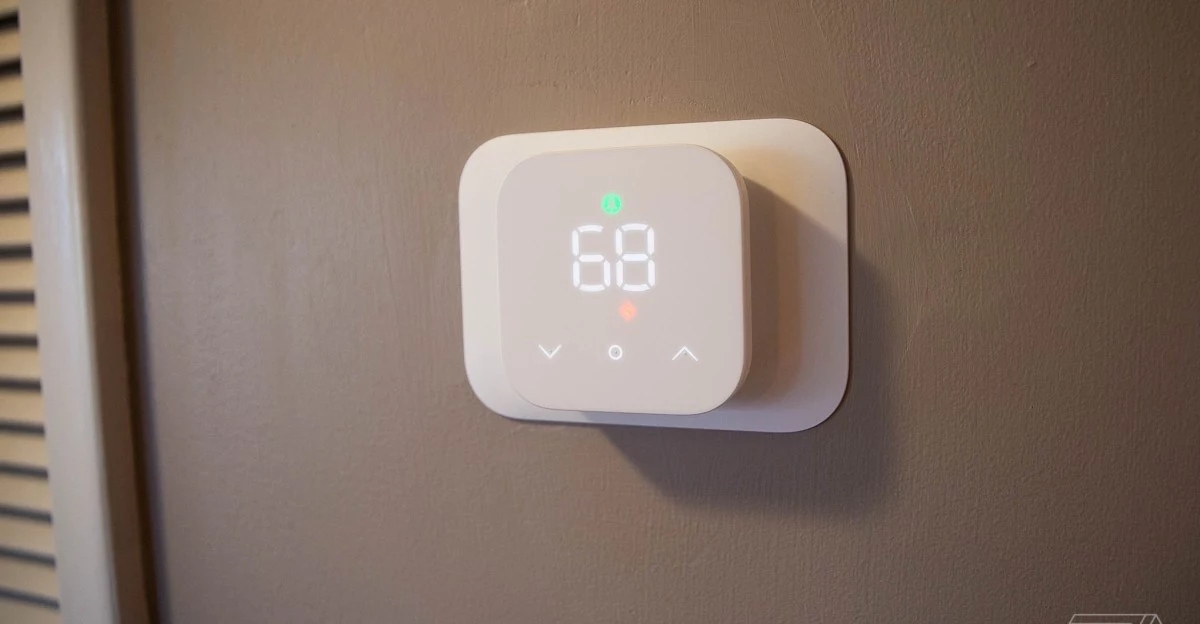

A sub-$60 smart thermostat signals a new phase in mass-market home energy tech
Amazon’s decision to discount its Smart Thermostat to $57.99 in an early Prime Day promotion—its lowest level since Black Friday—reads as more than a seasonal deal. It is a clear marker of where the smart home energy-management market is heading: toward hardware commoditization, broader adoption, and value-driven bundles that pull consumers deeper into platform ecosystems.
At under $100 even at list price, the device targets a large segment of households that have historically viewed smart thermostats as a “nice-to-have” upgrade rather than an essential efficiency tool. The pitch is straightforward: software-led energy savings without the premium pricing associated with incumbents like Nest and Ecobee. The timing is equally strategic. With many consumers still navigating elevated household costs, a thermostat positioned as both affordable and cost-reducing becomes an unusually compelling proposition—especially when marketed through Prime Day’s urgency and reach.
Key consumer-facing attributes reinforce that positioning:
- Learning-based automation that adapts to routines and reduces heating/cooling when occupants are asleep or away
- Alexa integration for voice control and smart-home interoperability
- Compatibility with most 24-volt HVAC systems, lowering installation friction for mainstream homes
- A natural pairing with adjacent devices such as Amazon’s Smart Air Quality Monitor (also discounted), suggesting a broader “home environment” bundle strategy
Notably, the thermostat’s value proposition is not rooted in premium sensor hardware. Instead, it leans on software intelligence and ecosystem connectivity—a recurring theme in Amazon’s approach to consumer devices.
Cloud-first intelligence reshapes the thermostat feature race
From a technology perspective, Amazon’s Smart Thermostat reflects a modern edge-to-cloud design philosophy. Rather than packing the device with expensive local compute and proprietary sensors, Amazon can keep bill-of-materials costs low while pushing differentiation into cloud-hosted machine learning and continuously updated software.
This model has several implications for the competitive landscape:
- Lower-cost hardware, higher-velocity iteration: Cloud-managed learning systems can improve over time without requiring consumers to buy new devices. That shifts competition away from one-time hardware superiority and toward ongoing software refinement.
- Ecosystem-level sensing: While the thermostat itself may not include the most expansive sensor suite, Amazon can effectively “borrow” context from the broader Alexa environment—voice activity, routines, and connected devices—turning the thermostat into a node in a larger IoT mesh.
- Interoperability as a growth lever: Compatibility with standard 24-volt HVAC systems reduces the need for specialized wiring or professional retrofits, expanding the addressable market and accelerating adoption among cost-conscious homeowners and renters (where permitted).
The deeper story is that the thermostat becomes less of a standalone product and more of a software endpoint—a controllable actuator that can respond to signals from multiple sources: schedules, inferred occupancy patterns, and potentially air-quality data. That architecture aligns with Amazon’s strengths: large-scale cloud infrastructure, consumer distribution, and a mature voice assistant platform.
Pricing pressure, energy savings, and the economics of platform-led home efficiency
The $57.99 price point is not merely competitive—it is structurally disruptive. Amazon can afford to treat devices as on-ramps rather than profit centers, subsidizing hardware through its broader retail engine and cloud economics. That creates immediate pressure on legacy smart thermostat vendors, who may be forced to respond by:
- Repricing to defend share in the mid-market
- Differentiating via premium sensors, design, or privacy assurances
- Partnering more aggressively with utilities to secure large-scale deployments and rebates
For consumers, the economic appeal is twofold: lower upfront cost and the prospect of operational expenditure (OpEx) reduction through automated efficiency. Even modest reductions in heating and cooling waste can matter, particularly in regions with high seasonal demand or time-of-use pricing. For utilities and grid operators, broader adoption of smart thermostats can be a pathway to demand shaping—flattening peaks and reducing reliance on expensive peaker generation.
This is where the category’s business logic becomes more strategic than it appears on the surface. Thermostats sit at the intersection of consumer comfort, energy markets, and grid stability. A sufficiently scaled installed base can enable new commercial models, including demand-response participation and incentive programs—especially if the platform provider can coordinate behavior across millions of endpoints.
Data, regulation, and the next frontier: grid-interactive, AI-managed homes
The strategic upside for Amazon extends beyond device sales. Thermostats generate high-value signals: temperature preferences, occupancy rhythms, and energy-use patterns. Aggregated responsibly, this data can support:
- Predictive maintenance prompts (e.g., HVAC performance anomalies, filter replacement timing)
- Personalized efficiency insights and benchmarking
- Utility partnerships tied to demand-response programs and time-of-use optimization
- Potential premium tiers that package automation, reporting, and proactive alerts
Yet the same data richness introduces governance complexity. Household energy and occupancy patterns are inherently sensitive, and regulatory scrutiny is rising across jurisdictions. In the U.S., state-level privacy regimes continue to expand; in Europe and other regions, evolving digital and energy frameworks increasingly emphasize data minimization, transparency, and localization. Any platform seeking to monetize energy intelligence at scale will need to balance innovation with credible privacy controls and clear consumer consent pathways.
Looking ahead, the most consequential evolution may be the shift from “smart thermostat” to grid-interactive building control. As utilities modernize pricing and demand-response programs, thermostats can become automated participants in energy markets—adjusting setpoints dynamically in response to grid signals while maintaining comfort constraints. If Amazon chooses to pursue this path, it would place the company closer to the operational fabric of the energy system, not just the consumer electronics aisle.
Amazon’s Smart Thermostat, especially at a sub-$60 promotional price, is best understood as a strategic wedge: a low-friction entry into home energy management that strengthens Alexa’s role as the control plane for the connected home, while positioning Amazon to compete in the emerging convergence of retail, cloud AI, and utility-grade energy orchestration.


 By
By
 By
By
 By
By
 By
By
 By
By