

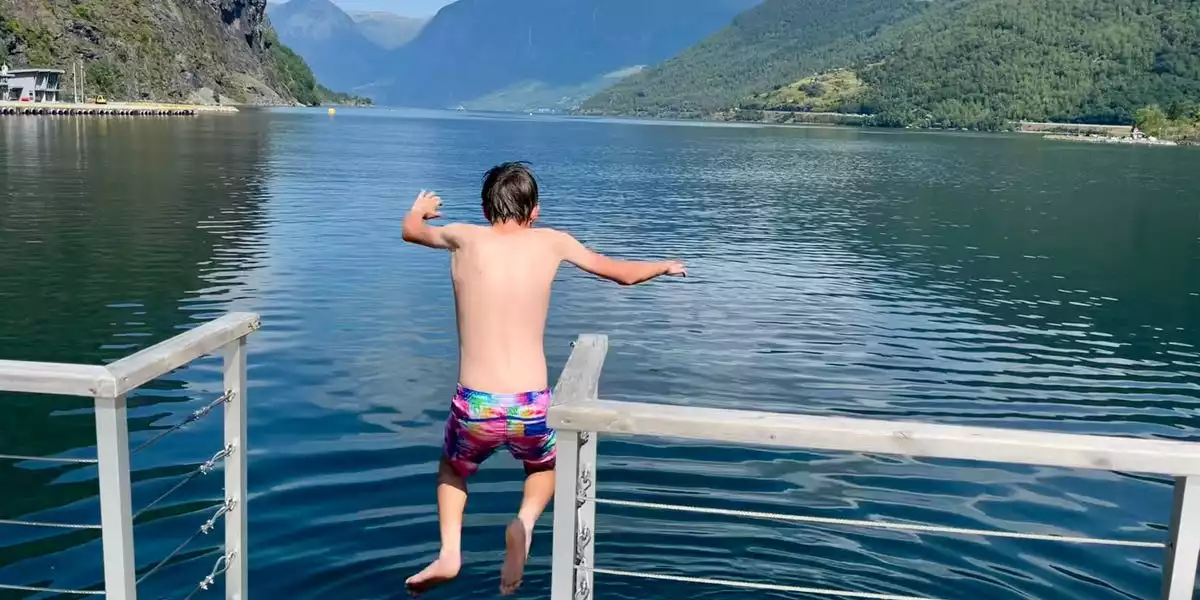

A floating sauna in Flåm as a signal of where premium travel is heading
A privately rented floating sauna in Flåm, Norway, priced at roughly $300 for 90 minutes, reads at first like a charming family anecdote—tiered wooden benches, panoramic fjord views, and a bracing plunge through a clear floor hatch. Yet as a piece of business and technology evidence, it points to a broader reconfiguration in tourism: value is increasingly captured not by the destination alone, but by designed, bookable, shareable experiences that convert natural scenery into a high-margin product.
This is the experience economy in its most distilled form. The fjord is the “asset,” but the revenue is unlocked by a modular hospitality unit—a compact, floating “houseboat” sauna with a wood-fired stove and a ritualized hot-cold cycle that feels both culturally rooted and globally legible. For affluent families traveling across Denmark, Norway, and Iceland, the appeal is not simply relaxation; it is intergenerational bonding packaged into a memorable, time-boxed format that fits neatly into a multi-stop itinerary.
Several characteristics make this model particularly potent in Northern Europe:
- High trust infrastructure (rail, buses, safety standards) that reduces friction for premium purchases
- Low-density landscapes that enhance perceived exclusivity
- A strong cultural association with sauna and wellness traditions, lending authenticity without heavy storytelling overhead
The result is a product that can command premium pricing even in a small village—because it sells a feeling: privacy, novelty, and immersion.
Modular hospitality meets craft engineering—and becomes scalable
The floating sauna’s design choices are not incidental; they are the enabling technology. Lightweight floating hulls, compact stoves, and durable polymer hatches are examples of small-scale fabrication meeting a global demand for “unique stays” and “one-of-one” activities. Importantly, this is not the capital-intensive world of mega-resorts. It is closer to a repeatable micro-asset: a unit that can be built, maintained, and operated by a small team, then distributed through digital channels.
From an economic standpoint, the product’s strength lies in its yield per hour and its operational simplicity. A 90-minute slot is long enough to feel substantial, short enough to maximize daily turnover, and structured enough to standardize cleaning, heating, and safety checks. For operators, this supports:
- Predictable scheduling and capacity planning
- Premium pricing justified by privacy and exclusivity
- A clear upsell path (guided rituals, add-on refreshments, photography packages, extended sessions)
For destinations, modular sauna platforms hint at a broader “micro-resort” playbook: small, high-experience units that can be deployed along underutilized waterfronts without the footprint of conventional development. That matters as regulators and communities push for low-impact tourism that still generates local income.
Digital booking, real-time coordination, and the new baseline for travel reliability
The family’s journey included a disruption—an initial train derailment reroute—yet the experience remained intact due to integrated logistics and contingency planning. That detail is more than travel color; it underscores a competitive truth: premium experiential tourism increasingly depends on operational resilience, not just aesthetics.
A modern operator’s advantage is often built on software and coordination as much as on the physical asset:
- Digital booking platforms reduce friction and enable global discovery
- Real-time coordination with regional rail and bus services protects the itinerary when disruptions occur
- Guided onboarding—here, a local Sauna Master—raises perceived quality and reduces safety risk
This is where data becomes a quiet differentiator. Even modest instrumentation—temperature and humidity monitoring, maintenance logs, occupancy analytics—can improve reliability and profitability. Over time, operators can use these inputs to support:
- Dynamic pricing based on demand peaks, weather, and seasonality
- Predictive maintenance for stoves, ventilation, and dock hardware
- Better staffing models and reduced downtime between sessions
For the broader travel ecosystem, the lesson is that “seamless” is no longer a luxury descriptor; it is a baseline expectation. Experiences that survive disruptions—without guests feeling the strain—earn repeat business and platform visibility.
Wellness tourism, ESG scrutiny, and partnership opportunities around contrast therapy
The hot-and-cold ritual at the heart of the floating sauna experience aligns with a fast-expanding segment: wellness tourism that extends beyond spas into nature-based, thermoregulatory practices often described as contrast therapy. While consumer interest is driven by lifestyle trends and social media, the commercial opportunity is more structural: wellness is becoming a cross-sector growth vector touching travel, corporate benefits, and health-adjacent technology.
That opens several plausible partnership paths:
- Wellness-tech brands (wearables, recovery tools) using floating saunas for experiential marketing and field testing
- Corporate retreats seeking high-impact, low-logistics wellbeing programming
- Potential collaborations with insurers or wellness programs—though any model involving biometric data will face heightened scrutiny around consent, anonymization, and governance
At the same time, sustainability expectations are rising. Wood-fired stoves and minimal infrastructure footprints can be positioned as “low impact,” but ESG-aware travelers and regulators will increasingly ask for proof points: sourcing, emissions accounting, waste handling, and shoreline protections. Operators who can credibly document:
- Responsible fuel sourcing and emissions mitigation
- Closed-loop or compliant water and waste practices
- Local supply-chain participation and community benefit
will be better positioned as permitting regimes evolve for floating hospitality units.
What makes the Flåm floating sauna story commercially significant is its clarity: a small, well-designed module can translate natural beauty and cultural practice into a premium, bookable product—supported by software, strengthened by logistics partnerships, and amplified by wellness demand. In a travel market where attention is scarce and differentiation is expensive, the most durable advantage may belong to operators who can make the extraordinary feel effortless, repeatable, and responsibly scaled.

 By
By

 By
By

 By
By

 By
By
 By
By







