

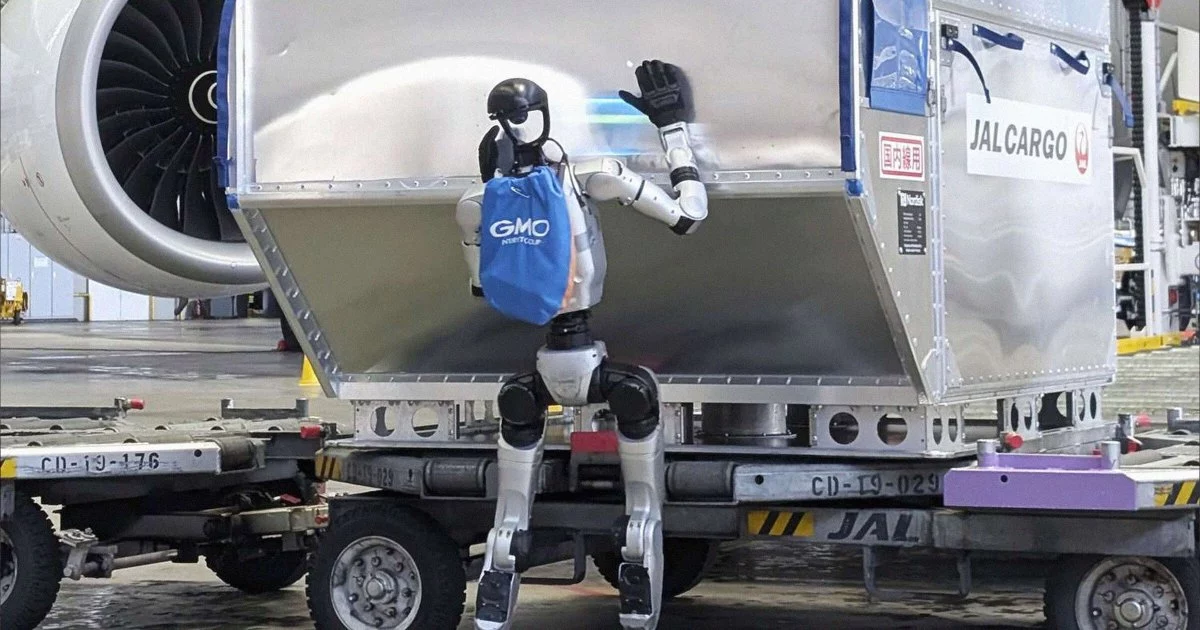

Haneda’s humanoid robot trial: a high-visibility response to Japan’s aviation labor crunch
Japan Airlines (JAL) is preparing to run one of the aviation industry’s most closely watched automation experiments: an extended humanoid robot trial at Tokyo’s Haneda Airport from May through 2028, in partnership with GMO AI & Robotics and China’s Unitree. The timing is not incidental. Japan’s demographic headwinds—an aging population and a tightening labor pool—are colliding with a sharp rebound in inbound travel. Haneda, already among the world’s busiest airports, is processing tens of millions of passengers annually, and recent visitor surges underscore how quickly volume can outpace staffing.
Baggage handling is a particularly strategic target for automation because it sits at the intersection of cost, safety, punctuality, and brand trust. It is also physically demanding work that has historically relied on skilled, coordinated teams operating under strict time pressure. For JAL, the promise is straightforward: reduce dependency on scarce labor while maintaining throughput during peak periods. The risk is equally clear: baggage is a “zero-margin-for-error” domain where a single failure can cascade into missed connections, compensation claims, and reputational damage—especially in a market where service precision is a competitive differentiator.
What the early demonstrations reveal about real autonomy versus staged capability
Public demonstrations have already highlighted a central tension in airport robotics: the difference between a robot appearing to perform a task and a robot reliably executing it end-to-end. Reports that a Unitree humanoid “pushed” a suitcase container that actually moved via concealed conveyor mechanics may seem like a minor optics issue, but it points to a deeper engineering reality. Airport baggage operations are not a single action; they are a chain of perception, decision-making, manipulation, and compliance steps performed in a dynamic environment.
To move from showcase to operational utility, humanoid robots in baggage handling must demonstrate competence across several hard problems:
- Real-time perception and localization: robust 3D vision and/or lidar to navigate cluttered service corridors, variable lighting, reflective surfaces, and moving obstacles.
- Adaptive grasping and manipulation: suitcase handles, irregular shapes, shifting loads, and soft-sided bags require dexterity beyond rigid industrial pick-and-place.
- Safety-critical decision layers: fail-safe behaviors, collision avoidance, and predictable motion around humans and vehicles—under strict airport safety protocols.
- System reliability under time pressure: baggage handling is governed by flight schedules; delays compound quickly, and “mostly works” is operationally insufficient.
This is why many experts anticipate a hybrid human–robot operating model rather than immediate replacement. In practice, the most credible near-term use cases are “cobot-like” deployments where robots handle repetitive transport or staging tasks while humans manage exceptions—misrouted bags, fragile items, last-minute gate changes, and irregular operations during weather or equipment disruptions.
The hidden infrastructure: edge AI, connectivity, and orchestration as the real product
Humanoid robots attract attention, but the decisive factor at Haneda may be the less visible stack: connectivity, orchestration software, and sensor-driven baggage traceability. To function in a live terminal logistics environment, robots must coordinate with:
- Baggage tracking systems (RFID/NFC, barcode scanning, and reconciliation databases)
- Fleet management and task allocation platforms (dispatching, routing, congestion control)
- Airport operational systems (gate changes, loading priorities, irregular operations protocols)
This is where edge AI becomes central. Many decisions—obstacle avoidance, grasp correction, micro-navigation—must occur with ultra-low latency. If the system leans heavily on cloud processing, network instability can become an operational risk. Conversely, fully on-device autonomy raises hardware cost, power constraints, and heat management challenges. The likely architecture is a layered approach: local autonomy for immediate safety and motion, with centralized orchestration for scheduling, optimization, and auditing.
For airports, this shifts the definition of “robotics deployment” from buying machines to building a mission-critical digital logistics layer. Any disruption—connectivity drops, sensor drift, software regressions—can translate into baggage backlogs and flight delays. The trial’s multi-year timeline suggests JAL and partners understand that reliability is earned through iterative integration, not a single hardware rollout.
Economics, governance, and competitive signaling in the “airport robotics” race
The business case rests on a delicate balance: labor-cost relief versus capital expenditure and lifecycle complexity. Japan’s wage pressures and staffing scarcity strengthen the incentive to automate, but the return on investment will depend on factors that are often underestimated in early-stage robotics programs:
- Maintenance and uptime economics: mean time between failures (MTBF), spare parts logistics, and on-site technical staffing
- Software and model update cadence: continuous improvements can also introduce operational risk if not governed with aviation-grade change control
- Integration costs: retrofitting workflows, safety certifications, and interfacing with legacy baggage systems
- Liability and service-quality externalities: mishandled luggage carries direct compensation costs and indirect brand damage
For JAL, brand equity is tightly linked to service consistency. That makes performance governance as important as mechanical capability. A credible trial will likely hinge on transparent, data-driven KPIs such as error rate per 1,000 bags, handoff success rates, incident response times, and customer satisfaction impacts tied to baggage outcomes.
Strategically, Haneda’s experiment is also a signal to the global airport ecosystem. Major hubs—from Singapore Changi to Amsterdam Schiphol and large U.S. airports—are watching for proof that humanoid or semi-humanoid systems can operate safely in mixed human environments. If JAL demonstrates measurable reliability gains, it could accelerate an “airport automation” investment cycle, shifting competitive benchmarks from terminal aesthetics to operational resilience and throughput per employee.
The workforce implications are equally consequential. Automation does not remove labor needs so much as recompose them—toward robot maintenance technicians, AI system trainers, safety supervisors, and logistics data specialists. Regulatory posture and labor-union dynamics will shape how quickly that transition can occur, particularly in safety-critical zones where accountability must remain clear.
Ultimately, the Haneda trial is less a bet on humanoid spectacle than a test of whether aviation-grade operations can absorb robotics without sacrificing punctuality, safety, and service trust—an experiment whose outcome will be measured not by what the robots can do on a stage, but by what they can do at 6 a.m. on a peak travel day with no room for error.

 By
By
 By
By

 By
By
 By
By
 By
By
 By
By
 By
By







