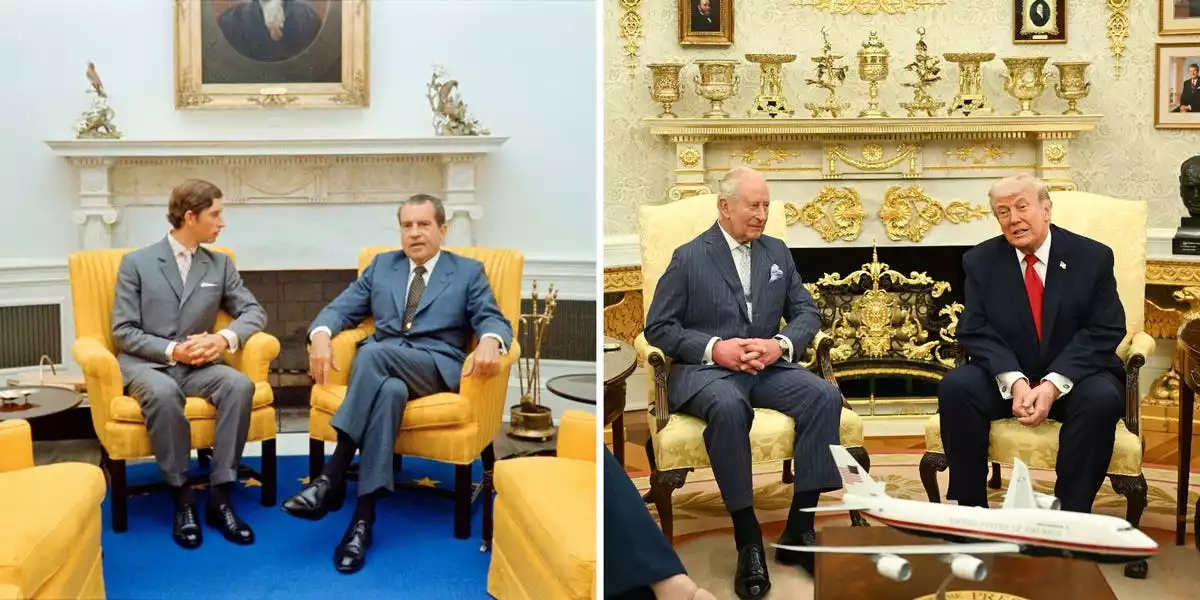

A six-decade diplomatic throughline that markets can price in
King Charles III’s interactions with ten U.S. presidents—stretching from a youthful meeting with Dwight D. Eisenhower in 1959 to engagements with Joe Biden in 2023 and Donald Trump in 2026—offer more than a chronology of ceremonial encounters. They form a durable narrative of continuity in the U.S.–U.K. “special relationship”, one that persists across party lines, geopolitical shocks, and shifting economic priorities.
What stands out is the blend of the personal and the institutional. Anecdotes such as Richard Nixon’s ill-fated matchmaking attempt in 1970 sit alongside moments of deliberate statecraft: receptions, state visits, and military reviews that signal alliance cohesion to allies and competitors alike. For business leaders and investors, this continuity matters because it reduces the “unknowns” that typically accompany political turnover. When high-level engagement remains steady across administrations, markets often interpret it as a stabilizer for:
- Regulatory alignment in emerging sectors (AI governance, data privacy, digital assets)
- Cross-border investment confidence, particularly in long-duration infrastructure and energy projects
- Defense and security interoperability, which underpins procurement pipelines and industrial planning
In an era where diplomacy increasingly shapes the operating environment for technology and capital, the King’s long-running U.S. relationships function as a form of reputational infrastructure—quietly reinforcing the predictability that global commerce depends on.
Soft power as an accelerant for climate technology and innovation policy
The most commercially consequential thread running through these presidential interactions is the way soft power can lubricate hard policy, particularly on climate and energy innovation. Royal advocacy on environmental stewardship has long been visible, but the strategic value lies in how informal rapport can create space for low-friction policy coordination—the kind that later becomes formal programs, funding vehicles, and standards.
The 2009 G20-era climate discussions with President Barack Obama, for instance, are framed here as part of the groundwork for the UK–U.S. Clean Energy Technology Center (2010)—a useful illustration of how relationship-driven dialogue can precede institutional outcomes. Under President Biden, similar engagement is described as catalyzing early-stage support for carbon capture, next-generation batteries, and other decarbonization technologies.
For industry, the signal is less about any single initiative and more about a pattern: when leadership-level attention remains consistent, bureaucracies and agencies tend to find pathways to cooperate. That can translate into tangible advantages for companies positioned to participate in transatlantic innovation ecosystems, including:
- Joint R&D and demonstration funding in offshore wind, smart grids, and green hydrogen
- Faster convergence on technical standards that enable scale-up and exportability
- Stronger policy durability—critical for capital-intensive climate technologies with long payback periods
This is also where diplomacy intersects with competitiveness. As the U.S., U.K., and EU each refine industrial policy for clean tech, the ability to coordinate—rather than fragment—becomes a strategic asset. Soft-power engagement does not replace legislation or industrial strategy, but it can meaningfully reduce coordination costs and shorten the time between political intent and deployable programs.
Capital markets, green finance, and the economics of perceived stability
The economic ramifications extend beyond technology collaboration into the realm of investment flows and financial standard-setting. The continuity of U.S.–U.K. engagement—reinforced by repeated high-profile interactions—can reduce perceived geopolitical and regulatory risk, particularly in sectors where compliance complexity is high and policy divergence is costly.
One area where this becomes concrete is green finance. The material suggests that mutual endorsement of green bond frameworks and sustainability reporting expectations—often amplified during state occasions—has helped standardize metrics and improve cross-border issuance efficiency. Even if ceremonial moments are not the venue where technical standards are negotiated, they can still provide the political cover and momentum that regulators, exchanges, and industry groups need to align.
For issuers and investors, the prize is straightforward: clearer reporting norms and more interoperable frameworks can lower the cost of capital for clean-energy and climate-resilience projects. Over time, that can influence where projects are financed, which markets become preferred listing venues, and how quickly institutional capital can move.
The broader implication for financial services is a potential deepening of transatlantic integration, particularly if London’s capital markets and U.S. venture and venture-debt ecosystems find more structured pathways to collaborate. Watch for practical mechanisms that often follow political alignment:
- Fintech sandboxes that enable cross-border testing under compatible rules
- Dual-listing and fundraising pathways that reduce friction for scale-ups
- Greater coordination on digital assets, biotech financing, and sustainability disclosure
For executives, the strategic question is whether their compliance, treasury, and capital strategy teams are prepared for a world where transatlantic alignment becomes a competitive advantage rather than a background assumption.
Defense innovation and strategic signaling in an era of great-power competition
The defense dimension—highlighted by ceremonial military reviews, including a 2026 event with U.S. marines—underscores that the “special relationship” is not merely cultural. It is operational, industrial, and increasingly technological. Modern alliance value is measured less by symbolism than by interoperability, shared R&D roadmaps, and the ability to coordinate quickly across domains such as cyber, space, and autonomous systems.
The commentary points to defense-technology integration spanning hypersonics, cyber-resilience, and other advanced capabilities. For defense contractors, dual-use technology firms, and critical infrastructure providers, sustained high-level contact can translate into:
- More predictable joint procurement and capability planning
- Faster alignment on security requirements for supply chains and software
- Stronger coordination in multilateral settings on semiconductor controls and 5G/telecom security
Just as importantly, these engagements send a market-facing signal amid U.S.–China and U.K.–China tensions: Western coordination is not episodic—it is reinforced at the highest levels, across administrations. That perception can shape corporate risk models, influence location decisions for sensitive manufacturing, and affect how global firms structure compliance for export controls and data governance.
Taken together, King Charles III’s long arc of presidential engagement illustrates how modern diplomacy works when it is effective: personal rapport creates access, access enables continuity, and continuity becomes a platform for policy convergence in climate tech, finance, AI governance, and defense innovation. For businesses navigating regulatory fragmentation and geopolitical volatility, that platform is not pageantry—it is part of the operating system of transatlantic commerce and security.


 By
By
 By
By
 By
By
 By
By


 By
By