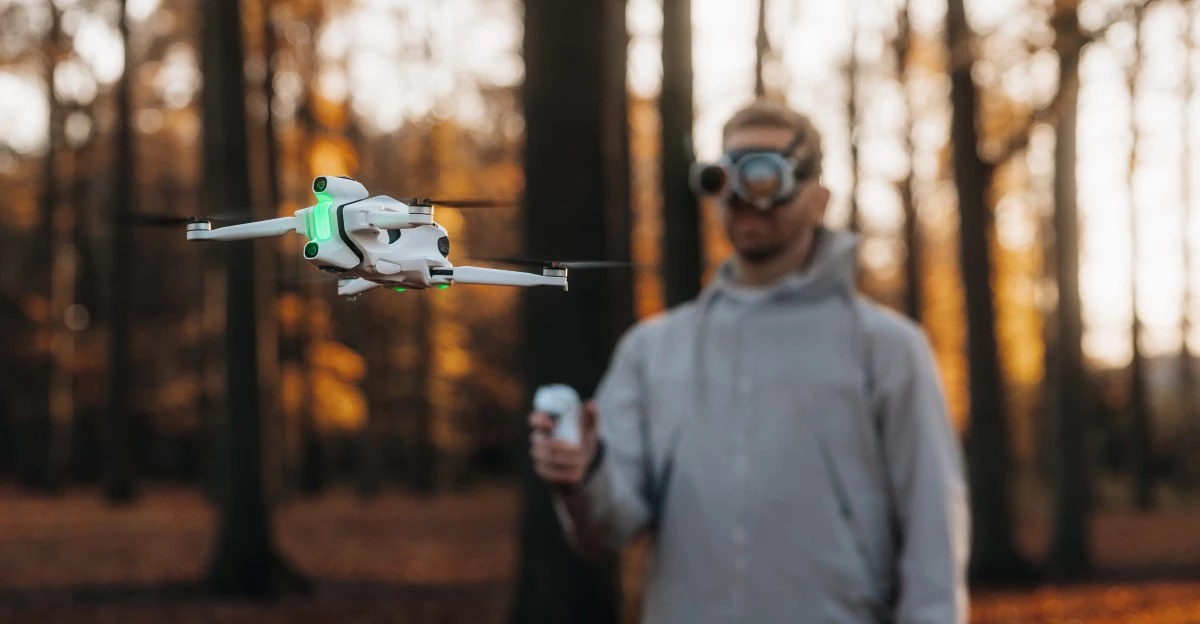

A 360° FPV proposition that reframes what “flying a camera” means
Insta360’s Antigravity A1 arrives at a moment when the drone market is no longer won purely on airframe specs or incremental camera upgrades. The headline is the marriage of ultra-high-resolution capture with immersive first-person viewing (FPV)—a combination that effectively turns aerial cinematography into a VR-adjacent, pilot-in-the-scene experience.
At the core is a dual-mode imaging stack—8K at 30 fps and 5.7K at 60 fps—paired with proprietary Vision Goggles that stream a full 360° perspective in real time. That pairing matters because it collapses what have historically been separate product categories: consumer drones optimized for stabilized footage, and VR/FPV systems optimized for low-latency piloting. Antigravity’s bet is that the next competitive frontier is not simply “better video,” but a more embodied way to operate and perceive the flight.
From an industry standpoint, this is also a signal that drones are increasingly being positioned as interfaces, not just aircraft—interfaces into environments, workflows, and eventually digital replicas of the physical world. The A1’s feature roadmap suggests Antigravity is aiming to own that interface layer.
Key product signals embedded in the launch:
- Immersive FPV via Vision Goggles: a 360° viewing paradigm that prioritizes presence and situational awareness.
- Publishing-grade capture: 8K/30 and 5.7K/60 align with creator and commercial deliverables, not just hobbyist expectations.
- Software-forward differentiation: simulator training, voice controls, and mixed-reality overlays point to a platform strategy.
Under the hood: why 8K capture plus real-time 360 streaming is strategically significant
The A1’s technical narrative is less about any single specification and more about systems integration. Real-time 360 streaming implies a stack that must coordinate sensor fusion, low-latency transmission, and on-the-fly stitching—capabilities that, until recently, tended to live in different corners of the market (broadcast rigs, VR cameras, FPV racing ecosystems). If Antigravity can deliver this reliably, it creates a differentiated “feel” that is difficult to replicate through spec-sheet matching alone.
The imaging modes—8K/30 fps and 5.7K/60 fps—also place the A1 in a zone that can credibly serve prosumer and light enterprise use cases. High-resolution aerial capture is increasingly tied to:
- Inspection and documentation (where detail and post-zoom flexibility matter)
- Mapping and photogrammetry-adjacent workflows (where resolution supports reconstruction fidelity)
- Digital twin creation (where visual data becomes an asset, not just content)
Just as important is the company’s emphasis on firmware and feature releases. A February Flight Simulator update enables goggle-based training without risking hardware, and an April 15 software release is slated to add voice-activated controls, timelapse modes, and a “Virtual Cockpit” overlay—including playful “mythical or mechanical vehicle” simulation. The whimsy is not incidental; it’s a way to make mixed reality overlays feel native, which can later translate into more serious overlays—telemetry, schematics, checklists, or mission prompts.
In effect, Antigravity is positioning the A1 as a drone that improves over time—an expectation consumers now bring from smartphones, cars, and game platforms.
Pricing, promotions, and omnichannel distribution as a market-timing play
The commercial packaging is unusually deliberate. Antigravity is offering tiered bundles—from a $1,279 Standard kit to a $1,599 Infinity package—with a 20% discount through April 16 across major retailers and the company’s own channels. That structure does several things at once.
First, it acknowledges price sensitivity in the prosumer segment, where buyers increasingly compare drones not only against competitors, but against adjacent spending priorities—action cameras, VR headsets, and creator tools. Second, it uses bundling to steer customers toward a more complete ecosystem purchase upfront, which can reduce friction and returns while increasing attachment to proprietary accessories like the Vision Goggles.
Third, the timing and breadth of the promotion reads as a hedge against macroeconomic uncertainty—particularly the risk of import duties and component cost volatility that continue to shape electronics pricing. A time-boxed discount can stimulate early demand, accelerate inventory turnover, and create a buffer against future pricing adjustments.
The distribution strategy is equally telling: Amazon, Best Buy, and direct-to-consumer channels operating in parallel. This omnichannel approach maximizes reach while preserving the strategic value of direct sales—namely customer data, post-purchase engagement, and the ability to market software updates and future add-ons. In a world where differentiation increasingly comes from software, controlling the customer relationship becomes a competitive asset.
Competitive implications: carving space beside DJI, autonomy-first rivals, and the VR/AR ecosystem
The drone market remains dominated by DJI, while other notable players emphasize autonomy and safety (often targeting enterprise or regulated environments). Antigravity’s A1 appears designed to sidestep a head-on contest over commodity specs and instead compete on experience design and platform depth.
Where DJI’s strength is breadth and refinement, Antigravity is leaning into a more distinctive identity: immersive 360 FPV plus continuous feature expansion. That approach can create meaningful switching costs if users invest in:
- Proprietary goggles and peripherals
- Simulator training time and flight profiles
- Workflow habits built around mixed-reality overlays
The more provocative strategic angle is adjacency. By blending drones with immersive viewing and simulation, Antigravity sits at the intersection of consumer drones, VR/AR hardware, and digital-twin software concepts. That opens pathways to partnerships with game engines, simulation vendors, training organizations, and industrial asset platforms—relationships that could matter as drones become less like standalone gadgets and more like endpoints in larger data systems.
If Antigravity executes, the A1 could represent a broader shift in the drone industry: away from one-time hardware transactions and toward software-defined aerial platforms where updates, overlays, training modes, and ecosystem accessories become the real moat. The companies that win that shift won’t just sell aircraft—they’ll own the experience of being in the sky.

 By
By
 By
By

 By
By
 By
By

 By
By
 By
By