
A drone strike at DXB exposes the new fragility of hyper-connected aviation hubs
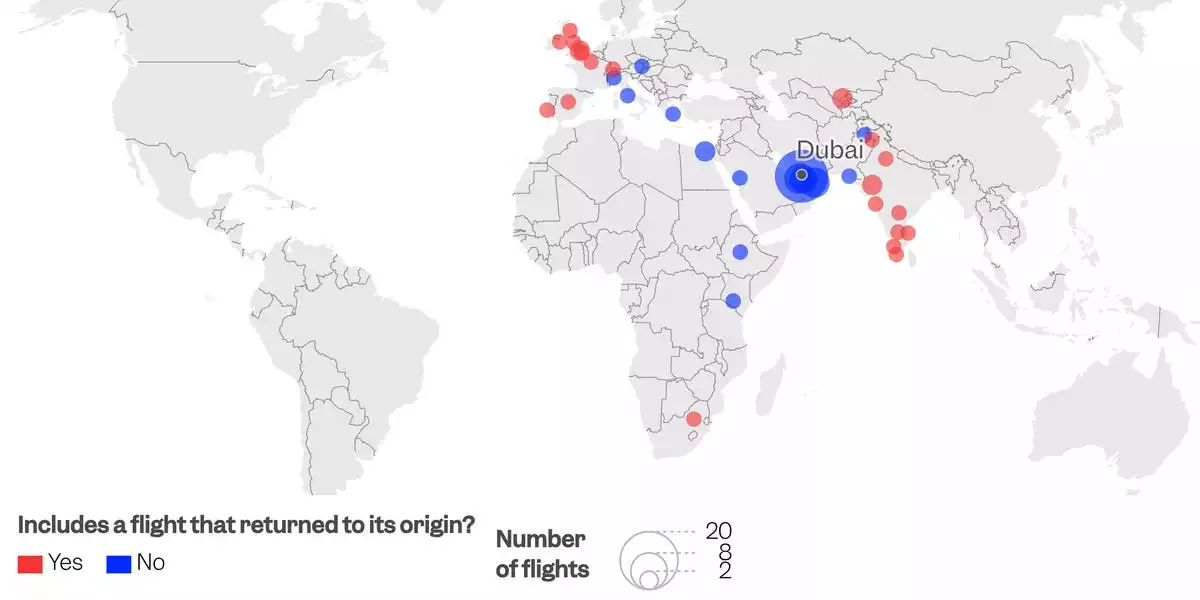
The March 16, 2026 drone strike near a fuel tank at Dubai International Airport (DXB) did not produce casualties, yet its operational footprint was unmistakable: a four-and-a-half-hour shutdown, 65 diverted flights to 34 alternate airports across Europe, Asia, and Africa, and 22 “flights to nowhere” forced to return to their departure points. The episode’s most vivid illustration came from Emirates Flight 76 (Paris–Charles de Gaulle), which spent 10 hours and 38 minutes in diversionary limbo before returning to base—an extreme example of how quickly a localized incident can metastasize into a network-wide disruption.
DXB’s scale turns any interruption into a global event. With over 95 million international passengers in 2025, the airport functions less like a single node and more like a load-bearing pillar in global aviation connectivity. When that pillar is temporarily removed, the system does not simply reroute; it rebalances under stress, consuming spare capacity across distant airports, stretching crew duty limits, and forcing airlines into difficult trade-offs between safety, schedule integrity, and passenger obligations.
This was also not an isolated shock. As the third drone-related disruption near DXB since late February, it compounds existing operational caution—most visibly through British Airways and KLM cancellations extending through March 28—and intensifies scrutiny of aviation security in a region where geopolitical volatility can spill into civilian infrastructure with little warning.
Asymmetric technology meets legacy airspace management
The recurring drone incursions around DXB signal a deeper shift: commercially accessible unmanned aerial systems (UAS) now offer capabilities—range, autonomy, payload potential—that were once largely confined to state actors and specialized military platforms. That democratization changes the threat equation for airports, which have historically optimized for safety and throughput against conventional risks (weather, mechanical failures, runway incursions), not low-cost, high-impact aerial disruption.
A modern counter-drone posture is not a single tool; it is a layered counter-UAS (C-UAS) architecture that must operate in real time and under strict civil aviation constraints. The operational challenge is that airports are dense electromagnetic environments, and the airspace around them is tightly regulated—meaning detection and mitigation must be precise, legally grounded, and interoperable with air traffic control.
Key capabilities increasingly viewed as foundational include:
- Multi-sensor detection: radar, electro-optical/infrared, acoustic sensing, and RF detection to reduce false positives and blind spots
- RF analysis and triangulation: identifying control links and potential launch points where feasible
- Electronic countermeasures (where permitted): jamming or protocol disruption balanced against aviation safety and spectrum rules
- Directed-energy and kinetic options: typically constrained near civilian airports, but increasingly debated as last-resort measures
- AI-driven anomaly detection: machine-learning models that can flag unusual trajectories and behaviors faster than manual rule sets
The strategic point is not simply “buy counter-drone tech.” It is to fuse C-UAS into legacy air traffic management (ATM) so that detection, risk scoring, and response actions are coordinated with runway operations, approach paths, and emergency protocols. Without that integration, airports risk either overreacting—triggering unnecessary shutdowns—or underreacting until disruption becomes unavoidable.
The hidden bill: diversions, insurance repricing, and supply-chain drag
The immediate costs of a disruption like DXB’s are measurable and steep: extra fuel burn, extended airborne time, crew duty-time overruns, passenger reaccommodation, and missed slots that ripple into subsequent rotations. But the more consequential impact often emerges in second-order effects—particularly when incidents recur and begin to reshape commercial assumptions.
For airlines, repeated disruptions erode on-time performance, which has become a primary competitive metric. They also strain customer trust in premium long-haul networks where passengers pay for reliability as much as comfort. For airports, the reputational risk is not merely public relations; it can influence route planning, capacity allocation, and the willingness of carriers to concentrate operations.
Insurance markets are another pressure point. Underwriters tend to respond to repeated perimeter or airspace incidents by repricing risk—potentially lifting hull and liability premiums and embedding “airport perimeter exposure” into operating costs for carriers serving the Gulf. Over time, that can translate into higher fares, tighter margins, or reduced schedule density.
Cargo adds a further layer of sensitivity. DXB is a critical artery for time-sensitive, high-value freight—electronics, pharmaceuticals, perishables—where delays can destroy value rather than merely postpone it. Even short disruptions can force:
- Inventory buffers to increase (raising working capital requirements)
- Mode shifts to more expensive alternatives
- Downstream production delays for just-in-time supply chains
- Price effects that ultimately reach end markets
In a world where supply chains are already balancing resilience against efficiency, drone-related airport disruptions act like a tax on speed—subtle at first, then structural if they persist.
What resilience looks like now: layered security, diversified networks, and predictive operations
The DXB incident underscores a broader lesson for business and technology leaders: resilience is no longer a crisis playbook; it is a design principle. For airports and aviation stakeholders, that design is likely to center on three mutually reinforcing moves.
First, deploy layered C-UAS with interoperability. Procurement decisions increasingly favor platforms with open APIs that can integrate with ATM systems and external data sources (ADS-B, satellite intelligence, perimeter sensors). The goal is not only detection, but decision-quality information delivered fast enough to avoid blanket shutdowns when targeted restrictions would suffice.
Second, reduce single-point dependency in route and hub strategy. Airlines and cargo integrators are likely to revisit hub concentration and treat secondary gateways—Abu Dhabi, Doha, Istanbul, among others—not as emergency fallbacks but as dynamic alternates with pre-negotiated handling, crew, and passenger-care arrangements. Network diversification is not a retreat from hub economics; it is an adaptation to a risk environment where continuity is a premium asset.
Third, operationalize predictive analytics and digital twins. By combining real-time telemetry with digital models of airport environments, operators can simulate drone incursions, airspace closures, and cascading delays—then pre-stage staffing, gates, and customer-care workflows. This is where AI becomes practical: not as a headline feature, but as a way to compress reaction time and reduce disruption amplitude.
The March 16 drone strike near DXB is ultimately a story about how modern infrastructure—optimized for frictionless movement—can be disrupted by tools that are cheap, portable, and hard to attribute in real time. The airports and airlines that thrive in this environment will be those that treat security, continuity, and intelligence integration as core operating capabilities—because in global aviation, connectivity is not just a service promise; it is the product.


 By
By

 By
By
 By
By

 By
By
 By
By