
The Anatomy of Sam’s Club’s Relentless Value Machine
In the crowded theater of American retail, Sam’s Club has quietly rewritten the script on price leadership. Recent price audits reveal a striking pattern: across high-velocity essentials—think diapers, pet food, and premium coffee—Sam’s Club doesn’t just compete, it dominates, often undercutting conventional retailers by double-digit percentages. The calculus is simple yet profound: for the $50 annual membership fee, most two-person households see “payback scores” ranging from 2.5× to 6×, effectively turning membership into a profit center rather than a sunk cost. Even in the slow-turn trenches—dishwasher pods, HVAC filters—the savings persist, signaling a disciplined, system-wide commitment to value rather than sporadic discounting.
This is not loss-leader economics. It is a deliberate, vertically integrated flywheel where membership fees, supply-chain prowess, and data-driven retail media form a self-reinforcing ecosystem. The result: a cost-leadership position that absorbs inflationary shocks and redistributes value to consumers, all while deepening the moat against both supermarkets and digital upstarts.
Subscription Economics: From Grocery Cyclicality to Annuity Streams
The genius of Sam’s Club’s model lies in its transformation of grocery’s notoriously cyclical demand into a predictable, annuity-like revenue stream. The $50 annual fee is more than an entry ticket—it is a financial engine. Membership cash flows lower the company’s effective cost of capital, enabling continuous price investment and algorithmic inventory optimization.
- Predictable Revenue: Memberships smooth out the volatility of grocery demand, funding ongoing price competitiveness.
- Algorithmic Inventory: Data from member consumption patterns feed advanced forecasting models, tightening working-capital cycles and minimizing stockouts.
- Inflation Hedge: In an era of stubborn food inflation, Sam’s Club becomes a quasi-hedge for households, capturing trade-down traffic from both supermarkets and digital-first grocers.
For Walmart, Sam’s Club’s value halo is more than a side business—it’s a strategic asset. The club format’s price narrative backstops pricing power in Walmart’s core Supercenter business, allowing margin protection while maintaining a system-wide low-price identity.
Data, Automation, and the Retail Media Flywheel
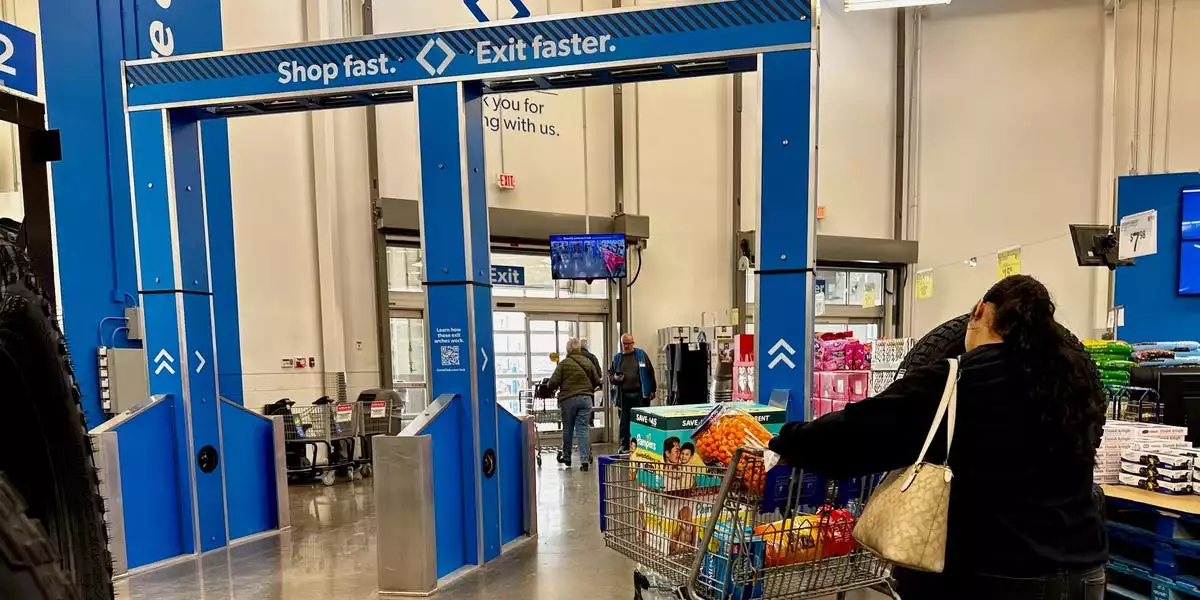
Sam’s Club’s digital transformation is not window dressing; it is foundational. Membership log-ins, Scan & Go mobile transactions, and computer-vision checkout generate a trove of first-party data—richer, more actionable, and more privacy-resilient than traditional web cookies. This data is the lifeblood of Walmart Connect’s retail media network, where brands now pay for closed-loop shelf visibility. The resulting media spend doesn’t just subsidize operations; it subsidizes further price reductions, creating a virtuous cycle that competitors—lacking both scale and a media arm—struggle to match.
- Automation: Goods-to-person robotics, autonomous floor scrubbers, and AI-directed pallet building compress operating costs, enabling the aggressive price gaps observed.
- Dynamic Pricing: Cloud-based engines recalibrate prices in real-time against Costco, Amazon, and regional grocers, ensuring Sam’s Club rarely cedes the lowest-delivered-cost crown for high-elasticity items.
- Retail Media Leverage: Brands must now budget for retail media to secure shelf space, effectively underwriting Sam’s Club’s price leadership.
Strategic Ripples Across the Retail Landscape
The implications ripple far beyond Bentonville. NielsenIQ projects the membership-club channel will outpace traditional grocery growth by 70% through 2026, fueled by urban infill pilots and last-mile delivery partnerships. As consumer sentiment bifurcates—with affluent shoppers chasing premium experiences and middle-income households laser-focused on value—Sam’s Club’s narrative is perfectly calibrated for the latter, widening the competitive moat against mid-tier grocers.
- Labor Model: With roughly six employees per $10 million in sales, Sam’s Club’s headcount-light approach insulates it from ongoing retail labor shortages and wage inflation.
- Supplier Pressure: Brands face mounting demands for club-exclusive SKUs and multi-pack configurations, while retail media spend becomes table stakes for shelf presence.
- Investor Lens: Membership growth emerges as a leading indicator for traffic, ancillary service adoption, and retail media revenue—a proxy for the expanding lifetime value of each member.
For competitors, the gauntlet is clear: accelerate private-label innovation and harness loyalty data, or risk seeing baskets migrate behind the membership gate. For technology vendors, the opportunity lies in fulfillment robotics, AI-driven pricing, and compliance tech as data privacy regulations tighten.
Sam’s Club’s model is not a promotional mirage but a durable architecture—one that absorbs macroeconomic shocks and redistributes value with mathematical precision. As the payback math becomes ever more compelling, the club’s gravitational pull on American households will only intensify, redrawing the boundaries of retail’s next chapter.

 By
By

 By
By
 By
By
 By
By
 By
By
 By
By
 By
By