


A Cosmic Anomaly Redefines the Early Universe—and the Technology Race
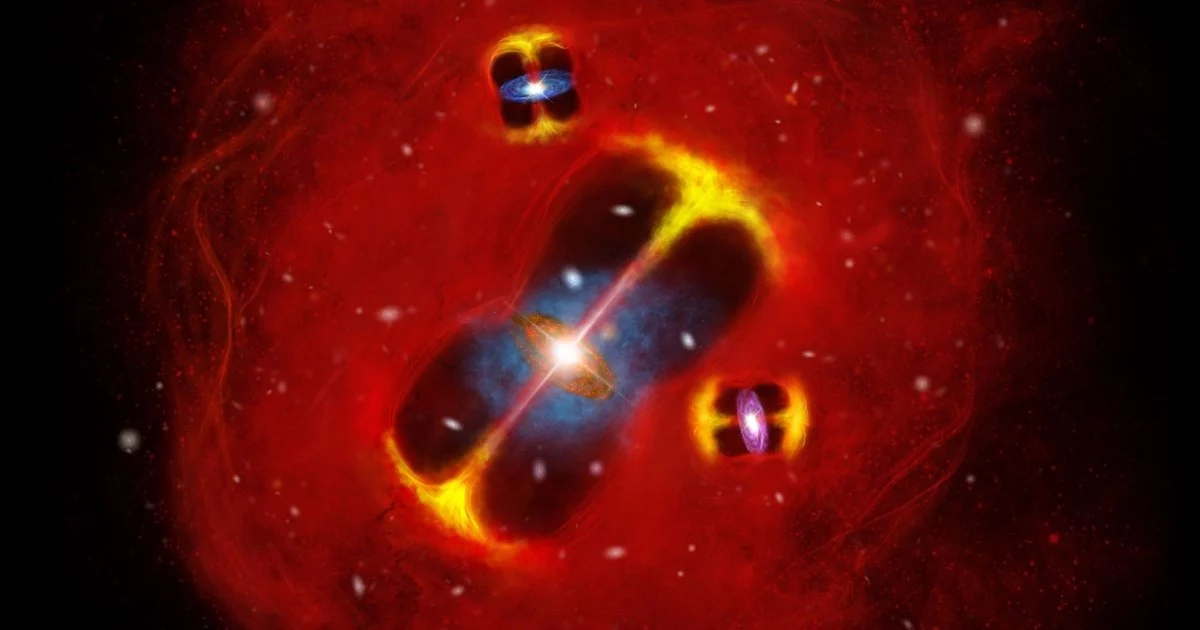
The universe, as we know it, is being rewritten. The recent identification of galaxy cluster SPT2349-56—an ancient agglomeration formed just 1.4 billion years after the Big Bang—has sent ripples through both astrophysics and the technology sector. What sets SPT2349-56 apart is not merely its age or mass, but the staggering revelation that its intracluster gas burns at temperatures at least five times hotter than what prevailing cosmological models had dared to predict. This inferno, likely stoked by the combined fury of three supermassive black holes at its core, has forced a radical reappraisal of how energy, matter, and structure entwined in the universe’s formative epochs.
Exascale Computing and the Arms Race in Astrophysical Simulation
The implications for computational science are profound. Traditional ΛCDM (Lambda-Cold Dark Matter) simulations, long the backbone of cosmic modeling, have been exposed as underpowered for capturing the chaotic ballet of multiple black holes feeding energy into their host clusters. To model these multi-feedback events with fidelity, researchers will require exascale-class computational resources—machines capable of performing a quintillion calculations per second. This necessity is more than academic: it provides a compelling, near-term benchmark for AI-accelerated cosmological solvers and a tangible justification for hyperscalers and high-performance computing (HPC) vendors to leap to the next performance node.
- Exascale Demand: Only next-generation, GPU-dense architectures can hope to resolve the turbulent interplay of black holes and baryonic matter in early clusters.
- AI-Driven Discovery: The challenge of distinguishing true anomalies from noise, as faced by Zhou’s team, underscores the urgent need for robust, self-auditing machine learning models. These AI workflows, honed on astronomical data, will inevitably cascade into fields as diverse as earth observation, climate modeling, and autonomous navigation.
Meanwhile, the data deluge from instruments like ALMA—already delivering petabytes of raw data—will soon be dwarfed by the exabyte-scale outputs of the Square Kilometre Array and the Extremely Large Telescope. Innovations in low-temperature detector technology, cryogenic amplification, and edge-based preprocessing are no longer luxuries but mission-critical R&D fronts. Notably, the design DNA of these cryogenic read-outs is shared with quantum-computing control systems, hinting at a fertile cross-pollination between astrophysics instrumentation and commercial quantum hardware.
Capital Flows, Supply Chains, and the New Industrial Geography
The economic reverberations of SPT2349-56’s discovery are equally striking. Deep-space science has become a theater for geopolitical soft power, with governments and sovereign funds leveraging cosmic breakthroughs to justify ambitious budgets—think U.S. Astro2020, Europe’s Cosmic Vision 2050, and China’s Tianlin program. Suppliers specializing in precision optics, high-bandwidth satellite communications, and advanced semiconductor cooling are poised for significant tailwinds.
- Capital Allocation: Inflation and rising costs are forcing mega-consortia to diversify funding, blending philanthropy, commercial data-rights, and renewable energy agreements to keep the lights on at remote observatories.
- Cloud and Connectivity Advantage: The need to process and share multi-continent datasets gives a decisive edge to hyperscalers with distributed, low-latency fiber or satellite backbones. Expect a surge in M&A activity targeting high-altitude platform stations and laser inter-satellite links.
- Supply-Chain Dynamics: The rare materials underpinning sub-Kelvin detector arrays—ultra-pure niobium, silicon germanium, rare-earth magnets—are also critical to electric vehicles and wind turbines. Companies that secure vertical integration or robust recycling streams for these inputs will enjoy resilience across multiple high-growth sectors.
Strategic Ripples: From Extreme Materials to AI Governance
The SPT2349-56 anomaly is more than a scientific curiosity; it is a crucible for next-generation materials, data governance, and workforce strategy.
- Materials Innovation: Mirror coatings and cryostats designed to withstand cosmic-ray bombardment are finding dual-use applications in radiation-hardened semiconductor fabs and medical imaging.
- Gravitational-Wave Synergies: The multi-black-hole interactions inferred from SPT2349-56 dovetail with upgrades to gravitational-wave observatories. The photonic integrated circuits and ultra-stable lasers developed here will soon power high-frequency trading and next-generation wireless.
- ESG and Talent: Companies aligning themselves with frontier science projects report lower R&D attrition and enhanced employer branding, especially among Gen-Z engineers. Participation—whether through joint fellowships, data-sharing, or cloud credits—delivers tangible returns in talent acquisition and retention.
For executives and strategists, the lesson is clear: the discovery of SPT2349-56 is a harbinger of a new era in both cosmology and technology. It demands scenario planning that accounts for compound disruptions, positions data-management offerings at the heart of global observatory networks, and catalyzes AI governance frameworks with real-world, high-stakes testbeds. As the universe reveals its secrets, those who adapt swiftly will find themselves not just spectators, but architects of the next industrial and scientific revolution.


 By
By

 By
By
 By
By

 By
By
 By
By







