

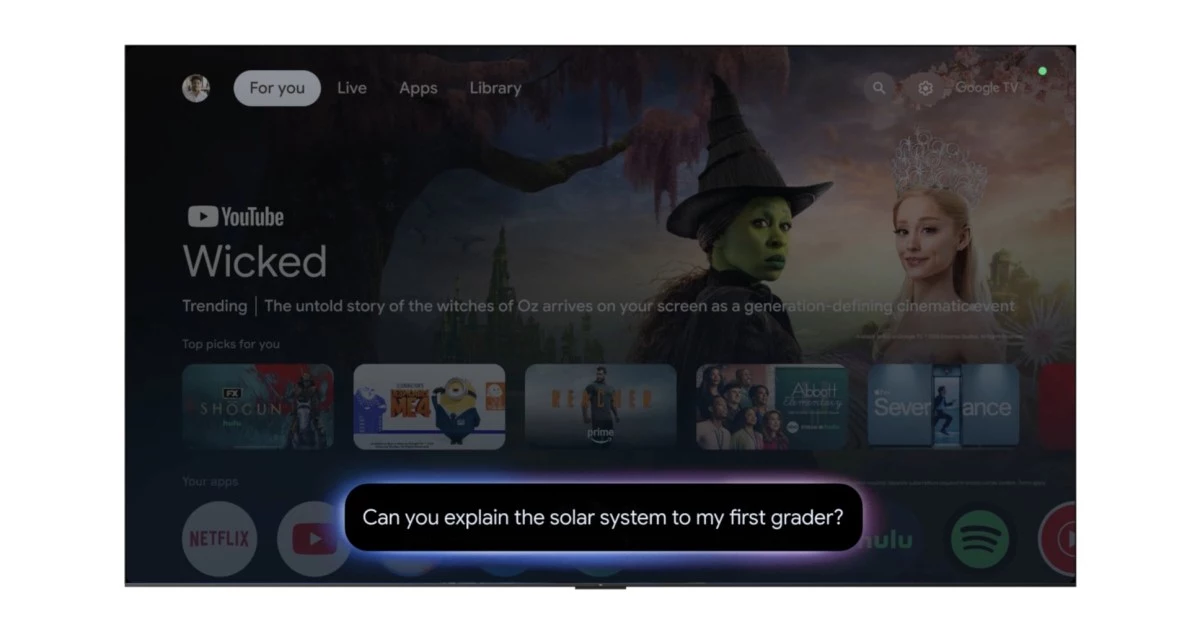

Gemini for TV: Ushering in the Era of Conversational Living Rooms
When Google announced the expansion of Gemini for TV—from a handful of premium smart sets to any television with an HDMI port—the move signaled more than just a technical upgrade. It marked a paradigm shift in how artificial intelligence, specifically large language models (LLMs), will inhabit and orchestrate the living room. The Google TV Streamer dongle, a modest device retailing for less than $50, now serves as a Trojan horse, quietly embedding Gemini’s generative prowess into millions of legacy screens. For consumers and industry insiders alike, the implications are both immediate and profound.
—
Redefining the Living Room Interface: Multi-Modal AI at Ten Feet
Gemini’s migration from mobile and desktop to the so-called “ten-foot interface” of the living room is a stress test for the next generation of AI. Here, the demands are unique: latency must be imperceptible, context must be inferred from both voice and visuals, and the assistant must gracefully orchestrate a cacophony of smart-home devices. Google’s approach—a hybrid of lightweight, on-device models and cloud-based reasoning—strikes a delicate balance between responsiveness and computational efficiency.
Key differentiators include:
- Conversational Content Discovery: Users can now ask for “comedies from the 1990s with strong female leads” or request real-time episode summaries, blurring the line between passive viewing and active exploration.
- Edge-Cloud Orchestration: Wake-word detection and intent parsing happen locally, while more complex tasks leverage Google’s cloud infrastructure—containing bandwidth costs without sacrificing speed.
- Home Graph Integration: Gemini’s ability to surface security camera feeds, adjust lighting, and control appliances hints at a unified, ambient intelligence—one that learns from and adapts to the rhythms of household life.
By supporting any HDMI/HDCP 1.3 television, Google is not just future-proofing its ecosystem; it is retrofitting the past, extending the lifespan of millions of TVs and democratizing access to generative AI.
—
Economic Stakes: Monetizing the Ambient Attention Economy
The strategic calculus behind Gemini’s HDMI-based rollout is as much about economics as it is about technology. Each streamer sold is a gateway to recurring revenue streams: increased search queries, premium content rentals, YouTube TV subscriptions, and—most critically—incremental ad inventory. As linear TV ad spend migrates to connected TV (CTV) amid a softening macro environment, Google’s conversational interface becomes a magnet for high-value, intent-rich data.
Consider the following economic vectors:
- AdTech Convergence: Gemini’s conversational requests feed Google’s audience graph, enabling more precise targeting and premium CPMs for “shoppable TV” and contextual overlays.
- Ecosystem Lock-In: By consolidating under the Gemini brand, Google nudges OEMs and consumers away from rival assistants, increasing switching costs and reinforcing the value of its broader hardware-software ecosystem.
- Cost of Compute: While LLM inference is resource-intensive, advances in TPU hardware and edge-pruning techniques are steadily reducing per-interaction costs. Expect experiments with ad-supported or freemium tiers as Google seeks to balance operational expenses with new monetization opportunities.
For content providers and advertisers, the living room is rapidly becoming the next great frontier for engagement and commerce—a space where voice, vision, and intent converge.
—
Competitive Tensions and Regulatory Crosswinds
The Gemini for TV rollout lands in a landscape already crowded with incumbents—Amazon’s Alexa, Apple’s Siri, and proprietary TV OEM solutions—but none have yet matched Gemini’s breadth of generative capabilities or its retrofit-friendly distribution model. This shift pressures TV manufacturers to license rather than build their own LLMs, especially as R&D budgets tighten.
Streaming platforms, meanwhile, face a new layer of recommendation logic they do not fully control, raising questions about discoverability and revenue sharing. Retail giants piloting voice-led commerce, such as Walmart and Target, may find their living-room ambitions accelerated by Gemini’s conversational hooks.
Yet, the path forward is not without friction:
- Consumer Frugality: With households extending the life of existing TVs, a low-cost AI overlay is particularly attractive.
- Energy and ESG Scrutiny: LLMs’ energy consumption is under the microscope; Google’s carbon-aware scheduling and on-device inference offer partial answers.
- Privacy and Compliance: As regulations like the EU’s Digital Markets Act evolve, Google faces mounting pressure to ensure transparent consent flows and robust data governance.
—
As the living room becomes a crucible for ambient, voice-first computing, Gemini’s HDMI-based expansion is more than a technical milestone—it is a strategic gambit that redefines the boundaries of AI in the home. For decision-makers across content, advertising, and hardware, the message is clear: the future of engagement is conversational, contextual, and increasingly, orchestrated by generative intelligence. Those who adapt swiftly will find themselves not just keeping pace, but shaping the very contours of the next digital epoch.

 By
By
 By
By


 By
By
 By
By

 By
By







