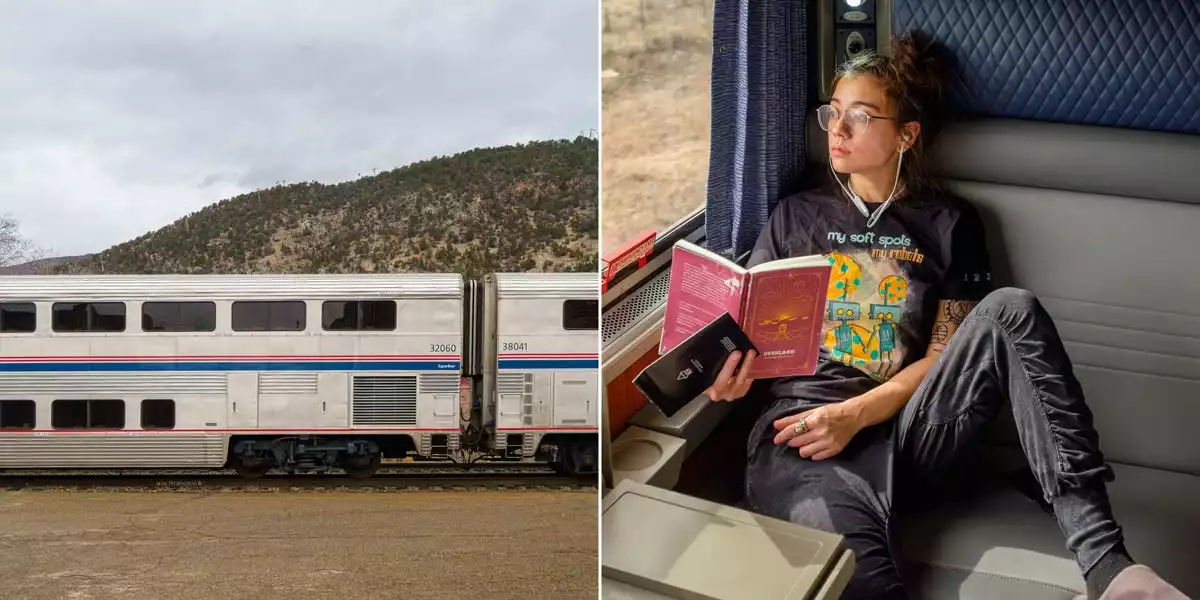

A 53-hour rail journey that doubles as a market signal for premium mobility
A 53-hour ride on Amtrak’s California Zephyr, running from Chicago Union Station to Emeryville, California, reads less like a throwback and more like a live case study in how U.S. passenger rail is being repositioned. At $2,200 for a roughly 50-square-foot bedroom with an en-suite bathroom, the experience sits firmly in the premium tier—yet the value proposition is not speed. It is space, privacy, service design, and scenery packaged into a single, continuous product.
What stands out is how the trip reframes long-distance rail from “transportation” into experiential travel, a category where consumers increasingly pay for the journey itself. The onboard rhythm—reading, streaming, journaling, gaming, and socializing with fellow passengers—mirrors the behavioral patterns seen in luxury cruising and boutique hospitality. In that sense, the Zephyr is competing not only with airlines and road trips, but with experience-led leisure markets that monetize time rather than minimize it.
The implications are commercial as much as cultural: if a meaningful segment of travelers is willing to pay premium prices for long-distance rail comfort, the U.S. rail conversation shifts from mere survival to product strategy, segmentation, and platform economics.
Stations and suites as “brand surfaces” in the competition with airlines and hotels
The journey begins where rail either wins or loses the premium customer: the terminal. Chicago’s Union Station, described as “European-style” in its grandeur, underscores a critical point for transportation executives: stations are no longer passive infrastructure. They are brand touchpoints that must compete with airport lounges, boutique hotels, and curated retail environments.
Premium rail travelers increasingly expect a coherent end-to-end experience, including:
- Lounge access that signals status and reduces friction
- Digital check-in and real-time service information that matches airline-grade transparency
- A station environment that feels safe, navigable, and intentionally designed
Onboard, the “hotel-like” bathroom and upgraded toiletries are not trivial perks; they are evidence of a broader shift toward hospitality-grade rail interiors. These enhancements also hint at the next operational frontier: modern rolling stock and retrofits can become smarter, not just nicer. Embedding IoT-style monitoring—for water pressure, HVAC performance, occupancy patterns, and maintenance cycles—could reduce downtime and improve consistency, turning customer satisfaction into an engineering outcome rather than a staffing miracle.
This is where premium rail becomes a technology story. The most defensible differentiation may come from systems integration: connected cabins, predictive maintenance, energy optimization, and service workflows that allow a small crew to deliver a high-touch experience reliably across multiple days.
The new premium traveler: experiential, sustainability-aware, and connectivity-dependent
The Zephyr’s appeal reflects a changing consumer calculus. For a growing cohort, the decision is not “fastest route” but best use of time—especially when time can be spent comfortably and privately. The sleeper suite becomes a hybrid of hotel room, lounge chair, and personal retreat.
Several demand drivers are converging:
- Experiential travel as a growth vector: Travelers are buying narrative, scenery, and social texture—elements airlines largely cannot deliver without significant add-ons.
- Work-from-anywhere expectations: Even leisure travelers now carry work habits and device ecosystems. Premium rail will be judged on connectivity, power availability, ergonomic comfort, and quiet.
- Sustainability and ESG signaling: Rail’s lower emissions profile per passenger-mile (relative to many air and car trips, depending on route and load factors) is becoming a decision input for both individuals and corporate travel policies.
This does not mean rail “beats” air on the traditional metrics. Domestic aviation remains structurally advantaged on speed and frequency across core U.S. corridors. But the Zephyr demonstrates a viable niche where comfort, carbon considerations, and experience justify a premium—particularly for travelers who treat the trip as part of the vacation, not a hurdle to clear.
For Amtrak and any future private-sector partners, the strategic question becomes: how large can this niche become, and what product architecture best captures it?
Investment, policy, and platform strategy: where the rail renaissance becomes real—or stalls
The $2,200 fare is a headline number, but it sits atop a complicated reality: U.S. passenger rail depends on public subsidy, shared rights-of-way, and political continuity. That interdependency is both risk and opportunity. Stable funding enables service upgrades; funding volatility can freeze modernization midstream, leaving premium promises stranded in legacy constraints.
The most actionable forward-looking themes are already visible:
- Tiered service models: Expect clearer segmentation—economy, premium recliner, sleeper, suite—mirroring airline cabins, but with more emphasis on privacy and space.
- Partnership-driven monetization: Hospitality brands, upgraded catering, and local tourism collaborations can turn stations and routes into curated cultural corridors, creating ancillary revenue beyond ticket sales.
- Digital experience platforms: The next competitive leap is not just nicer rooms; it is an integrated app ecosystem for ticketing, loyalty, onboard ordering, service alerts, and disruption management—the rail equivalent of an airline’s digital operating system.
- Freight-passenger coordination and AI scheduling: On mixed-use corridors, modern dispatching, dynamic track allocation, and predictive analytics can improve reliability for both passenger service and logistics—an underappreciated lever for national productivity.
The California Zephyr’s premium sleeper experience ultimately signals something larger than nostalgia: a credible attempt to reposition long-distance rail as a policy-aligned, experience-centric, digitally enabled mobility product. If operators and policymakers can align capital investment, technology modernization, and service design, U.S. rail may not need to outrun aviation to win—it may only need to make time itself feel like the upgrade.

 By
By
 By
By
 By
By
 By
By

 By
By