

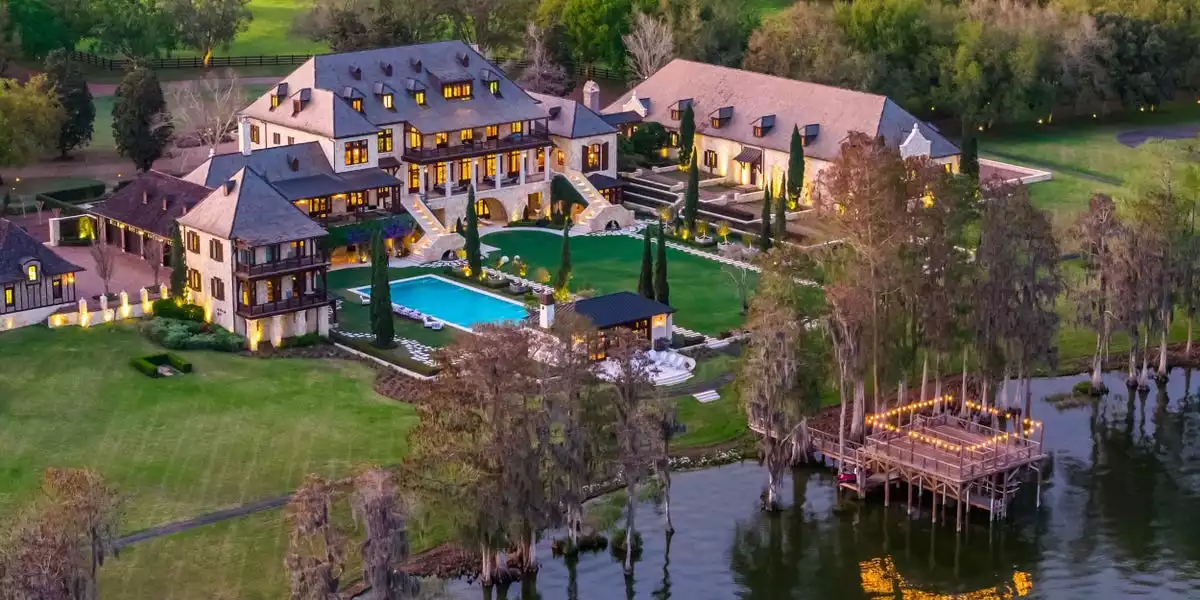

A $115 million Tampa estate as a signal flare for ultra-luxury pricing and capital flows
Steven Lempera’s decision to list his 87-acre Lake Thonotosassa estate near Tampa for $115 million—after acquiring it in 2021 for $16.7 million—lands as more than an eye-catching real estate number. The nearly sevenfold markup functions as a live market test of how far post-pandemic asset inflation and high-net-worth liquidity can stretch valuations in Florida’s uppermost tier.
The property’s scale and specificity matter because they illuminate where ultra-wealth is concentrating and how it is being deployed. Tampa and its surrounding enclaves have increasingly benefited from wealth migration out of traditional coastal strongholds, supported by a blend of tax advantages, lifestyle appeal, and a growing perception that Florida’s major metros and “secondary gateway” markets can now host global-caliber luxury demand. If a transaction approaches the ask, it would not merely set a local record—it would redefine comparable-based valuation models for large-parcel estates in the region, influencing land multipliers and amenity premiums across Florida’s “next wave” luxury corridors.
Yet the same dynamics that inflate headline pricing also introduce liquidity risk. Ultra-custom estates can become “one-buyer markets,” where the pool of purchasers is constrained not by wealth, but by taste alignment and operational appetite. In that sense, the listing becomes a referendum on whether today’s ultra-luxury buyer is still in expansion mode—or beginning to reprice uniqueness, maintenance complexity, and long-term carrying costs.
The modern estate as a private headquarters: work, leisure, and identity under one roof
What distinguishes this listing is not only acreage, but the way it reflects an evolving definition of “home.” The estate’s features—a private office complex with a glass-walled boardroom, a 22-car garage and car museum, a bespoke go-kart circuit, and full equestrian facilities—read less like a residence and more like a multi-use campus designed for leadership, recreation, and legacy-building.
This is a continuation of a broader post-2020 shift: residential environments increasingly serve as professional infrastructure. For senior executives and founders, the ability to host meetings in a controlled setting—complete with brand-forward design and privacy—has become a premium feature, particularly as remote and hybrid work normalize high-stakes decision-making outside traditional corporate offices.
Just as notable is the rise of experiential amenities as a form of status architecture. Instead of standardized luxury checklists, the market is rewarding hyper-personalized features that signal identity and narrative—whether that’s an automotive showcase, a themed room, or a track built for family recreation. In the ultra-luxury segment, these are not “extras”; they are increasingly the differentiators that justify pricing power, even as they narrow the buyer universe.
Key elements that exemplify this “estate-as-platform” model include:
- Dedicated executive workspace (boardroom-ready) that supports private governance and dealmaking
- Collector-grade automotive infrastructure, implying specialized climate control, lighting, and security
- Experience-first recreation (go-kart circuit) that turns land into programmable lifestyle space
- High-end wellness and craftsmanship cues (e.g., indoor saltwater spa, custom millwork) that reinforce bespoke positioning
Privacy, security, and land optionality: why acreage is becoming strategic again
At the top of the market, seclusion is not a preference—it is a product category. Large, contiguous parcels provide a buffer against visibility, intrusion, and future encroachment, while enabling controlled access and perimeter management. In parallel, the luxury buyer’s definition of security has expanded beyond gates and guards into a more integrated view that blends physical security, cyber-physical systems, and digital access control.
This is where the listing intersects with business and technology in a meaningful way. Estates of this caliber increasingly require bespoke security architectures—from surveillance and sensor networks to hardened connectivity and compartmentalized access. For security integrators and proptech providers, the ultra-luxury segment offers high-margin opportunities, but also demands a “white-glove” approach that aligns with design aesthetics and privacy expectations.
The land itself also carries a less visible value proposition: optionality. Nearly 90 acres of lakefront property can function as a strategic reserve—potentially supporting future subdivision (where permissible), equestrian events, or even philanthropic and community-facing development. For legacy-minded buyers, the purchase is not only consumption; it can be a long-duration asset with multiple future pathways.
What this listing suggests about Florida’s next phase—and the technology stack that will follow
Lempera’s divestment is reportedly tied to a family realignment around his daughter’s professional horseback-riding career, with relocation toward established equestrian hubs such as Wellington, Florida, and international venues. That detail underscores a critical point: ultra-luxury real estate is often shaped as much by life logistics and identity ecosystems as by investment logic. Buyers and sellers in this tier optimize for proximity to elite networks—sporting circuits, cultural nodes, private aviation access, and specialized services—where time and community are as valuable as square footage.
For Tampa, the question is whether the region can sustain and deepen this echelon of demand. Long-term durability will depend on the less glamorous fundamentals that ultra-wealth increasingly expects:
- Transportation and airport throughput, including private aviation convenience
- Cultural and institutional depth that supports year-round elite residency
- High-performance broadband and resilient infrastructure suited to executive-grade remote operations
Meanwhile, the technology expectations embedded in estates like this are becoming clearer: buyers want unified control across security, wellness, climate, lighting, and entertainment, with systems that are modular, maintainable, and discreet. The next competitive frontier is not merely “smart home” features, but platformized estates—properties designed to operate like secure, resilient micro-campuses without feeling like data centers.
If the market validates a $115 million ask in this setting, it will echo beyond one shoreline on Lake Thonotosassa. It will signal that Florida’s ultra-luxury ceiling is still rising, that privacy and experiential design are commanding new premiums, and that the most valuable square footage in America may increasingly be the kind that can function—quietly—as a headquarters.

 By
By

 By
By
 By
By
 By
By


 By
By







