


A security incident that exposed the friction line between access and assurance
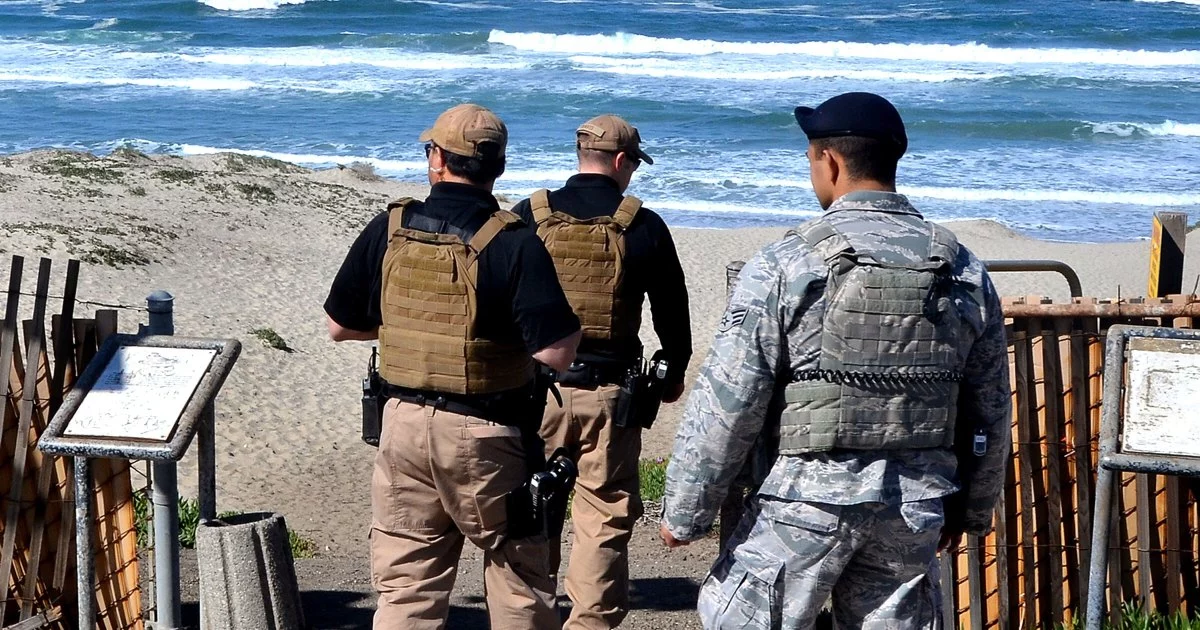
The detention of five journalists and two military officers at Vandenberg Space Force Base—reportedly at gunpoint, during an officially sanctioned convoy—lands at an awkward intersection of modern base security and the Space Force’s evolving public posture. The group, traveling in a government-escorted minivan to cover a missile-operator training-facility ribbon-cutting, was ordered out, with the officers handcuffed and the reporters directed to sit on a curb for more than 30 minutes. Base officials later described the episode as a “breakdown in communication,” while media representatives characterized the armed escalation as unnecessary and dangerous.
For a service still building its institutional identity, the optics matter. Vandenberg is not merely a base; it is a strategic node in U.S. space and missile operations. When credentialed visitors—especially press—are treated as potential intruders, the incident becomes more than a local mishap. It becomes a test case for how the Space Force balances force protection, operational transparency, and public accountability in an era of heightened intrusion concerns and geopolitical competition.
Key contextual elements shaping the narrative include:
- A reported spike in intrusion attempts, which likely primed security personnel toward worst-case assumptions
- A sanctioned media convoy, which should have been a low-risk, pre-coordinated movement
- A missed public event, turning a security action into a public-facing governance issue
Where command-and-control broke down: identity, escalation, and human factors
The most revealing detail is not the presence of weapons—security forces train for high-consequence threats—but the speed with which a routine arrival became an armed detention. That escalation pattern typically points to identity verification failure under uncertainty, compounded by fragmented communications between public affairs, base operations, and gate security.
Several operational dynamics appear to have converged:
- Escalation dynamics under incomplete information: When gate personnel receive alerts about potential breaches, the default posture often shifts toward immediate control—hands visible, occupants separated, restraints applied—especially if the arriving vehicle does not match an expected profile in the moment. If the convoy manifest, vehicle identifiers, or escort confirmation were not instantly accessible, the system effectively incentivized escalation.
- Command-and-control fractures: The episode suggests the absence of a shared, real-time “common operating picture” connecting base headquarters, public affairs scheduling, and checkpoint execution. In high-security environments, even minor discrepancies—wrong lane, mismatched vehicle description, delayed radio confirmation—can trigger a cascade where procedure overrides context.
- Training and human factors: Security personnel are conditioned to treat ambiguity as risk. Without routine drills that explicitly include media movements, VIP convoys, and public affairs events, teams may lack the muscle memory to de-escalate once initial control is established. The result can be a prolonged detention even after the situation is effectively clarified.
This is the paradox of mature security organizations: they can be excellent at preventing catastrophic outcomes while still vulnerable to avoidable reputational damage caused by procedural rigidity.
The technology paradox: high-tech perimeters, low-context decisions
Modern installations like Vandenberg increasingly rely on networked sensors, automated alerts, and layered access control. Yet this incident underscores a recurring weakness in advanced security architectures: data abundance without contextual integration can slow or distort decision-making precisely when clarity is most needed.
Several technology and policy themes stand out for defense and security leaders:
- Physical security is now inseparable from digital identity: A convoy can be “authorized” in a calendar system yet appear “unknown” at a checkpoint if identity systems are not federated end-to-end. The gap between scheduling tools, credential databases, and gate workflows becomes a vulnerability—not to intruders, but to operational coherence.
- Zero-trust logic can misfire in the physical world: In cybersecurity, “zero trust” assumes no actor is inherently safe. Applied bluntly to physical checkpoints—without fast, granular credential validation—it can produce overreach. The goal is not less security, but more discriminating security: rapid authentication that reduces the need for forceful uncertainty management.
- A market signal for next-generation access control and C4I: Incidents like this tend to accelerate demand for integrated solutions—smart credentials, real-time manifests, biometric verification, and decision-support tools that reduce reliance on ad hoc radio calls. Vendors offering AI-assisted access control, predictive threat scoring, and integrated command-and-control dashboards will see growing interest, but only if systems are auditable and designed for de-escalation as well as detection.
The lesson is straightforward: the most advanced perimeter is only as effective as the human-machine interface at the moment of decision.
Strategic and reputational stakes for the Space Force—and what changes next
Beyond the immediate controversy, the Vandenberg detention highlights governance risks that can ripple into budgets, recruitment, and strategic messaging. As the Pentagon funds Space Force infrastructure and missile training modernization, high-profile operational missteps can invite congressional scrutiny, slow appropriations, and complicate public support—particularly when the press is involved.
The reputational dimension is equally material:
- Talent and partner confidence: Contractors, academic researchers, and interagency partners watch how bases handle controlled access. A perception of unpredictability or hostility can chill collaboration and complicate routine engagement.
- Information environment and adversary narratives: In a climate of U.S.–China strategic rivalry in space, even domestic incidents can be amplified externally to question U.S. professionalism and command competence.
Practical reforms likely to gain traction after an event like this include:
- Integrated identity management that allows gate personnel to validate sanctioned visitors instantly (vehicle, occupants, escort, and event linkage)
- Cross-functional exercises that include public affairs and media movements to stress-test escalation thresholds in low-risk settings
- A strategic communications playbook that acknowledges facts quickly, explains corrective actions, and reduces speculation without compromising security
Vandenberg’s episode is ultimately a case study in how a modern force protects critical assets while remaining legible to the public it serves. The Space Force’s credibility will be shaped not only by launches and capabilities, but by whether its security posture can be both resilient and proportionate when routine access collides with heightened alert.

 By
By
 By
By
 By
By
 By
By
 By
By
 By
By









