


A calibrated naval interdiction that signals a new phase of maritime enforcement
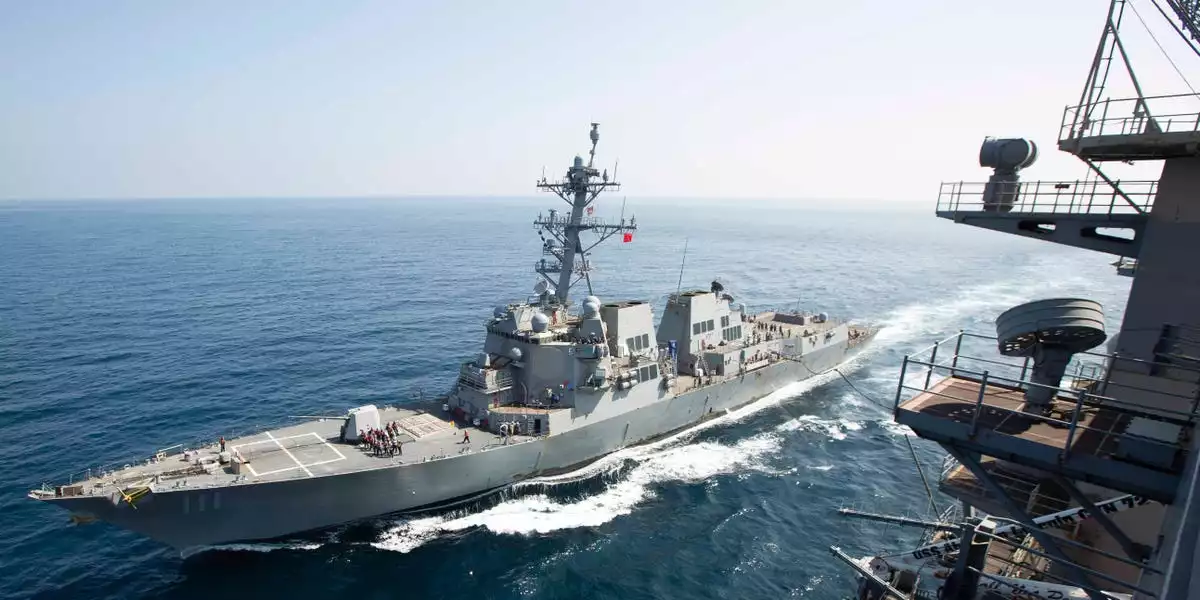
The six-hour confrontation between the U.S. Navy guided-missile destroyer USS Spruance and the Iranian-flagged cargo vessel M/V Touska offers a sharply defined snapshot of how modern maritime power is being applied: measured force, tightly governed rules of engagement, and an explicit economic objective. According to the account provided, Touska attempted to breach a U.S.-imposed maritime blockade targeting Iranian ports. After repeated warnings and five warning shots, Spruance received authorization for “disabling fire”—nine inert rounds that struck the engine room and immobilized the vessel without endangering the crew—followed by a U.S. Marine boarding to secure the ship.
This is not merely a tactical episode. It is a demonstration of gray-zone coercion at sea, where the aim is to reshape behavior—deterring blockade-running and constraining Iranian oil-linked revenues—without triggering the political and military consequences associated with sinking ships or causing casualties. The broader context described is expansive: a blockade initiated April 13 that has reportedly compelled 34 ships to reverse course, supported by 17 warships, 100+ aircraft, and combined-arms activity including mine-clearing in the Strait of Hormuz under Operation Epic Fury, alongside the signal of a third carrier strike group in theater.
For global business and technology stakeholders, the key takeaway is that maritime security is increasingly being executed as a precision-managed system—one that blends kinetic restraint, persistent surveillance, and economic pressure into a single operational design.
Precision “disabling fire” and the technology stack behind modern sea control
The reported use of inert disabling rounds is a telling detail. It reflects a growing preference for graduated-response options that can stop a vessel, enforce a blockade, and preserve escalation control. In practical terms, this approach sits between verbal warnings and lethal force—creating a credible enforcement ladder that can be applied repeatedly without automatically widening the conflict.
Several technology themes stand out for defense analysts and commercial operators alike:
- Non-lethal or less-lethal kinetic effects as doctrine: Immobilizing a ship by targeting propulsion spaces—while minimizing risk to crew—signals an operational emphasis on *compliance through controllable effects*. This foreshadows broader adoption of tools that can disable rather than destroy, including:
– Electronic warfare to disrupt communications or navigation
– Directed-energy concepts (where deployed) for selective effects
– High-powered microwave and other counter-electronics approaches discussed in defense circles as future interdiction options
- C4ISR as the enabling backbone: Coordinating 17 vessels, 100+ aircraft, and mine-countermeasure operations across the Arabian Sea and the Strait of Hormuz implies a heavy reliance on networked command-and-control and near real-time data fusion. The operational model described depends on:
– Persistent ISR coverage (manned and unmanned)
– Shared operational pictures across air, surface, and boarding elements
– Rapid authorization pathways for escalation steps (warnings → warning shots → disabling fire → boarding)
- Maritime Domain Awareness (MDA) becomes a commercial necessity: The same sensor fusion and tracking logic that enables blockade enforcement is increasingly mirrored by private actors seeking to avoid it. For shipping lines, commodity traders, and insurers, the incident underscores the value of:
– Advanced AIS analytics to detect enforcement patterns and anomalies
– Satellite imagery subscriptions and synthetic aperture radar coverage for persistent monitoring
– AI-driven route optimization that incorporates geopolitical constraints, not just weather and fuel economics
In effect, the operational environment is becoming more “data-dense,” and the winners—military or commercial—will be those who can translate surveillance into timely decisions.
Oil, insurance, and sanctions: how a naval blockade propagates through global markets
The blockade’s strategic logic is explicitly economic: pressure Iran’s oil revenues and enforce secondary sanctions with physical interdiction. That has immediate implications for energy markets and maritime trade.
Key economic transmission channels include:
- Energy price volatility and supply tightening: Constraining Iranian exports can tighten global supply and amplify swings in Brent crude and refined products. Even when alternative barrels exist, the market often prices in *risk premiums* tied to disruption probability—especially when the Strait of Hormuz remains central to global flows.
- Shipping costs and war-risk premiums: Elevated risk in the Arabian Sea and Hormuz corridor tends to raise:
– War-risk insurance and security-related surcharges
– Freight rates due to capacity constraints and longer voyage times
– Fuel costs if rerouting becomes necessary (including longer transits that can stretch schedules by days to weeks depending on route and cargo)
- Compliance complexity and trade diversion: Physical enforcement strengthens the practical reach of secondary sanctions, while incentivizing evasive tactics such as:
– Ship-to-ship transfers
– Masked registries and opaque ownership structures
– Front-company arrangements that raise due-diligence burdens for banks, brokers, and commodity desks
For corporate risk teams, the compliance challenge is no longer limited to paperwork and counterparties; it is increasingly shaped by real-time operational enforcement at sea.
Strategic signaling in the Strait of Hormuz—and what businesses should plan for next
The Strait of Hormuz remains a geopolitical fulcrum, often cited as carrying roughly one-fifth of global oil transit. In that setting, the described U.S. posture—expanded naval presence, mine-clearing operations, and a blockade that compels ships to reverse course—communicates deterrence not only to Tehran but also to other observers, including China and Russia, each with distinct incentives in a higher-price, higher-risk energy environment.
For industry leaders, the forward-looking implications are practical and near-term:
- Integrate rules-of-engagement realities into voyage planning: Operators should assume that interdiction may involve graduated force, including disabling measures, and train crews accordingly—procedurally and psychologically.
- Invest in resilient supply chains and communications: Redundant communications, cyber-hardened systems, and diversified routing options are moving from “nice-to-have” to competitive differentiators.
- Expect growth in maritime security services: Demand is likely to rise for private-sector offerings that complement naval activity—drone surveillance, secure comms, and liaison capabilities—potentially reshaping the maritime security market through consolidation or defense-industry entry.
The Spruance–Touska episode, as described, is ultimately a case study in how 21st-century maritime power is exercised: precision enforcement, information dominance, and economic leverage, all calibrated to compel behavior while keeping escalation on a tight leash.


 By
By
 By
By
 By
By
 By
By


 By
By







