

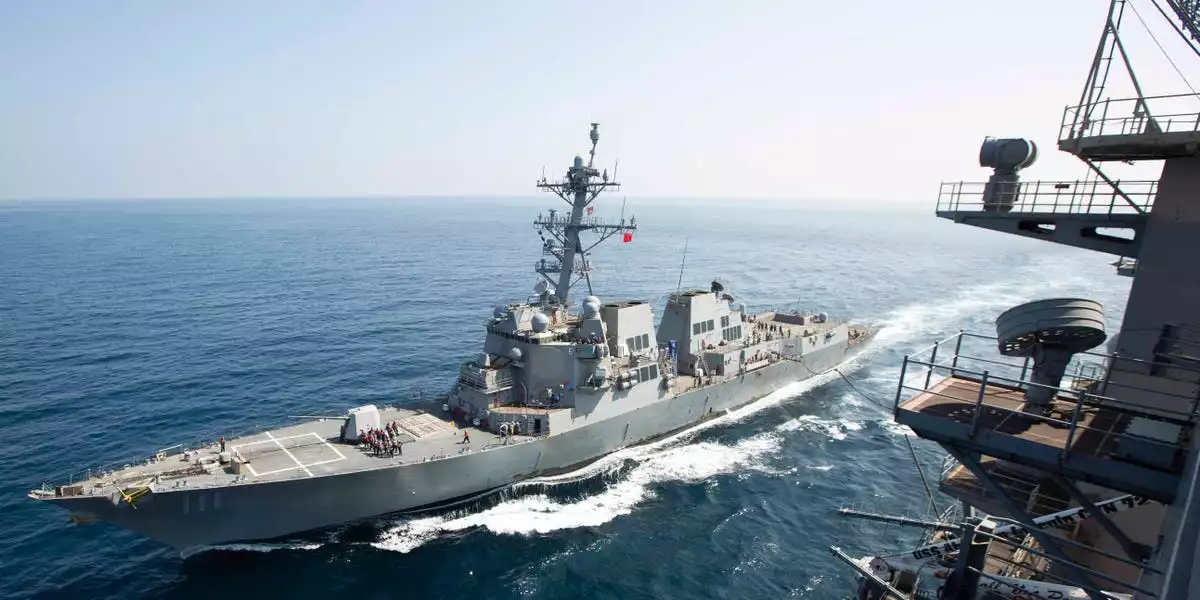

A calibrated maritime interdiction signals a harder edge in US–Iran sea power competition
The reported encounter between the US Navy guided-missile destroyer USS *Spruance* and the Iranian-flagged cargo vessel M/V *Touska* reads less like a spontaneous clash and more like a deliberately staged demonstration of graduated coercion at sea. Over roughly six hours, the escalation ladder—radio hails, warning shots, then authorized disabling fire using inert rounds aimed at the engine room—appears designed to achieve a narrow operational outcome: stop and secure the vessel without casualties, while preserving political control over the pace of escalation.
That choice matters. In contested waterways such as the Arabian Sea and the approaches to the Strait of Hormuz, the difference between *deterrence* and *provocation* can hinge on munitions selection, aim points, and the visibility of restraint. Disabling a ship’s mobility while avoiding crew harm signals capability and intent—yet leaves room for de-escalation and diplomatic maneuvering. It also sends a message to commercial operators: noncompliance with interdiction orders may be met with force that is precise, repeatable, and operationally scalable.
The broader context—an expanded US maritime operation reportedly involving 17 warships and more than 100 aircraft, plus the deployment of a third carrier strike group and explicit orders to neutralize mine-laying—suggests Washington is pairing economic pressure with a visible, persistent enforcement posture. For Tehran, the implication is equally clear: the maritime domain is becoming the primary arena where sanctions, security, and signaling converge.
Technology, rules of engagement, and the modern “graduated blockade” playbook
From a business-and-technology lens, the *Spruance–Touska* episode highlights how modern naval operations increasingly rely on systems integration and decision discipline as much as raw firepower. The reported sequence—warnings, controlled escalation, and a boarding action—reflects a doctrine optimized for high-traffic, high-stakes environments where miscalculation can trigger regional spillover.
Key operational and technological elements stand out:
- Combat management and command authorization loops: A destroyer’s ability to move from detection to identification to controlled engagement depends on real-time sensor fusion and communications that support rapid but auditable decisions—especially when disabling fire requires higher-level authorization.
- Precision effects without mass lethality: The use of inert rounds aimed at propulsion spaces underscores a growing emphasis on mission-kill outcomes (immobilize, board, inspect) rather than destructive strikes—an approach aligned with minimizing collateral damage and managing escalation risk.
- Air–sea ISR integration: Persistent airborne surveillance—manned or unmanned—provides the situational awareness needed for interdictions in an A2/AD-tinged environment, where threats can emerge from fast craft, coastal systems, or mines.
- Boarding as asymmetric leverage: The reported Marine boarding and securing of the vessel illustrates how littoral maneuver and visit-board-search-seizure (VBSS) operations convert sea control into legal and economic leverage: the ability to inspect cargo, enforce restrictions, and collect evidence.
This is also where legal and normative questions intensify. A “graduated blockade” posture—especially one tied to economic objectives like constraining oil revenue—invites scrutiny around international maritime law, freedom of navigation, and the standards for interdiction of non-combatant shipping. Even when states assert legal justification, the operational reality is that each interdiction becomes a precedent others will cite, contest, or emulate.
Energy markets, shipping economics, and the price of contested chokepoints
For global markets, the strategic center of gravity remains the Strait of Hormuz, a chokepoint that underwrites a meaningful share of seaborne energy flows. Any credible threat—mines, interdictions, or escalation between state forces—tends to transmit quickly into insurance pricing, freight rates, and volatility premiums.
Several second-order effects are especially relevant to executives in energy, logistics, and finance:
- War-risk premiums and underwriting tightening: Each interdiction or mine-related alert can push insurers to reprice risk, raising costs for shipowners and charterers and increasing collateral demands in trade finance.
- Rerouting and schedule disruption: Even modest changes in routing behavior can add days to voyages, strain vessel availability, and inflate delivered costs—pressuring margins across petrochemicals, manufacturing inputs, and consumer goods.
- Supply diversification accelerants: Prolonged friction in Hormuz can strengthen the business case for diversification toward US shale, Qatar LNG, and emerging producers, while encouraging longer-term contracting and infrastructure investment outside the Gulf.
- Shadow trade and compliance complexity: If Tehran leans further into opaque channels—barter structures, intermediated shipments, or reflagging—counterparties face higher compliance burdens, weaker commercial protections, and elevated financing costs.
For traders, the immediate consequence is often event-driven volatility—a premium that can be hedged but not eliminated. For corporates, the challenge is more structural: building procurement and logistics strategies that assume periodic disruption rather than treating it as an outlier.
What business and defense-industrial leaders should watch next
The reported presidential directive to neutralize mine-laying vessels elevates the importance of mine countermeasures (MCM) and persistent maritime surveillance—capabilities that are increasingly shaped by dual-use innovation. If the standoff deepens, several investment and policy vectors may sharpen:
- Defense procurement tailwinds: Expect heightened demand for MCM systems, unmanned surface vehicles (USVs), advanced sensors, and precision “non-lethal” disablement options—areas where commercial robotics, autonomy stacks, and AI-enabled ISR can translate into defense partnerships.
- Digital risk management in shipping: Carriers and operators are likely to expand AI-driven route planning, dynamic risk scoring, and cyber-hardened communications to operate under sanctions and interdiction pressure.
- Norm-setting and compliance regimes: Companies should monitor debates at the International Maritime Organization (IMO) and related forums, as evolving interpretations of interdiction practices can reshape compliance expectations and liability exposure.
- Geopolitical infrastructure hedges: Continued chokepoint stress can catalyze investment in alternative corridors—pipelines, transshipment hubs, and multimodal routes—reducing reliance on any single maritime bottleneck.
Taken together, the *Spruance* action against the *Touska* is best understood as a precision enforcement signal: technologically enabled, legally framed, and economically consequential. For markets and industry, the lesson is not merely that risk has risen—it is that maritime risk is being operationalized in ways that can be repeated, scaled, and integrated into broader economic strategy, with the Strait of Hormuz once again serving as the world’s most consequential pressure point.


 By
By
 By
By
 By
By
 By
By


 By
By







