

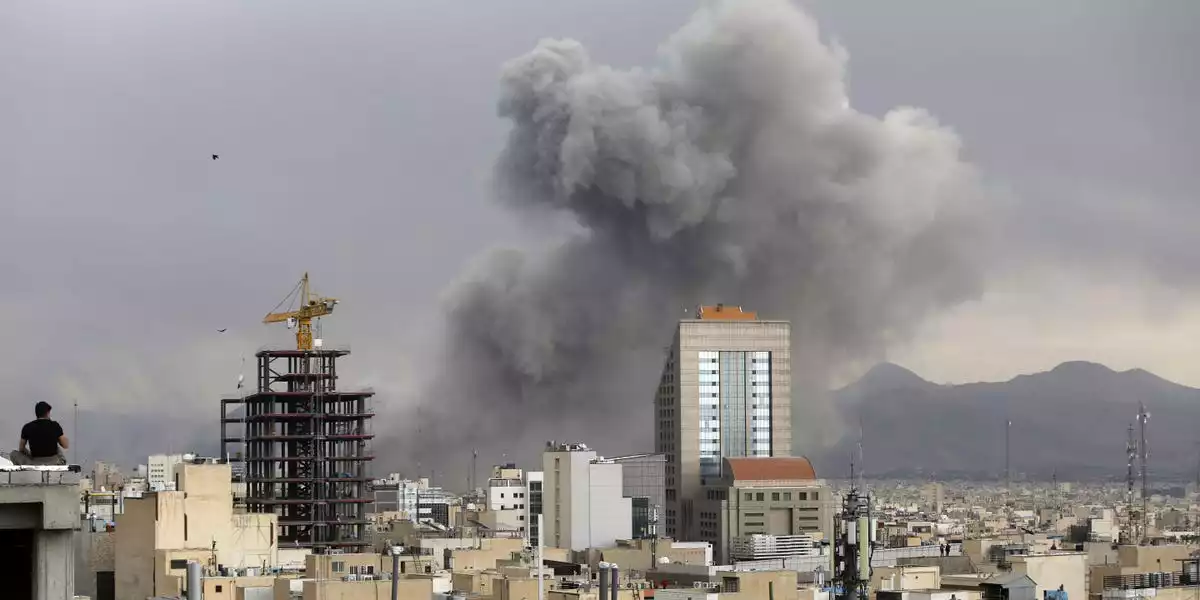

A widening conflict footprint reshapes risk for citizens, corporates, and capitals
The latest Middle East escalation—marked by direct U.S. and Israeli strikes on Iranian targets followed by Iranian retaliatory missile barrages—is no longer a contained military exchange. It is rapidly becoming a regional systems shock: one that touches diplomatic facilities, civilian landmarks, aviation corridors, and the operating assumptions of multinational firms. Reports of attacks affecting high-profile sites, including the U.S. Embassy in Riyadh and civilian infrastructure such as Dubai’s Burj Al Arab, underscore how quickly symbolic and economic nodes can be pulled into a kinetic contest.
For business and technology leaders, the immediate headline risk is physical security. The deeper issue is that geopolitical escalation is now colliding with mobility, communications, and logistics architectures that were designed for efficiency—not denial. When missiles fly and airspace closes, “globalization” stops being a macro concept and becomes a queue at a border crossing, a canceled flight plan, or a stranded employee with limited consular options.
The U.S. State Department’s urgent “Do Not Travel” and evacuation advisories across Bahrain, Egypt, Iraq, Israel, Jordan, Kuwait, Lebanon, Qatar, Saudi Arabia, Syria, the UAE, and Yemen reflect the breadth of the threat environment. Yet the more consequential signal for corporate risk officers may be procedural: U.S. embassies in Jerusalem and Doha have explicitly withdrawn assurances of evacuation support, urging reliance on commercial routes, Israeli-run shuttles toward Egyptian crossings, or private charter solutions. That shift effectively transfers last-mile responsibility to individuals and employers—at the exact moment when commercial mobility is most constrained.
Evacuation reality meets airspace denial: the new mobility bottleneck
The closure of air corridors by Iran, Iraq, Kuwait, Bahrain, and Qatar has created a fragmented aviation map that is difficult to navigate even for sophisticated travelers. Evacuees are being pushed into a narrow set of imperfect alternatives: sporadic departures from major hubs such as Dubai International, expensive private aviation, or overland routes toward Saudi and Omani borders—all while border backlogs and security uncertainty compound delays.
This is not merely a travel disruption; it is a stress test of how modern economies move people under duress. Three dynamics stand out:
- Airspace fragmentation is now a first-order operational risk. Airlines, lessors, and airports must plan for rapid rerouting, shifting overflight permissions, and sudden slot scarcity—often with minimal notice and high insurance sensitivity.
- Private aviation becomes a parallel evacuation network. The surge in business jet charters highlights a two-tier mobility reality. For the private aviation ecosystem—FBOs, MRO providers, and specialized ground handlers—demand concentrates around secure corridors, rapid-clearance services, and encrypted communications.
- Consular constraints amplify corporate duty-of-care exposure. When diplomatic posts caution that they cannot guarantee evacuation, employers face sharper scrutiny over preparedness, communications, and extraction options for staff and dependents.
Academic critiques—such as the observation from an NYU Abu Dhabi professor pointing to the absence of a coherent U.S. noncombatant evacuation doctrine—land with particular force in this environment. Whether or not governments ultimately scale up support, the market is already absorbing a clear message: contingency mobility cannot be assumed; it must be engineered.
Defense tech and AI-enabled intelligence move from advantage to necessity
The strike–retaliation cycle also reveals a fast-evolving competition in precision strike, integrated sensing, and defensive countermeasures. Both sides are effectively probing the modern kill chain: satellite ISR, over-the-horizon radar, electronic warfare, and guidance systems that compress decision time and widen the battlespace.
For the defense and dual-use technology sectors, the implications are structural:
- Demand signals for force protection and countermeasure systems are likely to intensify—particularly for hardened, mobile assets; rapid-deployable base defense; and electronic-warfare resilience.
- Autonomous and AI-enabled ISR is becoming central to real-time targeting, threat classification, and damage assessment. This pulls commercial space providers, drone and sensor firms, and AI analytics vendors closer to defense procurement cycles—often with accelerated certification and compliance requirements.
- Cyber and communications hardening becomes inseparable from physical defense. As airspace closures and infrastructure disruptions cascade, secure communications and resilient networks shift from “IT priorities” to operational survival tools.
This is where business strategy intersects with national security: the same AI pipelines that optimize logistics or detect fraud can be adapted for geospatial analytics, anomaly detection, and threat forecasting—provided governance, export controls, and ethical constraints are addressed early rather than retrofitted under pressure.
Energy volatility, supply-chain rerouting, and the boardroom’s new playbook
Military flare-ups in the Gulf predictably reverberate through oil and gas futures, but the more enduring corporate challenge is managing volatility as a recurring condition rather than an episodic shock. Energy consumers and industrial operators face a dual mandate: hedge near-term exposure while accelerating structural resilience through diversification.
At the same time, regional trade disruption—especially risks to overland corridors through Iraq and Jordan—raises the probability of delayed inputs, rerouted shipments, and higher insurance and security costs. The companies best positioned in this environment will be those that treat geopolitical risk as an operational dataset, not a quarterly narrative.
Practical priorities are coming into focus:
- Scenario planning as a board-level discipline, including tabletop exercises for airspace denial, border closures, and communications outages.
- Resilient mobility investments, such as pre-negotiated charter frameworks, vetted ground transport partners, and digital muster-point systems for employee accountability.
- Real-time risk analytics, blending official advisories with satellite context, logistics telemetry, and AI-normalized alerting thresholds that reduce both panic and paralysis.
- Public–private coordination mechanisms, including pre-arranged MoUs that clarify roles, certifications, and funding pathways before a crisis peaks.
What emerges from this episode is a clearer picture of modern fragility: when missiles and policy decisions can close skies overnight, the competitive edge shifts to organizations that can move people safely, reroute supply chains intelligently, and make decisions with high-confidence intelligence. In a region where escalation can redraw operational maps in hours, resilience is no longer a defensive posture—it is a core capability that separates continuity from disruption.

 By
By
 By
By
 By
By
 By
By
 By
By


 By
By







