

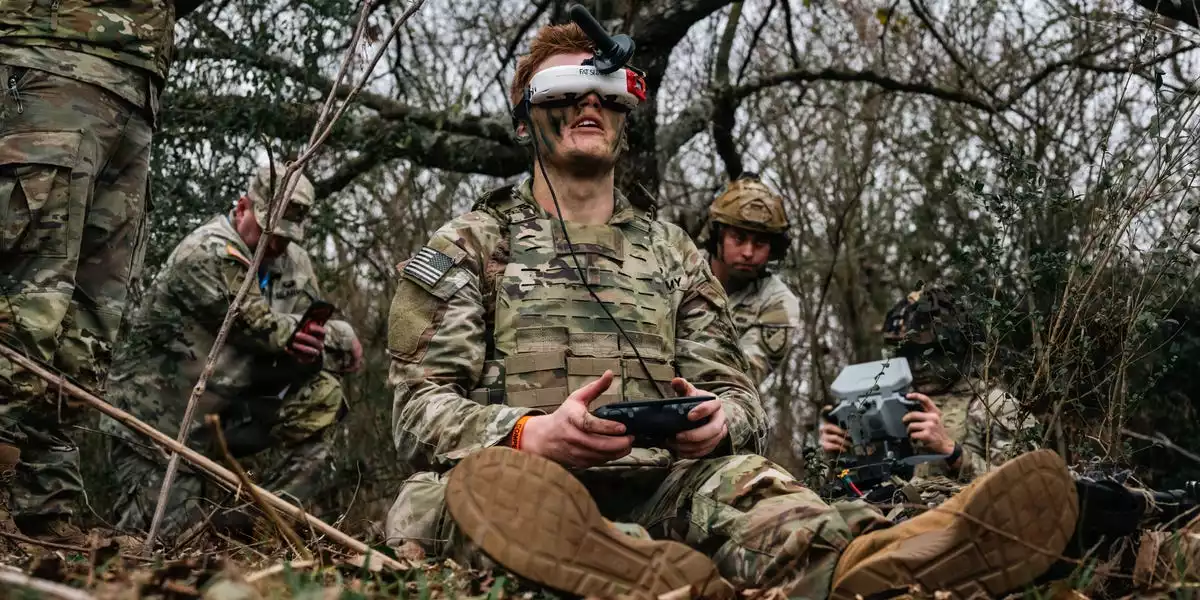

A tournament becomes a doctrine lab for U.S. Army drone warfare
The U.S. Army’s inaugural Best Drone Warfighter competition in Huntsville, Alabama, reads at first like a skills showcase—first-person-view (FPV) obstacle runs, hunter-killer target prioritization, and an innovation challenge featuring bespoke drone modifications. Yet the deeper signal is institutional: the Army is treating small uncrewed aerial systems (UAS) not merely as equipment, but as a distinct warfighting discipline with measurable human performance variables, emerging career pathways, and a rapidly evolving technical stack.
Col. Nicholas Ryan’s emphasis that the event’s value lies “not in trophies” but in isolating what separates elite operators is telling. The competition format functions as a controlled stress test—a way to surface repeatable performance traits under time pressure and ambiguity, closer to combat conditions than classroom qualification. In that sense, the Army is borrowing from aviation culture and special operations selection models: identify aptitude early, quantify it rigorously, and build training around the data rather than tradition.
Key operator attributes highlighted by the event—rapid reflexes, precise hand-eye coordination, and spatial awareness—sound intuitive, but the competition’s structure turns them into observable metrics. That shift matters because it enables the Army to move from “everyone gets baseline UAS familiarization” toward tiered specialization, where the most capable pilots can be developed into high-end tactical assets.
—
Gaming as a talent signal—and a new public-private interface
One of the most consequential takeaways is the reported correlation between video-gaming backgrounds and superior piloting performance. This is not a novelty headline; it is a strategic recruiting and training implication. Consumer gaming has matured into an ecosystem of:
- High-fidelity simulators with low latency and wide field-of-view
- Haptic feedback and controller ergonomics that mimic real piloting demands
- A culture of iterative skill-building, performance measurement, and competitive pressure
For the Army, this creates a practical question: should gaming be treated as a soft indicator of interest, or as an evidence-backed proxy for cognitive-motor readiness? If the correlation holds under broader sampling, it could justify more formal mechanisms such as:
- Aptitude screening that includes simulator-based trials resembling esports tryouts
- Partnerships with gaming hardware vendors for standardized training rigs
- Collaboration with game studios to build mission-relevant scenarios that preserve training realism without exposing sensitive tactics
This is also where the economics become compelling. If commercial simulation ecosystems can accelerate early-stage proficiency, the Army may reduce the cost of “time-to-competence” before operators ever touch scarce live-fly range resources. The result is not a replacement for military training, but a front-loaded pipeline that makes advanced instruction more efficient and less wasteful.
—
Modular drones, open architectures, and the innovation flywheel
The competition’s innovation challenge—where soldiers showcased drone modifications—mirrors a broader defense technology trend: modularity and open-architecture design. In practical terms, the most adaptable small UAS platforms are increasingly defined by:
- Plug-and-play payloads (cameras, thermal sensors, signal relays, mapping modules)
- Rapidly swappable components to support mission-specific configurations
- A software layer that can integrate new capabilities without redesigning the airframe
This matters operationally because small drones are becoming attritable by design: numerous, expendable when necessary, and continuously iterated. The procurement logic shifts from buying a “perfect” platform to sustaining a fast upgrade cadence—a system-of-systems approach aligned with broader Department of Defense modernization efforts.
Economically, modularity can reduce lifecycle costs by avoiding full platform replacement when only sensors or compute modules need refresh. But it also introduces governance challenges: open ecosystems can accelerate innovation while complicating cybersecurity, configuration control, and supply-chain assurance. As the Army leans into modular UAS, it will need disciplined standards for:
- Interoperability (common interfaces and data formats)
- Software assurance (trusted code, update integrity, vulnerability management)
- Component provenance amid microelectronics supply-chain volatility
The competition environment, notably, provides a low-bureaucracy venue to observe which modifications produce real tactical advantage—and which are clever but fragile under stress.
—
From piloting excellence to contested-spectrum combat readiness
Perhaps the most strategically revealing detail is the plan to incorporate kinetic and electronic warfare (EW) elements in future iterations. That roadmap acknowledges a defining feature of modern drone warfare: the decisive contest is often not aerodynamics, but the electromagnetic spectrum—jamming, spoofing, detection, and resilient command-and-control (C2).
The hunter-killer scenarios already exposed communication shortfalls, underscoring that elite piloting is necessary but insufficient. Multi-UAS operations demand disciplined, standardized information flow—especially when seconds determine whether a target is confirmed, misidentified, or lost. The next phase of Army UAS doctrine will likely hinge on improving:
- Real-time C2 and common data links across teams
- Shared mission tools that reduce ambiguity in target handoff
- Techniques for operating under degraded comms and EW pressure
Strategically, this points toward a future where the most valuable operators are not those who can fly one drone exceptionally well, but those who can orchestrate multiple networked systems—and eventually supervise semi-autonomous teaming. That is the force-multiplier promise: fewer personnel achieving greater battlefield effect, provided the Army can build the training pipeline, retention incentives, and doctrinal clarity to sustain it.
The Best Drone Warfighter competition, then, is less a one-off event than a prototype for how the Army may professionalize drone operations: measure talent, industrialize learning, and evolve toward spectrum-resilient, multi-domain integration—the kind of institutional muscle memory that separates experimentation from enduring advantage.

 By
By
 By
By
 By
By
 By
By


 By
By
 By
By







