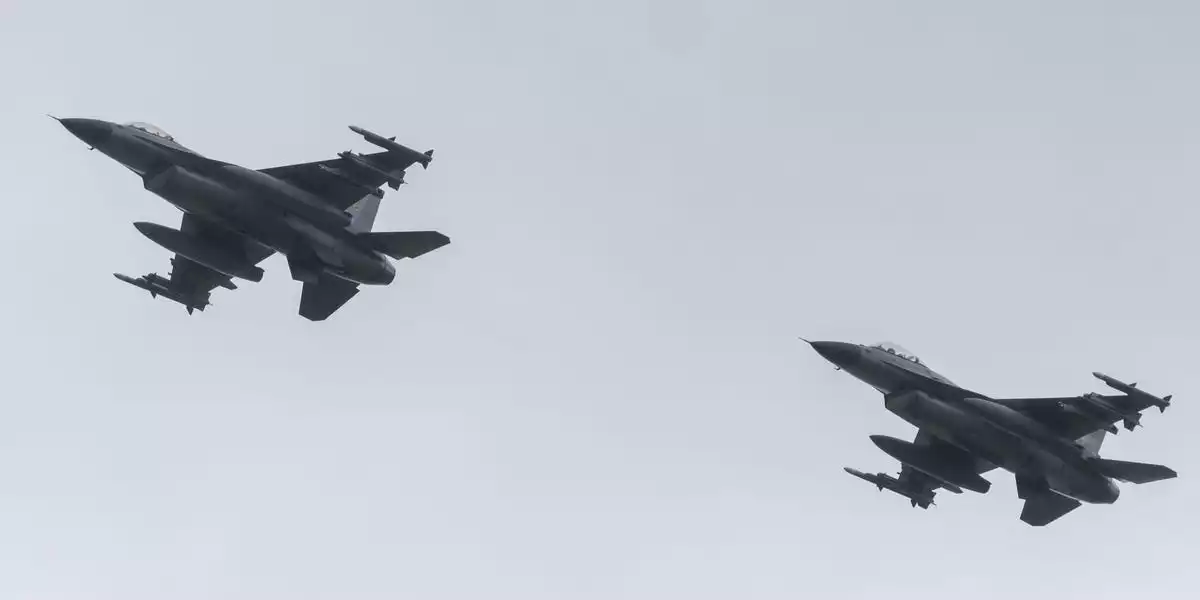

UK flight training as a frontline response to electronic warfare realities
The UK’s decision to train Ukrainian pilots with a pronounced emphasis on GPS-denied navigation is less a nostalgic return to “old-school” airmanship than a pragmatic adaptation to one of the defining features of the war: persistent Russian electronic warfare (EW). In contested airspace, satellite-based Positioning, Navigation, and Timing (PNT) can shift from a trusted utility to a brittle dependency—sometimes within minutes.
More than 50 Ukrainian trainees have completed an RAF course that blends English-language instruction, foundational flight skills, and map-and-terrain navigation. The program is explicitly aligned with Ukraine’s transition to F-16 Fighting Falcon operations—an aircraft now central to air defense and precision-strike tasks as Ukraine modernizes away from legacy Soviet-era Sukhois and MiGs.
What stands out is the training philosophy: rather than treating GPS jamming as an edge case, the curriculum treats it as a baseline condition. That reframing matters. It signals that modern airpower is no longer defined only by platform performance—speed, radar, weapons carriage—but by resilience under degradation, where pilots and systems must continue to function when the electromagnetic spectrum is hostile.
Key operational takeaways emerging from this approach include:
- Navigation as a contested capability, not a background service
- Human factors as a combat multiplier, particularly under EW stress
- Interoperability as a training outcome, not merely a diplomatic goal
The F-16 transition: capability uplift meets sustainment and interoperability demands
Ukraine’s introduction of the F-16 in 2024 is widely discussed in terms of air-to-air and air-to-ground capability, but the deeper story is the scale of transformation required to make a Western fast-jet ecosystem work in wartime conditions. Training in UK airspace—alongside allied standards and procedures—helps compress years of doctrinal learning into months, while also building habits that translate into coalition compatibility.
The RAF’s role is not limited to stick-and-rudder instruction. In practice, Western aircraft integration forces a re-architecture of the entire operational stack: maintenance culture, parts forecasting, documentation discipline, safety management, and mission planning workflows. In that sense, instructors become a hybrid of flight coaches and operational systems integrators, transferring methods that underpin sortie generation and aircraft availability.
From a NATO and European security perspective, the interoperability dividend is tangible. Training aligned with allied norms increases the likelihood that Ukrainian F-16 operations can plug into a broader ecosystem of:
- Early warning and air surveillance processes
- Layered air and missile defense coordination
- Standardized tactics and communications procedures
This is also a form of strategic signaling. UK-led training underscores alliance cohesion and reinforces the UK’s posture as a security provider—particularly salient in a post-Brexit environment where defense leadership remains a central lever of influence.
GPS-denied flight and the new premium on PNT resilience
Russian EW has highlighted a central vulnerability of modern militaries: heavy reliance on satellite navigation in environments where adversaries can jam, spoof, or degrade signals. The RAF’s emphasis on terrain-referenced navigation and manual methods is not an argument against advanced avionics; it is an argument for multi-layered navigation resilience—a blend of human proficiency and hardened systems.
In practical terms, resilient navigation in contested airspace increasingly depends on a stack that can include:
- Inertial Navigation Systems (INS) capable of maintaining accuracy without external signals
- Multi-band, anti-jam antennas and filtering techniques that reduce susceptibility to interference
- Sensor fusion that blends inputs from radar, electro-optical systems, terrain databases, and inertial data
- Procedural competence—dead reckoning, map reading, terrain association—when automation becomes unreliable
The training emphasis also reflects a broader shift in how air forces think about performance. The metric is not “best-case capability,” but capability continuity: how well pilots and aircraft sustain mission effectiveness when key enablers fail. That has implications beyond manned aviation. The same cognitive frameworks—operating under uncertainty, cross-checking instruments, navigating with partial information—are increasingly relevant to unmanned systems operators and network-centric forces that must function in degraded communications environments.
Industrial and economic ripple effects: sustainment markets and dual-use innovation
Sustained F-16 operations generate a long tail of demand that extends far beyond airframes. The economic center of gravity often shifts to sustainment, upgrades, spares, munitions integration, and training systems—areas where U.S. and European defense suppliers, as well as specialized avionics firms, can see durable opportunities. For Ukraine, the strategic objective is not only to fly sorties today, but to build a pathway toward indigenous sustainment capacity that reduces dependency and improves wartime resilience.
The EW-driven focus on PNT hardening also pressures supply chains to evolve. If jamming is endemic, then components such as antennas, inertial modules, and hardened avionics become strategic commodities—encouraging allied investment in diversified sourcing and trusted manufacturing.
Notably, the push for EW-resilient navigation is likely to spill into civilian markets. The same technologies that help a fighter pilot navigate without GPS can inform:
- Commercial aviation safety in interference-prone corridors
- Autonomous vehicles and robotics operating in urban canyons or disrupted environments
- Critical infrastructure timing for telecoms, energy grids, and financial systems
- Potential LEO-based augmentation and alternative timing services that reduce reliance on a single PNT source
Taken together, the UK’s GPS-denied navigation training for Ukrainian pilots reads as a microcosm of modern conflict adaptation: a blend of human skill renewal, platform transition, and industrial recalibration. In a battlespace where the electromagnetic spectrum is as contested as the sky itself, the advantage increasingly belongs to forces that can keep flying—and keep finding their targets—when the map goes digital-dark.

 By
By
 By
By
 By
By
 By
By

 By
By
 By
By