

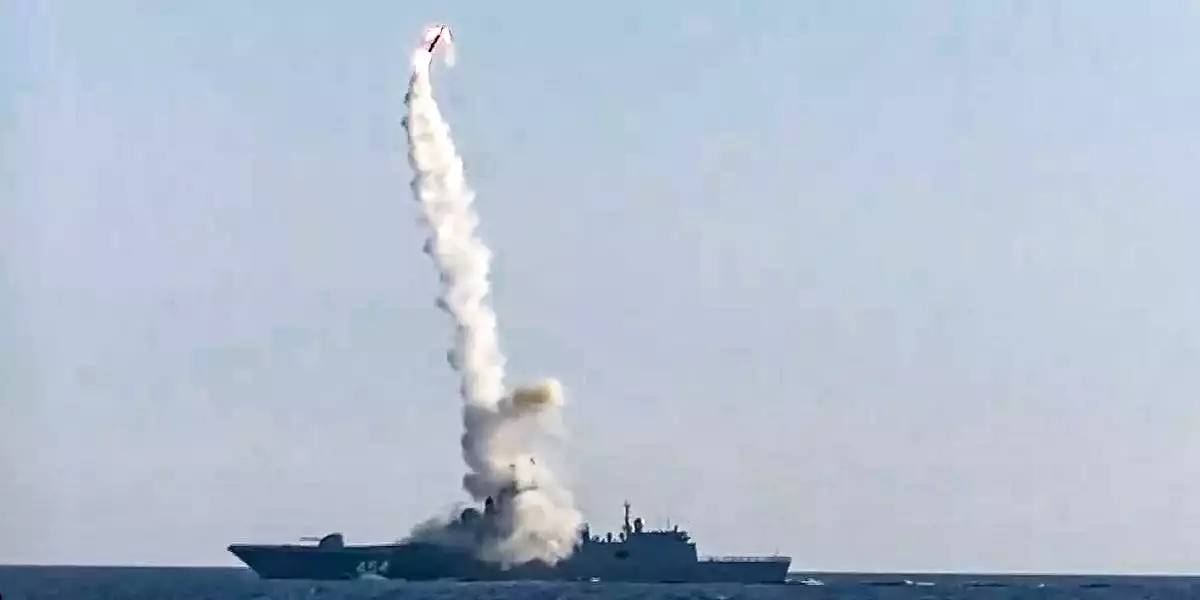

Zircon’s reclassification and what it signals about Russia’s strike doctrine
Ukraine’s military intelligence agency (GUR) has injected a consequential technical dispute into the information war surrounding Russia’s 3M22 Zircon. Where Moscow has marketed Zircon as a hypersonic cruise missile capable of reaching Mach 9, GUR’s assessment reframes it as a two-stage, solid-fuel ballistic missile with an estimated top speed closer to Mach 6.8. That distinction is more than semantics: it reshapes how analysts interpret Russia’s evolving approach to long-range precision strike, and how air-defense planners model the threat.
A cruise missile—especially one designed for sustained atmospheric flight—implies a different set of constraints and advantages: longer maneuvering phases, potentially more flexible routing, and a guidance profile optimized for terminal accuracy. A ballistic missile architecture, by contrast, tends to prioritize compressed timelines and high-energy trajectories, often at the expense of a broader maneuver envelope. GUR’s framing suggests Zircon’s real operational value may lie less in headline hypersonic branding and more in its ability to shrink the sensor-to-shooter window for defenders.
The timing of this reassessment is also telling. Since February 2024, Ukraine reports intensified Russian use of Zircon alongside an upgraded Iskander-1000, with strikes increasingly affecting urban centers. This aligns with a broader doctrinal pivot: after Ukrainian air defenses reportedly achieved interception rates above 90% against many cruise missiles and drones, Russia appears to be leaning into harder-to-intercept ballistic profiles—not necessarily because they are invincible, but because they are cost-imposing and decision-compressing.
Key implications of the reclassification include:
- Threat modeling changes: ballistic trajectories and staging alter detection, tracking, and engagement assumptions.
- Performance trade-offs: a lower claimed speed may correlate with constraints in guidance, thermal loads, or reliability.
- Narrative recalibration: Russia’s hypersonic messaging may be yielding to battlefield realities and measurable outcomes.
The air-defense race: compressed timelines, scarce interceptors, and software-defined warfare
Ukraine’s air-defense performance has been one of the defining technology stories of the war: rapid integration of multi-sensor networks, layered interceptor mixes, and adaptive command-and-control has enabled unusually high success rates against certain classes of threats. Yet the emergence of two-stage solid-fuel projectiles—Zircon and Iskander-1000 in particular—changes the engagement geometry in ways that stress even sophisticated systems.
Ballistic or quasi-ballistic weapons reduce the time available for:
- Radar cueing and track refinement (especially under electronic warfare pressure)
- Fire-control solution generation across multiple batteries
- Interceptor launch authorization in a saturated environment
- Terminal seeker discrimination when debris, decoys, or complex trajectories complicate the picture
This is where the business and policy dimension becomes unavoidable. Ukraine’s leadership is pressing for additional Patriot PAC-3 interceptors, a request that underscores a structural reality: modern air defense is increasingly constrained not by concept, but by inventory depth and production tempo. Even highly capable systems become strategically brittle when interceptor stockpiles are thin and replenishment cycles lag operational demand.
The reported reduction in Russia’s Kinzhal production due to persistent accuracy issues adds another layer. If Moscow is de-emphasizing a marquee “hypersonic” system in favor of Iskander and Zircon, it suggests a pragmatic shift toward weapons that are:
- more scalable to produce,
- more predictable in operational employment, and
- better suited to saturation tactics that force defenders into difficult allocation decisions.
In effect, the contest is moving toward industrialized air defense versus industrialized strike, where software integration and sensor fusion matter—but so do factories, supply chains, and the ability to sustain high operational tempo over months.
Dual-use supply chains under strain: the export-control and compliance dilemma
One of the most economically significant elements of GUR’s report is its mapping of over 70 contributing firms, including suppliers linked to U.S.-origin components. This is a familiar pattern in modern weapons programs: advanced missiles are not built solely from exotic, bespoke parts; they increasingly rely on commercial microelectronics, navigation modules, and control components that originate in globalized, dual-use ecosystems.
For regulators and corporate compliance teams, the Zircon case highlights the persistent gap between policy intent and supply-chain reality:
- Indirect procurement channels can route controlled items through intermediaries and re-export hubs.
- Counterfeit substitution markets can mimic legitimate parts, complicating traceability and forensic attribution.
- End-use verification struggles in fragmented manufacturing networks where components change hands multiple times.
- Cryptocurrency and darknet procurement can reduce the friction of sanctions by enabling smaller, harder-to-trace transactions.
The strategic consequence is uncomfortable: even under sanctions pressure, Russia appears able to sustain and, by some accounts, expand ballistic missile inventories beyond earlier estimates—suggesting that export controls alone, without high-resolution supply-chain intelligence and enforcement capacity, may slow but not stop advanced weapons production.
For technology firms, this is not an abstract geopolitical issue. It raises board-level questions about know-your-customer rigor, distributor oversight, anomaly detection in sales patterns, and the reputational and legal risks of inadvertent diversion—especially for components that are “ordinary” in civilian contexts but decisive in military ones.
What executives and policymakers should watch next in the missile–interceptor economy
The Zircon debate ultimately points to a broader market and security inflection: demand is rising for advanced interceptors (notably PAC-3 class systems), while adversaries increasingly favor ballistic saturation to exploit inventory limits and decision latency. This dynamic can reshape defense procurement priorities across Europe and the Middle East, and it will be closely studied by near-peer competitors assessing what works under combat conditions.
Several forward indicators merit close attention:
- Interceptor production capacity: whether the U.S. and allies can expand output without creating multi-year bottlenecks.
- Integrated air-defense architectures: investments in secure, low-latency data links and mesh-networked sensors that reduce engagement time.
- Next-generation alternatives: whether directed-energy and other non-kinetic defenses can mature fast enough to relieve pressure on kinetic stockpiles.
- Operational learning diffusion: how states such as China and Iran absorb lessons about staging, signatures, maintenance cycles, and trajectory predictability from Russia’s battlefield use.
If GUR’s technical assessment is broadly accurate, Zircon’s real significance may be less about Mach numbers and more about what it reveals: a war increasingly shaped by industrial scalability, dual-use technology leakage, and the economics of depletion—where the decisive edge belongs to the side that can integrate sensors, software, and supply chains into a defense posture that holds under sustained, high-velocity pressure.

 By
By
 By
By

 By
By
 By
By

 By
By
 By
By







