

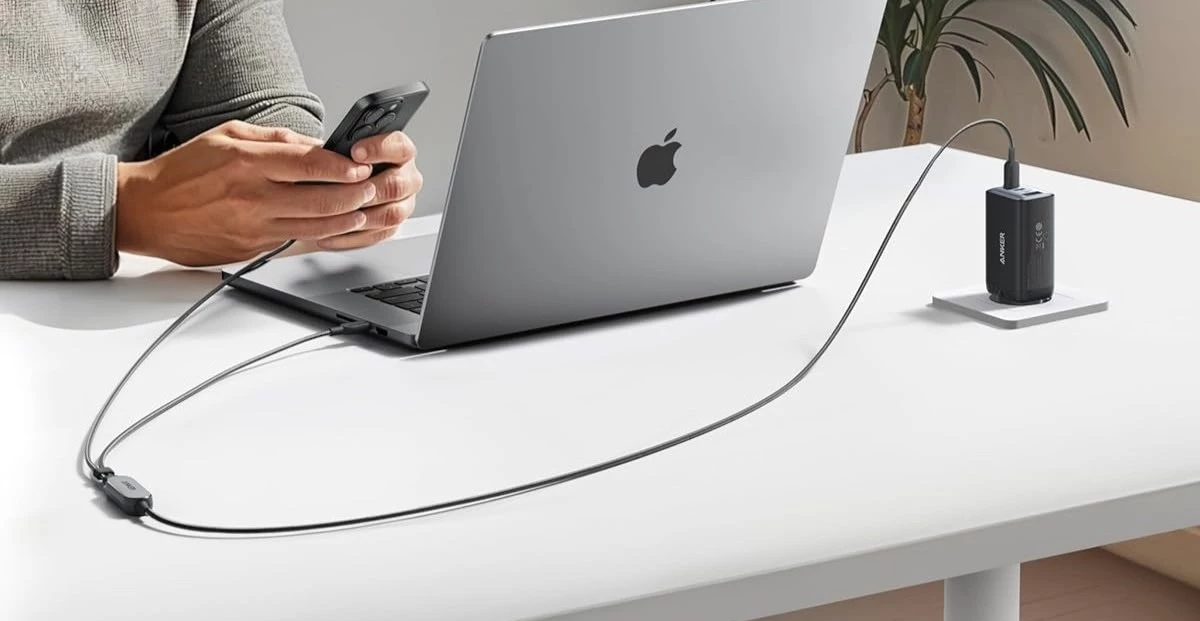

USB‑C’s shift from convenience to infrastructure-grade standard
The latest wave of promotions around 2‑in‑1 USB‑C charging cables is easy to read as routine retail discounting. Yet the underlying story is more structural: USB‑C has moved decisively from “nice-to-have” port uniformity to a foundational layer of modern device infrastructure, spanning laptops, tablets, phones, handheld consoles, and an expanding set of peripherals.
Two market signals stand out. First, regulatory and industry convergence—most visibly the EU’s USB‑C mandate—has accelerated consumer expectations that one connector should handle both high-wattage power delivery (USB Power Delivery / USB‑PD) and everyday data needs. Second, the charging stack itself is becoming more sophisticated. As devices demand higher sustained power (especially ultraportable laptops and performance tablets), the cable is no longer a passive conduit; it is increasingly a critical component in safety, performance, and user experience.
This is where dual-device USB‑C cables—designed to charge two devices at once—fit into the broader maturation of the ecosystem. They reflect a world in which users routinely carry multiple USB‑C devices and expect a single compact setup to manage them reliably, without juggling ports, bricks, and adapters.
What the new 2‑in‑1 cable deals reveal about competition and product strategy
The spotlighted products—Anker’s braided 2‑in‑1 USB‑C cable (priced at $14.99) and Native Union’s Belt Cable using recycled materials (priced at $23.99)—offer a clear view into how the accessory market is evolving.
At a functional level, the proposition is straightforward and highly practical:
- Simultaneous charging of two USB‑C devices from one source
- Intelligent power apportioning up to 140W, prioritizing the higher-demand device
- USB 2.0 data on one port (480 Mbps)—adequate for syncing and basic transfers, but not positioned as a high-speed data cable
That last point matters. These products are optimized for power delivery and convenience, not for creators moving large media files. The market is segmenting: one class of cable is built for charging performance and portability, another for high-speed data and display output (USB 3.x, USB4, Thunderbolt). Consumers increasingly need to understand which job they’re buying for—an emerging friction point that brands can either clarify through labeling or exploit through ambiguity.
Commercially, the pricing tells an even bigger story. A sub-$20, 140W-capable cable underscores how quickly performance features commoditize once supply chains stabilize and certification becomes mainstream. In that environment, brands have two primary levers:
- Price and promotion velocity (volume-driven competition, often tied to events like Prime Day or back-to-school cycles)
- Differentiation through materials, design, and sustainability
Native Union’s positioning—recycled plastics and an animal-free leather strap—illustrates the “eco-luxury” wedge: a way to justify premium pricing in a category where baseline functionality is increasingly interchangeable. Whether consumers pay that premium depends on trust, durability reputation, and the perceived authenticity of sustainability claims.
The charging stack effect: why cables and 140W adapters are being marketed together
The discounts are not occurring in isolation. They coincide with price reductions on compatible high-capacity chargers, notably Anker’s 140W four-port wall adapter (reported at $79.99 for Prime members). This pairing is strategically important: high-wattage charging is only as good as the weakest link in the chain—charger, cable, and device negotiation all have to align.
This is where the accessory market becomes a growth engine. As smartphone and laptop markets mature, brands look to peripherals for:
- Higher-margin attach revenue (cables, chargers, hubs, travel kits)
- Ecosystem stickiness (users standardize on a brand’s charging gear across devices)
- Upgrade cycles driven by wattage and portability rather than device replacement
Retailers also benefit from selling the “whole stack” rather than a single component. A cable alone is a low-ticket item; a cable plus a multi-port GaN charger becomes a higher-value bundle with clearer utility. Expect more data-driven bundling—recommendations based on a shopper’s device portfolio (laptop wattage needs, phone fast-charge compatibility, number of USB‑C devices)—because it increases conversion while reducing returns from mismatched expectations.
Behind the scenes, these promotional cycles place pressure on supply chains. High-wattage accessories depend on reliable sourcing of connectors, e-markers, and power-management components. Brands that can forecast demand spikes and maintain quality control during volume surges will outperform those that treat cables as disposable commodities.
Where “smart cables” and sustainability could take the next phase of USB‑C accessories
The most forward-looking implication is that cables are inching toward becoming semi-intelligent power-management nodes. When a 2‑in‑1 cable can dynamically allocate power between two devices, it hints at a future where cables incorporate more active control—potentially including:
- Thermal and current monitoring to prevent overheating and manage sustained high-wattage loads
- Enhanced negotiation logic to optimize charging profiles by device type
- Firmware-like behavior (even if not user-upgradeable yet), shifting the cable from passive hardware to managed electronics
That trajectory raises new questions for the industry. If regulators eventually push for stronger safety or data-security requirements in charging accessories, manufacturers may need to invest in standardized interoperability, certification rigor, and secure control logic. Meanwhile, sustainability will likely move from marketing differentiator to procurement requirement, especially as ESG expectations harden across enterprise purchasing and public-sector channels.
For consumers, the immediate takeaway is practical: these deals make it cheaper to streamline multi-device charging. For the industry, they signal something more consequential—USB‑C accessories are becoming a competitive battleground where power, trust, and ecosystem design matter as much as the devices themselves, and where the humble cable is steadily evolving into a strategic product category rather than an afterthought.

 By
By

 By
By
 By
By
 By
By

 By
By








