

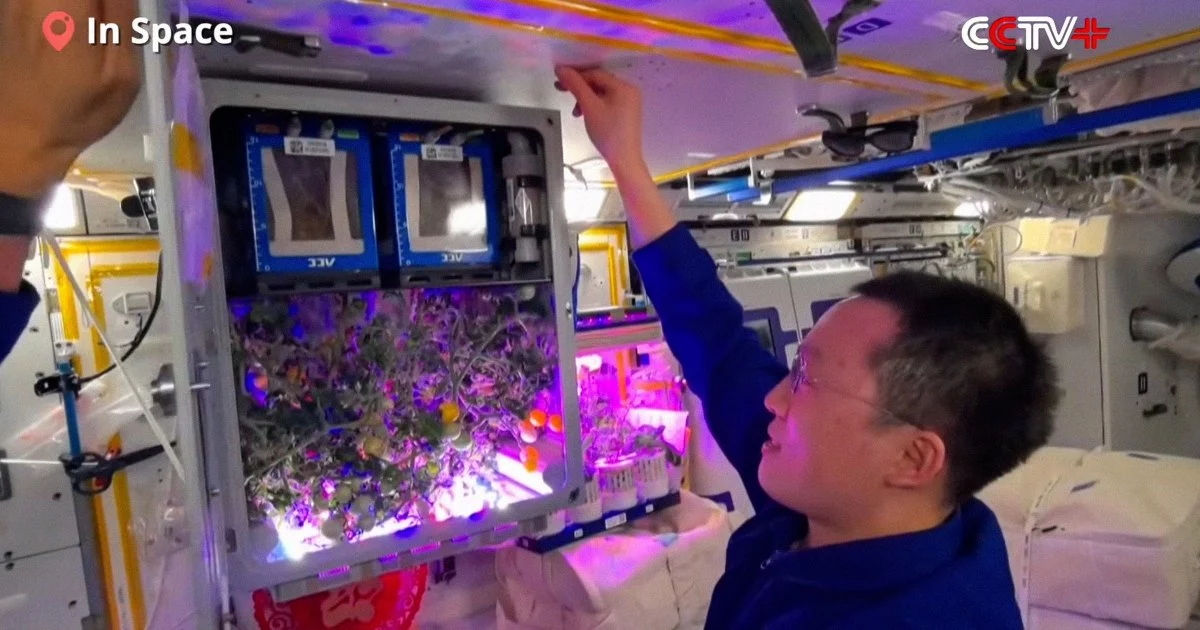

Tiangong’s “space tomatoes” as a signal of maturing orbital capability
China’s Tiangong space station has moved beyond the symbolic milestone of sustaining a continuous human presence in low Earth orbit (LEO) and into a more consequential phase: demonstrating repeatable, systems-level experimentation that ties directly to long-duration mission viability and commercial technology spillovers. Though smaller than the International Space Station (ISS), Tiangong’s three pressurized modules, capacity for up to six taikonauts, and two dedicated laboratory modules have steadily evolved into a platform optimized for iterative research cycles—especially in life sciences and controlled-environment systems.
The recent harvest of cherry tomatoes grown via aeroponics is not merely a photogenic moment. It is a public proof point that China can operate a closed-loop cultivation approach in microgravity with enough stability to support edible yields. The station’s agricultural portfolio—spanning wheat, carrots, and medicinal herbs—suggests a deliberate strategy: build a credible knowledge base for in-situ food production, then translate that capability into broader life-support and bio-manufacturing competencies.
This is unfolding as the ISS approaches a planned retirement window in the late 2020s, and as Tiangong prepares to host a Hubble-class space telescope. The juxtaposition matters: one era of multinational orbital infrastructure is winding down while another, more state-directed model is expanding—potentially reshaping where research, standards, and partnerships concentrate in the next decade.
Aeroponics in microgravity: why the engineering details matter
Tiangong’s aeroponic system—misting plant roots with a nutrient solution rather than relying on soil or substrate—sits within the broader category of Controlled Environment Agriculture (CEA), but microgravity forces the technology to prove itself under harsher constraints than terrestrial vertical farms. In orbit, every kilogram of payload and every liter of water is a cost center, and every biological process must be made predictable.
Key technical implications of the Tiangong approach include:
- Water efficiency and recycling: Aeroponics can recycle a large share of water (often cited around up to 90% versus soil-based methods), aligning directly with closed-loop life-support goals.
- Mass and logistics reduction: Eliminating soil or bulky growth media reduces launch mass and simplifies contamination control, a non-trivial advantage for sustained operations.
- System integration: Tiangong’s modular lab racks can share station resources—power, thermal management, telemetry, and crew procedures—allowing plant-growth experiments to scale without monopolizing crew time or volume.
- Operational autonomy: Running biological systems in orbit requires troubleshooting and procedural judgment, pushing crews toward cross-disciplinary competence—an essential rehearsal for lunar or Mars missions where communication delays limit real-time ground support.
NASA’s decades-long ISS plant-growth programs provide an important benchmark: the science community already recognizes that fresh produce offers both nutritional value (vitamins and phytonutrients that degrade in stored food) and psychological benefits (routine, care-taking, sensory variety). Tiangong’s work does not replace that legacy; it reinforces the direction of travel—toward agriculture as a core subsystem of deep-space habitation rather than a novelty experiment.
Strategic competition and soft-power economics in the post-ISS orbit market
The optics of “space-grown food” are inseparable from geopolitics. Tiangong’s tomato harvest functions as a compact narrative of self-sufficiency, technical competence, and mission readiness—a form of soft power that is easy for global audiences to understand. Yet behind the narrative is a more structural shift: China’s vertically integrated aerospace ecosystem—launch, station operations, life-support hardware, and mission cadence—reduces dependence on foreign suppliers at a time when high-tech supply chains face sustained decoupling pressures.
For international stakeholders, the competitive landscape is becoming more multi-polar:
- Research gravity may shift: As the ISS sunsets, nations and institutions seeking LEO access will weigh options among emerging commercial stations and state-backed platforms like Tiangong.
- Standards influence follows operational leadership: The operator that runs the most consistent, high-tempo station program can shape norms around bio-containment, GMO protocols, intellectual property for space-derived biology, and even adjacent issues such as orbital debris mitigation and safety certification.
- Commercial payload dynamics: If Tiangong offers reliable schedules and infrastructure, it could attract experiments and payload customers—especially those prioritizing continuity over the evolving business models of private-sector stations.
The addition of a Hubble-class telescope further broadens Tiangong’s strategic footprint. It signals that China is not building a single-purpose outpost but a multi-domain orbital campus—life sciences, materials, and astrophysics—capable of sustaining attention, budgets, and international interest.
From orbital life-support to terrestrial AgTech: where the business value could land
The most durable impact of space-based aeroponics may be terrestrial. Technologies hardened for microgravity tend to be resource-frugal, sensor-rich, and reliability-driven—traits that map cleanly onto Earth markets facing water scarcity, urbanization, and climate volatility. If Tiangong-derived systems can demonstrate competitive cost-per-kilogram and operational simplicity, they could challenge or complement existing vertical-farming approaches.
Likely commercialization pathways include:
- Dual-use CEA platforms: Water-efficient aeroponic modules adapted for arid regions, dense cities, or disaster-relief deployments where logistics are constrained.
- Bio-manufacturing adjacency: Plant-based production of high-value compounds—nutraceuticals, specialty proteins, or pharmaceutical precursors—where controlled conditions and traceability matter as much as yield.
- IP and licensing leverage: Patent activity around mist delivery, root-zone control, and microgravity-adapted monitoring could become a competitive moat, especially if paired with export financing or infrastructure diplomacy.
At the human level, the significance is equally pragmatic. Gardening in orbit is not a lifestyle perk; it is a behavioral health tool and a systems rehearsal for autonomy. The station that best integrates food production into daily operations—without excessive crew burden—will be closer to solving the lived reality of deep-space travel.
Tiangong’s tomatoes, then, are less about novelty than about trajectory: a compact demonstration that China is turning LEO into a testbed for closed-loop living, while positioning the resulting know-how for influence—scientific, commercial, and geopolitical—well beyond the station’s hull.


 By
By
 By
By

 By
By
 By
By







