

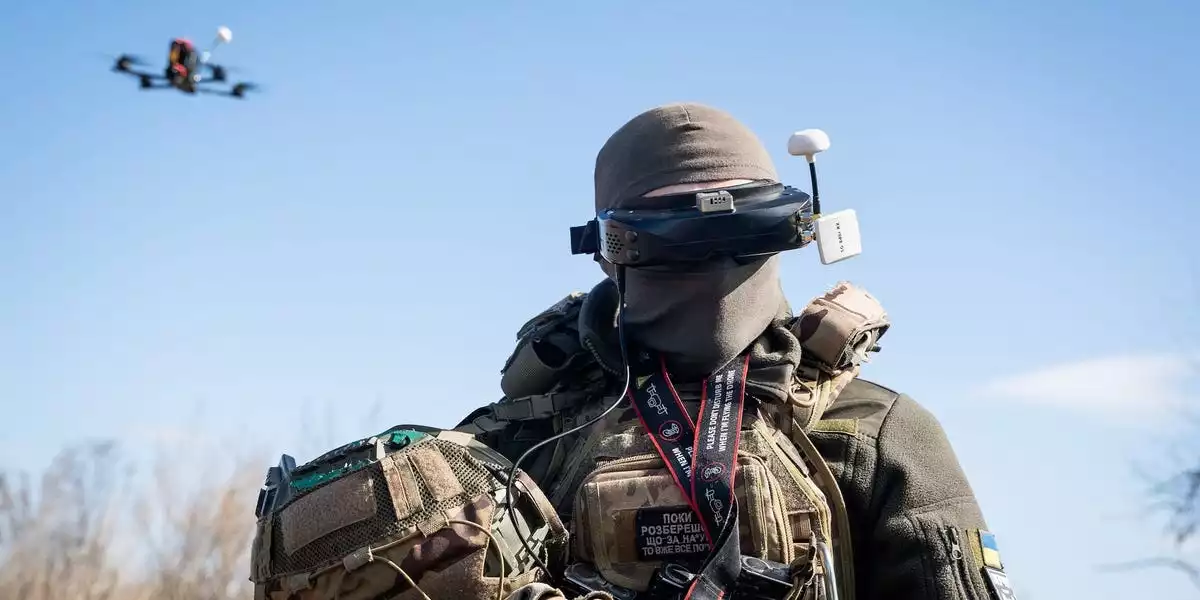

Ukraine’s Battlefield: The Incubator of Algorithmic Warfare
Across the scarred landscapes of Ukraine, a silent revolution is underway—one that is redefining the very grammar of war. Here, the relentless pressures of attrition and innovation have fused to create a live-fire laboratory, where the future of autonomous combat is not theorized in think-tanks, but forged in the crucible of necessity. The emergence of Ark Robotics’ Frontier platform, a software-defined architecture capable of choreographing thousands of drones and unmanned ground vehicles, signals a profound shift: the age of algorithmic scale has arrived, and its implications ripple far beyond the Donbas.
Swarm Autonomy: From Human Command to Algorithmic Choreography
The promise of the Frontier platform is not simply one of mechanical multiplication, but of cognitive acceleration. Where once a single pilot guided a single drone, tomorrow’s battlefield will see a lone operator orchestrate heterogeneous swarms—fixed-wing scouts, quadcopters, and ground robots—through shared perception and adaptive mission planning. Human input recedes to the realm of high-level intent, while the software’s neural core parses, adapts, and executes at speeds that outpace human cognition.
This transition is not merely technical, but existential. Ukraine’s acute manpower deficit, set against Russia’s mass, has forced a pivot away from bespoke, “silver-bullet” platforms toward cheap, expendable, and self-organizing systems. The economic calculus is stark: a $2,000 quadcopter neutralizing a $2 million tank rewrites the rules of cost-imposition and deterrence. Defense ministries, long wedded to exquisite engineering and legacy arsenals, now confront a new reality—one where volume, resilience, and rapid iteration trump tradition.
Software, Silicon, and the New Arsenal
Beneath the surface, the technological foundations of this revolution are as complex as they are transformative. Swarm coordination hinges on edge AI—low-power neural processors embedded within each node, enabling autonomy even when GPS is denied or communications are jammed. Ukraine’s improvisational use of consumer-grade chips, such as Nvidia Jetson modules, is a harbinger of a broader shift toward heterogeneous and resilient computing supply chains.
- Mesh Networking: Short-range, self-healing links enable swarms to operate with minimal electromagnetic signatures, though they demand new waveforms and encryption standards. While LEO satellite back-haul (Starlink, Ku-band) extends operational reach, it remains vulnerable to electronic warfare, prompting parallel investment in optical communications.
- Modular Payloads: The hardware-as-platform model allows rapid swap-outs—from ISR pods to loitering munitions—mirroring the app-store paradigm and placing software at the heart of differentiation.
- Ethical and Legal Layers: As autonomy moves from “human-in-the-loop” to “human-on-the-loop,” the policy debate intensifies. Regulatory friction, often overlooked, threatens to become a hidden cost driver and a potential bottleneck for deployment.
The industrial signal is unmistakable. Procurement priorities are tilting toward software talent, open architectures, and commercial off-the-shelf (COTS) components, eroding the traditional moat of prime contractors. Ukrainian SMBs, often backed by diaspora capital, iterate hardware in weeks—a DevSecOps ethos that is beginning to infiltrate Western defense giants via mergers and joint ventures.
Strategic Reverberations: Deterrence, Doctrine, and the New Workforce
The strategic implications of this shift are as far-reaching as they are disruptive. Swarms lower the entry barrier for mid-tier powers, diffusing precision-strike capabilities and forcing a reappraisal of classic anti-access/area denial (A2/AD) doctrines. Command hierarchies are compressed as machine-to-machine coordination accelerates the OODA loop, raising urgent questions about strategic stability, “off-switch” protocols, and the need for robust AI red-teaming.
- Workforce Transformation: The archetype of the soldier is evolving—from physical endurance to systems integration, from marksmanship to code fluency. New training pipelines and partnerships with technology firms are essential.
- Supply Chain Geopolitics: With Taiwan-centric semiconductor nodes now a critical path for NATO’s deterrence credibility, the push for reshoring and defense autonomy is intensifying. CHIPS-style incentives may soon pivot to explicitly serve national security mandates.
- Cross-Sector Ripples: The convergence of telecom (5G/6G), insurance risk modeling, and battery recycling infrastructures underscores the permeable boundaries between defense and civilian domains. Techniques developed to harden drone swarms against spoofing are already migrating to autonomous logistics and smart-city systems.
The Unfolding Playbook for 21st-Century Deterrence
For defense planners, the imperative is clear: reallocate R&D toward autonomous enabling layers—edge compute, resilient comms, and AI safety—rather than platform hulls. Institutionalize rapid software release cycles, and acquire code in escrow to avoid vendor lock-in. For industry, the opportunity lies in platform-agnostic modules and dual-use certification, while hedging semiconductor exposure through diversification.
Policymakers and investors must move from an export-control mindset to co-development alliances, leveraging Ukraine as a validation sandbox and accelerating ethical oversight to keep pace with innovation. The coming years will likely see a consolidation wave, as prime contractors seek to acquire AI and robotics boutiques at premium valuations.
Platforms like Frontier do not merely represent a technological upgrade; they crystallize a tectonic reordering of industrial supply chains, doctrinal frameworks, and geopolitical risk models. As Ukraine’s battlefields continue to write the spec sheet for 21st-century deterrence, the clock is running—and those who fail to adapt risk being left behind by the relentless march of algorithmic warfare.

 By
By
 By
By


 By
By

 By
By
 By
By







