

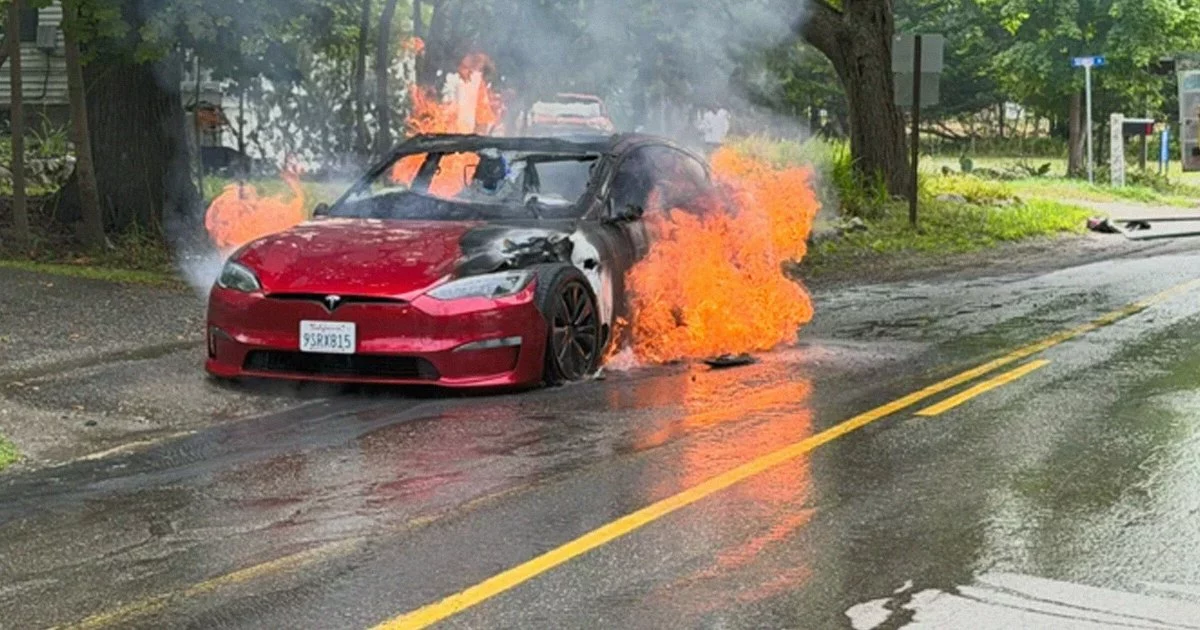

Two Tesla fire incidents sharpen the spotlight on high-voltage battery risk
A pair of recent Tesla-related fire events—one in Tremont, Maine, the other in Seattle, Washington—are reverberating well beyond their local headlines because they illuminate a shared vulnerability in modern electric vehicles: when a lithium-ion battery pack is compromised, the resulting failure mode can be fast-moving, difficult to arrest, and operationally unfamiliar to many drivers and emergency teams.
In Maine, a Tesla Model S reportedly struck roadside debris that punctured the underbody battery pack. The driver made a decisive choice—diverting immediately to a fire station—yet the pack entered thermal runaway and ignited on-site. Firefighters from two departments contained the blaze, the driver was unharmed, and the vehicle was deemed a total loss. In Seattle, a parked Tesla ignited in an attached garage, escalating to a two-alarm response, injuring two firefighters, and displacing a family.
These incidents do not, on their own, establish a statistically meaningful trend—EV fires remain relatively rare compared with the vast number of electric miles driven. But they do underscore a critical reality for the EV transition: low-frequency, high-severity events can shape public perception, insurance pricing, building codes, and OEM product strategy far more than their raw incidence rate would suggest.
What the Maine puncture reveals about battery pack engineering and thermal runaway dynamics
The Maine case is particularly instructive because it points to a classic trigger: mechanical intrusion into the battery enclosure. Many EV packs are designed with robust underbody protection, but road debris, unusual impacts, or secondary collisions can still defeat shielding—especially when the impact vector concentrates force into a small area.
From a technology standpoint, the event highlights three interlocking design challenges:
- Cell chemistry and propagation behavior: Packs using nickel-rich chemistries (often discussed in the context of NMC/NCA families) can deliver high energy density, but mechanical damage can initiate internal shorting and heat generation that cascades cell-to-cell. Chemistries such as lithium iron phosphate (LFP) are often viewed as more thermally tolerant, while solid-state approaches promise structural and safety benefits—but broad deployment remains constrained by cost, manufacturing scale, and validation timelines.
- Pack architecture and intrusion resistance: Underbody “skateboard” packs are integral to EV performance and packaging, yet they place the energy store close to road hazards. Reinforced housings, improved crush structures, and better debris deflection can reduce puncture likelihood, but these measures compete with weight, cost, and range targets.
- Detection and response latency: A key operational question is whether vehicles consistently detect early-stage thermal anomalies and communicate them effectively. The absence of widely understood, standardized driver-facing thermal event alerts—and the lack of automatic, structured data sharing with first responders—can compress decision time precisely when minutes matter.
For OEMs, the strategic takeaway is not merely “stronger shielding,” but a more integrated safety stack: impact sensing + thermal sensing + automated mitigation + external notification.
Firefighting reality: why EV incidents strain current protocols, especially in garages
The Seattle garage fire adds a second layer of complexity: structure exposure. When an EV ignites in an attached garage, the incident becomes a building fire with a high-energy source, smoke and toxic byproducts, and potential re-ignition risk. Firefighters face tactical uncertainty around battery location, access constraints, and cooling requirements—while also managing the priority of preventing spread into living spaces.
Two operational gaps stand out:
- Non-uniform training and tooling: EV firefighting guidance exists, but adoption and resourcing vary widely by jurisdiction. Departments may lack consistent access to thermal imaging, specialized nozzles, containment tools, or clear vehicle-specific response information.
- Limited on-board suppression: Most vehicles still rely on external suppression—often large volumes of water for cooling and exposure protection. The industry conversation is increasingly turning toward integrated micro-suppression concepts (inert gas, aerosolized agents, compartmentalized pack designs) that could slow propagation long enough to prevent total loss or structural escalation.
For municipalities and standards bodies, the Seattle case reinforces why home-charging safety, garage ventilation, and compartmentalization are becoming central to code discussions—particularly as EV adoption rises in dense neighborhoods where attached garages are common.
The business ripple effects: insurance, resale values, and a new EV fire-safety market
Even when injuries are avoided, the economic consequences can be substantial. A single highly publicized EV fire can influence underwriting models, fleet procurement, and residual value assumptions, especially for models perceived—fairly or not—as higher risk.
Several market dynamics are likely to accelerate:
- Insurance and total-loss economics: Battery damage often leads to conservative repair decisions. As claims data accumulates, insurers may respond with premium adjustments, stricter garage-parking guidance, or requirements for certified charging equipment and installation.
- Home infrastructure upgrades: Consumer demand is poised to grow for “fire-safe” charging ecosystems, including:
– Vented or compartmentalized charging enclosures
– Remote shutoff and fault isolation modules
– Enhanced circuit protection and compliance audits
- Regulatory compliance costs: Building and fire codes (including frameworks such as NFPA 855 and the International Fire Code) are evolving. Automakers, charging-station operators, and property developers may face rising costs tied to certification, retrofits, signage, and emergency access requirements.
This is also an opportunity landscape. Startups and established suppliers offering battery telemetry, hazard sensors, thermal imaging drones, and robotic firefighting tools are positioned to become part of the EV safety stack—especially for fleets, municipalities, and large property owners.
The broader EV industry’s credibility will increasingly hinge on whether it treats these events as isolated anomalies—or as signals to industrialize a new baseline: predictive detection, standardized emergency interfaces, and safety-forward design choices that remain robust under real-world abuse.

 By
By
 By
By

 By
By
 By
By

 By
By
 By
By







