

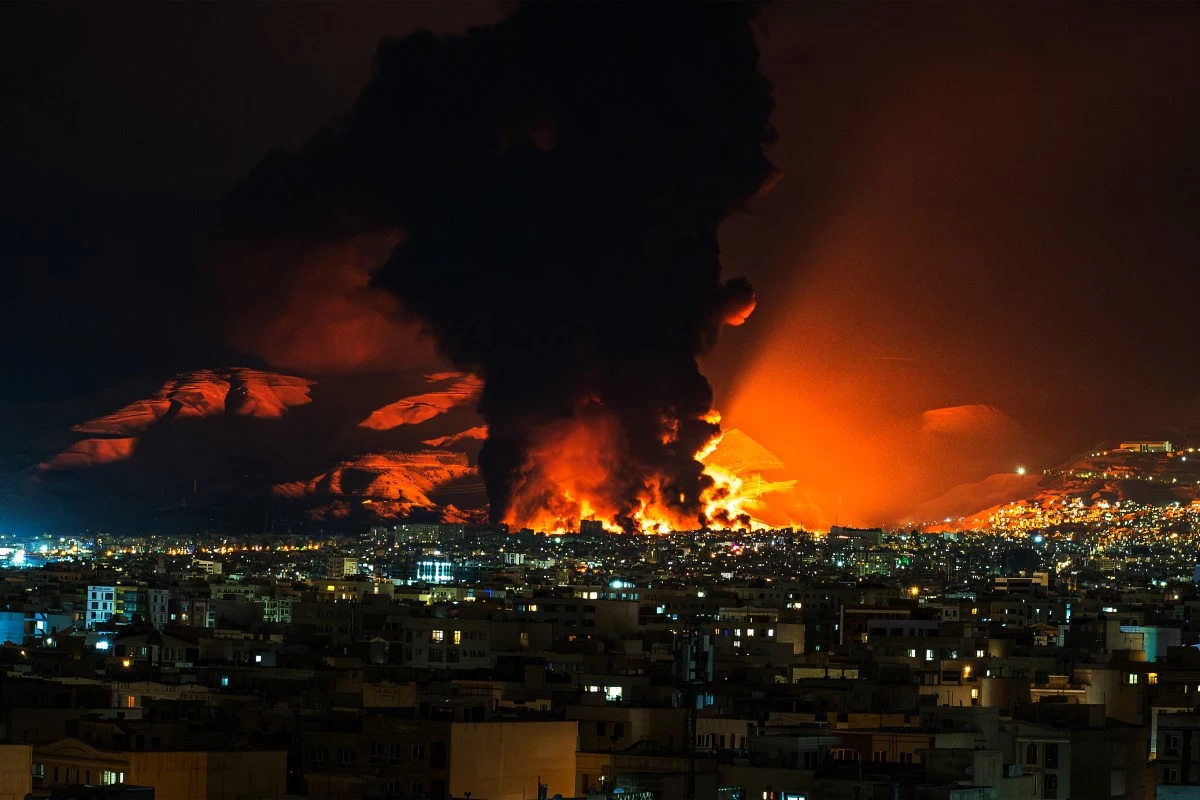

Tehran’s “black rain” as a real-time stress test for urban environmental intelligence
Tehran is confronting a compound environmental emergency with immediate human-health and infrastructure implications. Recent Israeli airstrikes on four oil depots and a gasoline logistics site near the city triggered sustained fires that released a dense mix of pollutants—hydrocarbons, sulfur dioxide (SO₂), nitrogen oxides (NOₓ), and other toxic combustion by-products—into an already stressed atmosphere. Over the weekend, residents reported “black rain” with acidity measured as low as pH 4.0, a level consistent with acid rain capable of irritating lungs, aggravating asthma, damaging vegetation, and accelerating corrosion on buildings and transport assets.
What makes this episode especially consequential is not only the severity of the emissions, but the context: six years of drought and recurring dust storms have already weakened air quality, water security, and public health resilience. In such conditions, conflict-driven pollution does not arrive as a discrete shock—it behaves like a force multiplier, compounding baseline environmental fragility.
For technology and business leaders, the episode exposes a widening gap between the speed of modern crises and the capacity of many cities to measure, attribute, and communicate environmental risk in real time. When pollutants originate from overlapping sources—industrial activity, natural particulates, and conflict-related fires—traditional monitoring approaches can struggle to provide actionable clarity. That gap is increasingly where public trust, operational continuity, and policy legitimacy are won or lost.
Key signals emerging from the Tehran event include:
- Complex pollutant attribution is now a frontline requirement, not a research luxury.
- Hyper-local sensing and rapid analytics matter as much as regional averages.
- Public health messaging must be data-driven and immediate to reduce harm and panic.
The business impact: energy logistics, insurance repricing, and credit risk transmission
Strikes on oil storage and fuel logistics infrastructure reverberate far beyond the burn perimeter. Even limited disruptions in the Middle East can inject volatility into oil supply expectations, widening risk premiums in futures markets and pushing buyers toward more aggressive hedging. The market response is rarely a straight line from “damage” to “price”; it is mediated by uncertainty—how quickly facilities can be restored, whether attacks recur, and how governments respond.
For corporates, the more durable effect may be financial rather than physical: insurance and credit risk repricing. When energy infrastructure is shown to be vulnerable—particularly near dense population centers—underwriters and lenders tend to recalibrate models quickly. The likely outcomes include:
- Higher premiums for energy and petrochemical assets in perceived conflict-adjacent zones
- Narrower coverage terms, exclusions, or stricter compliance requirements
- Tighter borrowing costs linked to geopolitical risk indices and business interruption exposure
This matters for multinationals and regional operators alike. A refinery, depot, or logistics hub is not merely a facility; it is a node in a financing network. If insurers and lenders treat certain geographies as structurally higher risk, capital allocation shifts—sometimes abruptly—toward jurisdictions and assets viewed as more resilient or “conflict-immune.”
Critical infrastructure in the crosshairs: dual-use exposure and the new resilience market
Tehran’s situation underscores a difficult reality of modern infrastructure: many assets are dual-use in effect, even when civilian in purpose. Oil depots and fuel logistics sites are economically essential, yet their strategic value can draw attention during conflict. When such facilities sit near population centers, the externalities are immediate—air quality collapse, contaminated runoff, and heightened emergency-room burden—while the economic costs accumulate through downtime, cleanup, and reputational damage.
This is pushing resilience from a compliance checkbox into a competitive differentiator. Municipal authorities and corporate operators are likely to revisit:
- Zoning and siting decisions for high-risk industrial storage near dense neighborhoods
- Hardening protocols (physical protection, redundancy, segmentation of storage)
- Fire suppression readiness, including rapid-deployment systems tailored to hydrocarbon fires
- Continuity planning that integrates environmental fallout, not just physical damage
A parallel market is emerging for defense-adjacent industrial protection—not necessarily weapons systems, but technologies that reduce blast and fire consequences: protective coatings, blast-mitigation barriers, and advanced suppression tools designed for petrochemical environments. For vendors, the opportunity is real, but so is the scrutiny: solutions will be judged not only on performance, but on governance, export controls, and ethical deployment.
From eco-security to investment strategy: AI monitoring, remediation tech, and energy transition acceleration
The Tehran episode is likely to accelerate a broader reframing already underway in boardrooms and investor committees: environmental harm in conflict zones is becoming an “eco-security” issue—one that blends humanitarian risk, regulatory exposure, and ESG scrutiny. International bodies, civil society, and ESG-focused capital are increasingly attentive to environmental trauma, attribution, and remediation commitments. For companies operating in or sourcing from high-risk regions, the compliance frontier is expanding from emissions reporting to crisis-linked environmental accountability.
Technology responses are poised to scale quickly, particularly where they can shorten the time between event and decision:
- Real-time air-quality sensor networks with resilient power and connectivity
- IoT and edge analytics platforms that function during infrastructure disruption
- AI-enabled models that distinguish dust storm particulates from combustion aerosols and industrial emissions
- Satellite and drone-based monitoring for plume tracking, deposition mapping, and damage assessment
On the remediation side, demand is likely to rise for:
- Advanced water treatment and filtration systems capable of handling hydrocarbon contamination
- Soil bioremediation approaches, including engineered microbes and phytoremediation strategies
- Protective coatings and materials that reduce acid-rain corrosion on critical infrastructure
Strategically, episodes like this can also accelerate the energy transition through risk logic rather than climate logic. Energy buyers and traders seeking to reduce exposure to geopolitical shocks may diversify supply, expand strategic storage in stable jurisdictions, and increase long-term contracting for renewables and LNG. Investors, meanwhile, may favor assets perceived as less vulnerable to conflict-driven disruption—potentially lowering the cost of capital for wind, solar, and green hydrogen projects that sit outside high-risk corridors.
Tehran’s black rain is more than a local environmental disaster; it is a vivid demonstration of how conflict, climate stress, and industrial concentration can converge into a single systemic event—one that markets, insurers, technologists, and policymakers will increasingly be forced to model not as an exception, but as a recurring feature of the global risk landscape.

 By
By
 By
By
 By
By
 By
By











