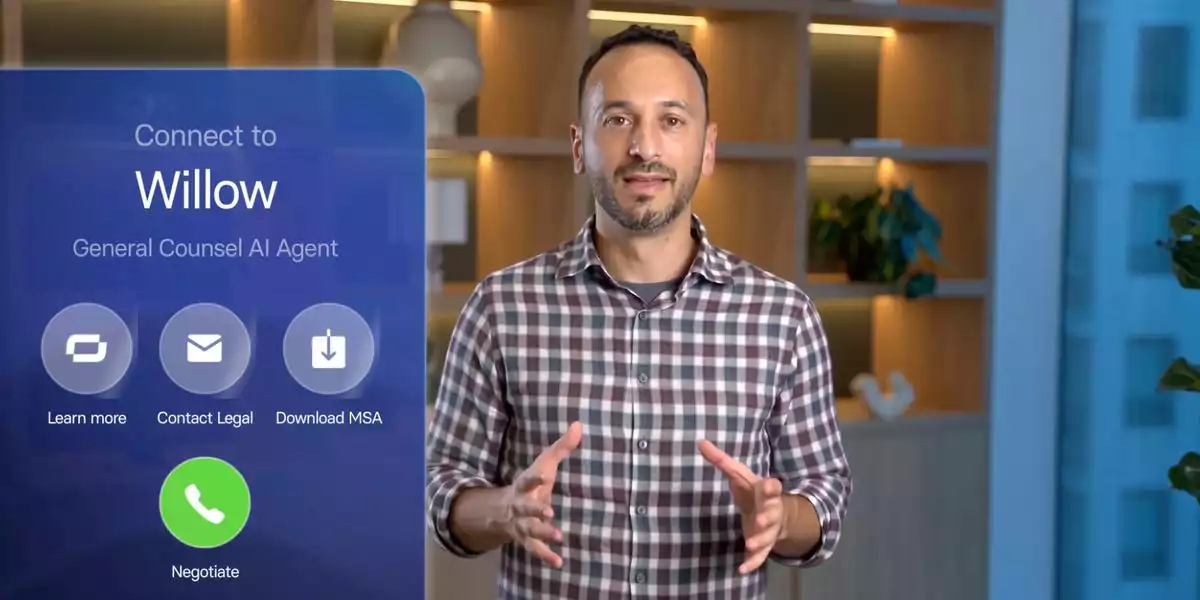

A “legal avatar” as the next interface for contract work
Synthesia’s decision to prototype a low-code, AI-driven legal avatar is less a novelty than a signal: the user interface for corporate legal operations is beginning to shift from static portals and inboxes to interactive, multimodal agents that can triage, explain, and initiate work in real time. Built in roughly two weeks by General Counsel Gabe Stern using Synthesia’s own video-avatar platform and a custom OpenAI ChatGPT model, the prototype is designed to handle the front edge of contract workflows—answering routine questions, scheduling meetings, and kicking off master subscription agreement (MSA) negotiations—before escalating to human counsel.
What makes this development strategically notable is not simply that an AI can draft or summarize clauses; many tools already do. The differentiator is the packaging: a conversational avatar that can meet prospects where they are—during a sales cycle—while presenting as a consistent “face” of the legal function. Early demonstrations, including a secondary guide avatar named Willow, show the system responding to real-time questions on topics such as security posture and liability, drawing from internal policies and public template contracts. Private testing is underway, and Synthesia has indicated interest in adding visual-cue recognition, suggesting a roadmap toward richer multimodal interaction.
For enterprise buyers, the implication is clear: legal enablement may increasingly resemble customer support and sales engineering—always-on, responsive, and designed to reduce friction at the moment of decision.
Low-code “vibe coding” and the rise of citizen-built AI agents in legal
The most consequential element may be the build process itself. Synthesia’s prototype embodies the accelerating trend of low-code/no-code AI agent creation, sometimes described as “vibe coding,” where domain experts assemble functional systems without traditional software development cycles. In practice, this compresses experimentation from months to days by combining:
- Pre-trained large language models (LLMs) for conversational reasoning
- Domain-specific knowledge sources (policies, playbooks, template agreements, security FAQs)
- Workflow hooks for scheduling, routing, and handoff to humans
- Audiovisual synthesis that turns text-based assistance into a face-to-face experience
This matters for legal departments because many of their bottlenecks are not purely legal—they are operational. A large portion of contract work is “swivel-chair” activity: answering repeat questions, finding the right template, confirming standard positions, coordinating calendars, and ensuring the right stakeholders are looped in. These are precisely the tasks conversational AI and light automation can absorb.
In that sense, the legal avatar is best understood as an early form of Legal Process Automation (LPA)—not replacing counsel, but reducing the number of human touchpoints required to move from prospect inquiry to a negotiation-ready state. If the system can reliably handle first-contact resolution for common questions and initiate standardized redlines, it can shorten time-to-negotiation and reduce the latency that often stalls deals.
The broader industry context reinforces why this is happening now. Post-pandemic operating models normalized asynchronous work; tight labor markets and rising specialist costs have increased pressure to do more with flat budgets; and AI tooling has matured to the point where non-engineers can assemble credible prototypes. Legal is joining the same wave already reshaping HR, sales, and customer service.
Commercial upside—and why governance will decide the winners
From an economic standpoint, the near-term ROI case is straightforward: cost containment and cycle-time reduction. Legal teams are under sustained pressure to limit outside counsel spend and avoid headcount growth. An avatar that absorbs repetitive intake and FAQ work can free lawyers for higher-value negotiation and risk decisions.
But the more strategic upside is revenue-adjacent. Contracting delays are a hidden tax on growth; if an AI legal avatar reduces turnaround time at the top of the funnel, it can accelerate sales cycles and improve conversion—benefits that often outweigh pure labor savings.
For Synthesia specifically, the move also functions as go-to-market leverage. As a video-AI vendor valued in the multi-billion-dollar range, turning an internal workflow into a client-facing demonstration showcases not only avatar realism, but the platform’s promise: customers can create bespoke agents quickly, without deep engineering investment. In a competitive avatar-video market, “we built a legal agent in two weeks” is a potent proof point for platform stickiness.
Still, legal automation is uniquely unforgiving when it fails. The risks are not hypothetical:
- Liability and misrepresentation if the avatar provides incorrect contractual positions
- Auditability gaps if responses are not logged, versioned, and reproducible
- Regulatory exposure in sectors like finance, healthcare, and defense
- Data governance concerns around what documents the model can access and how outputs are generated
The winners in this category will likely be determined less by demo quality and more by operational discipline: guardrails, escalation thresholds, template version control, and comprehensive logging that can stand up to procurement scrutiny and, if necessary, e-discovery. Human-in-the-loop design is not a concession—it is the mechanism that makes automation deployable at scale.
Where this points next: multimodal negotiation, cross-functional agents, and new legal KPIs
Synthesia’s mention of future visual-cue recognition hints at a more ambitious trajectory: agents that do not merely answer questions, but interpret context—tone, hesitation, confusion—and adapt. If combined with sentiment analysis and structured negotiation playbooks, avatars could approximate some of the “soft signals” that experienced counsel and sales teams use to steer discussions.
Equally important is the portability of the architecture. A legal avatar built on a unified repository of policies, contracts, and product documentation can become a template for other roles:
- Compliance officer avatars for policy guidance and training reinforcement
- Sales engineer avatars for product/security Q&A
- Customer success avatars for post-sale enablement and renewals
As these systems spread, organizations will need new ways to measure performance beyond classic legal metrics like throughput and cycle time. Emerging KPIs may include avatar engagement rate, first-contact resolution, handoff accuracy, and adoption by deal size or risk tier—metrics that connect legal operations directly to commercial outcomes.
Synthesia’s prototype ultimately underscores a broader shift: enterprise AI is moving from tools that assist individuals to agents that represent functions. In legal, where trust, accountability, and precision are non-negotiable, the path to scale will be defined by governance as much as capability. The companies that pair fast iteration with rigorous controls won’t just automate workflows—they’ll redefine how business gets to “yes” in the first place.

 By
By
 By
By
 By
By


 By
By
 By
By
 By
By