

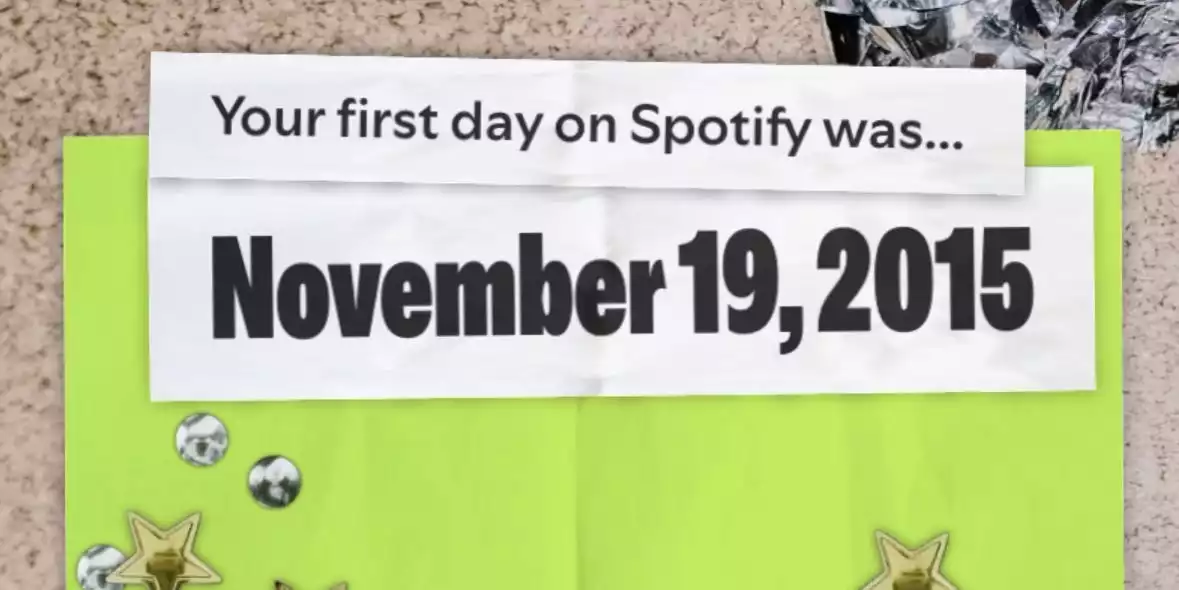

A 20-year milestone reframed as a user story, not a corporate victory lap
Spotify’s “Party of the Year(s)” arrives as a carefully calibrated anniversary campaign that resists the usual temptation of brand self-celebration. Instead, it positions the platform as a personal archive of listening identity, inviting users to retrace their full journey—from the first streamed track and first day on Spotify to a cumulative play count and an “All-Time Top Songs” playlist that can stretch to 120 tracks.
That distinction matters. Spotify Wrapped has become a year-end ritual, but it is inherently bounded by the calendar. “Party of the Year(s)” expands the frame to a lifetime view, turning long-term usage into narrative: not “what you did last year,” but “who you’ve been over time.” The disco-themed creative and shareable social cards are not merely aesthetic choices; they are distribution mechanics designed to make personal nostalgia portable, postable, and socially legible.
From a marketing and partnerships standpoint—echoing Marc Hazan’s emphasis on user-centricity—the campaign signals a strategic thesis: the strongest anniversary message is the one that makes the customer the protagonist. In a mature streaming market, that is less sentimentality than it is disciplined retention strategy.
The data engineering beneath nostalgia: lifetime queries at streaming scale
Behind the celebratory interface sits a demanding technical proposition: surfacing “lifetime” listening history for tens of millions of users requires industrial-grade data warehousing and retrieval. Delivering first-stream moments and all-time rankings implies that Spotify can efficiently query deep historical logs while keeping latency low enough for a consumer-facing experience.
This is a quiet but meaningful proof point of Spotify’s platform maturity. It suggests ongoing investment in the machinery that makes personalization possible at scale, including:
- Data-lake and warehouse optimization to store and access long-range event histories cost-effectively
- ETL and feature pipelines capable of transforming raw streaming logs into user-ready insights
- Query engines and caching strategies that balance responsiveness against compute expense
- Governance and data quality controls to ensure “first song” and “first day” claims are accurate and defensible
Just as important, the campaign is not a static “top list.” It is storytelling through micro-segmentation—the kind of personalization that feels intimate because it is anchored to specific, emotionally resonant facts. That approach tends to create a second-order benefit: every interaction, share, and replay of these “memory objects” can generate fresh behavioral signals that improve recommendation systems and personalization models. In effect, the campaign doubles as a brand moment and a learning loop.
The share cards are also a strategic technology layer. They reduce friction between insight and distribution, turning each user into a broadcaster of Spotify-branded identity. In platform economics terms, that’s network-effect reinforcement: the product experience becomes its own acquisition channel.
Competitive strategy in a plateauing market: retention, differentiation, and first-party leverage
At 20 years, Spotify operates in a market where growth is increasingly contested and incremental. Apple Music and Amazon Music remain formidable, while regional services and short-form platforms continue to fragment attention. In that environment, “Party of the Year(s)” reads as a pragmatic bet on deepening loyalty rather than chasing novelty.
Several strategic implications stand out:
- Churn reduction through emotional switching costs: When a platform becomes a personal timeline, leaving it feels like abandoning a part of one’s history. That is a powerful retention lever, particularly for subscribers weighing discretionary spend.
- Brand differentiation through cultural positioning: Spotify is implicitly arguing it is not just a utility for playback, but a lifestyle and identity platform—a curator of moments, not merely a host of files.
- First-party data credibility for advertisers and partners: By demonstrating the depth of its user insight, Spotify reinforces its value in a world moving away from third-party cookies. The message to brands is clear: Spotify can translate attention into measurable, segmentable, privacy-governed signals.
- A template for co-marketing and commerce adjacency: These personalized “anniversary artifacts” can be extended into label activations, artist collaborations, live-event tie-ins, and potentially merchandise or ticketing pathways—areas where Spotify has long signaled interest.
Notably, the campaign’s framing—celebrating user memories rather than corporate milestones—also helps Spotify navigate a delicate reputational balance. It keeps the spotlight on listeners and creators, which is culturally safer and strategically smarter than centering the company at a time when platforms are routinely scrutinized for power dynamics in the creator economy.
Where Spotify can take this next: experience loops, partnerships, and privacy as product
“Party of the Year(s)” aligns with a broader industry shift: competition is moving from catalog breadth to experience richness. Across media and technology, the winners increasingly build narrative layers on top of content—interactive formats, algorithmic discovery, and shareable identity markers. Spotify’s campaign is a clean expression of that trend, and it opens several forward paths:
- Continuous engagement beyond Wrapped: periodic “flashback” moments, seasonal listening timelines, or region-specific nostalgia campaigns could keep the emotional cadence running year-round.
- Artist and label integrations that feel personal, not promotional: opt-in experiences where an artist message, remix, or exclusive unlocks when a user’s history intersects with a milestone could create premium partnership inventory without degrading trust.
- Richer media formats: short-form video recaps, interactive listening maps, or AR-adjacent creative could deepen immersion—provided they remain additive rather than gimmicky.
- B2B productization of data storytelling: Spotify’s playbook—turning customer history into shareable experiences—could translate into enterprise offerings for loyalty programs, retail, or entertainment partners.
Yet the campaign also underscores a non-negotiable: privacy and trust must scale with personalization. As platforms surface deeper historical insights, expectations rise around transparency, opt-outs, and regulatory compliance (including frameworks such as the EU Digital Services Act). In the next phase of consumer tech, governance is not simply legal hygiene—it is part of the product’s credibility.
Spotify’s anniversary campaign ultimately functions as a strategic mirror: it reflects back to users a story they recognize as their own, while signaling to competitors and partners that Spotify’s real advantage is not just a catalog, but a data-driven ability to turn listening into identity, memory, and community—at scale, and in public.

 By
By
 By
By
 By
By

 By
By


 By
By







