
A humanoid robot meets commercial aviation’s rulebook in real time
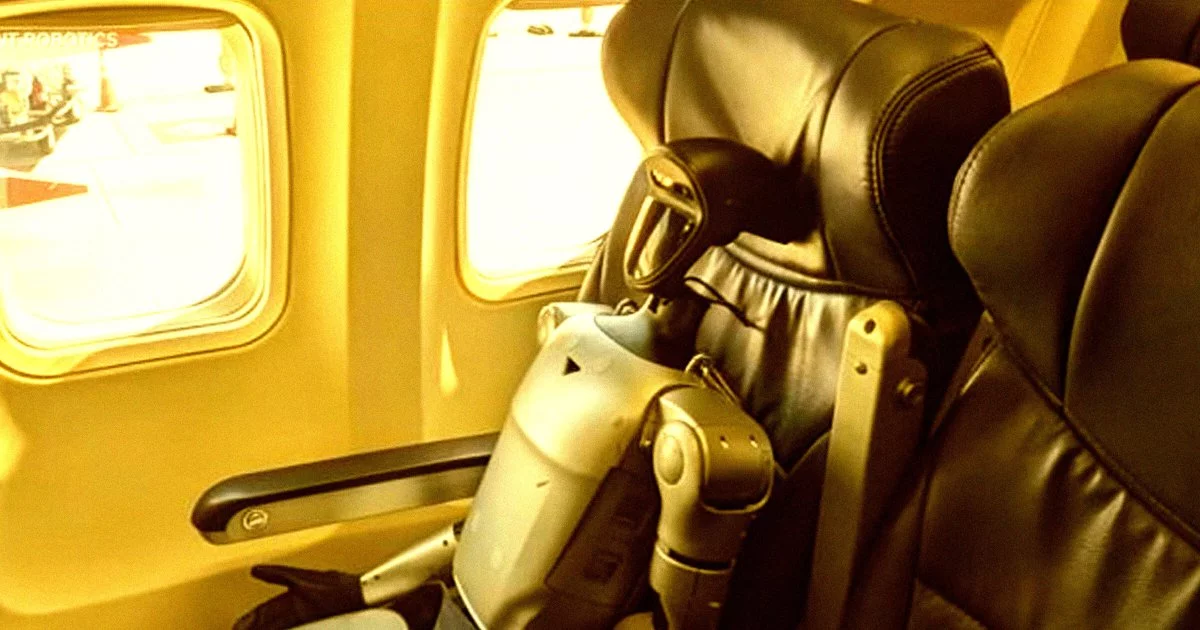
The scene at Oakland International Airport reads like a near-future vignette: a 77-pound humanoid robot, “Bebop,” built on a Unitree G1-style platform, arrives not as cargo but as a would-be passenger. The Elite Event Robotics team, seeking to transport the machine from Oakland to San Diego, reportedly did what many travelers would consider the most straightforward workaround—buy an extra seat. Yet the attempt collided with a reality that the robotics industry is increasingly confronting: commercial aviation is optimized for humans and standardized luggage, not autonomous or semi-autonomous machines with high-density power systems.
Southwest Airlines’ response—detailed questioning by flight attendants about the robot’s behavior, battery type, and operational status, followed by an hour-long runway delay and the confiscation of Bebop’s lithium power pack due to size-limit concerns—underscores a critical point. Even when a robot is treated as a “passenger” in a commercial sense, it is still governed by safety, hazardous materials, and operational predictability requirements that were not designed with humanoid platforms in mind.
If this is indeed the first recorded flight delay attributed to a humanoid robot, it is less a novelty than a signal: robot mobility is now intersecting with regulated public infrastructure, and the seams are showing.
Why lithium batteries and “behavior” became the decisive questions
Two themes dominated the crew’s inquiry—energy storage and operational uncertainty—and both are foundational to aviation safety culture.
Most field-capable humanoid robots rely on lithium-ion packs for energy density and runtime. Aviation, however, treats lithium batteries through the lens of Dangerous Goods risk management, shaped by frameworks such as IATA Dangerous Goods Regulations (DGR) and ICAO Technical Instructions. The practical outcome is that frontline airline staff must make fast decisions based on:
- Battery size and watt-hour thresholds (and whether the pack is removable)
- Packaging and protection against short-circuit
- Whether the device can be fully powered down and secured
- The ambiguity of “spares” versus “installed” batteries in a complex device
In Bebop’s case, the reported confiscation of the power pack due to size-limit violations illustrates a design mismatch: robot batteries are engineered for performance first, while airline rules prioritize containment, predictability, and standardized documentation.
A humanoid robot’s value proposition—mobility, articulation, human-like interaction—can read as a liability in an aircraft cabin where unexpected motion is unacceptable. The crew’s questions about behavior and operational status reflect a broader issue: there is no widely adopted, cross-manufacturer standard for communicating a robot’s safety state in a way that is instantly legible to non-expert personnel.
What airlines implicitly need from advanced robotics in transit is closer to an “appliance mode” than a “demo mode,” including:
- A clearly verifiable powered-down state
- A physical emergency-stop mechanism that is obvious and accessible
- Tamper-evident battery enclosures and transport locks for joints/actuators
- Standardized labeling that translates robotics terminology into aviation-relevant assurances
Until those conventions become common, each robot becomes a one-off judgment call—exactly the kind of variability aviation operations are built to minimize.
The hidden economics: when a robot’s seat purchase becomes an ROI problem
From a business and technology perspective, the most instructive element may be the cost structure implied by the incident. Buying a seat for a 77-pound robot is not merely a quirky expense; it highlights how legacy transportation models impose friction costs on emerging robotics deployments.
For robotics companies, integrators, and event-technology teams, the episode surfaces several economic realities:
- Compliance friction becomes operating expense (OPEX): time lost to inspections, documentation gaps, and ad hoc decisions can quickly outweigh the convenience of air travel.
- Uncertainty becomes financial risk: confiscation of a critical component—here, the lithium power pack—can derail a deployment, trigger replacement costs, and jeopardize service-level commitments.
- Reputational exposure cuts both ways: a high-visibility delay can be perceived as operational immaturity, even if the underlying issue is regulatory ambiguity rather than negligence.
At the same time, the incident hints at a near-term market opportunity: turnkey “robot travel readiness” services—documentation, packaging, insurance riders, and pre-clearance workflows—could become a differentiator for integrators and OEM partners as humanoid robots move from labs and showrooms into field operations.
What this episode foreshadows for airlines, regulators, and robotics OEMs
Bebop’s runway delay is best understood as an early stress test of a system that has not yet been updated for machine passengers. With service-robot deployments expected to expand rapidly over the coming years, the pressure will build for clearer, repeatable processes that reduce frontline improvisation.
Several developments now look increasingly likely:
- “Robot passport” data schemas: standardized, machine-readable credentials covering dimensions, weight, battery specifications, firmware versions, and fail-safe modes—designed to translate into airline screening workflows.
- Design shifts toward “airport-ready” robotics: modular, swappable batteries engineered to fit aviation thresholds; visible status indicators; transport locks; and documentation that maps directly to Dangerous Goods requirements.
- Cross-sector standard-setting: aviation bodies, regulators, and standards organizations (ANSI/ISO/ASTM) may be pushed to define guidance for autonomous devices in transit, much as other micromobility and drone categories have gradually been formalized.
- New liability and insurance products: as robots appear more often in public conveyances, insurers will seek clearer risk profiles—creating incentives for OEMs to build compliance and auditability into the product roadmap.
For Southwest and other carriers, the operational lesson is equally pragmatic: absent a dedicated framework, the burden of interpretation falls on crew and ground staff, increasing the probability of delays and inconsistent outcomes. For robotics firms, the strategic takeaway is sharper: mobility is not only a mechanical capability—it is a regulatory capability.
Bebop’s interrupted trip from Oakland to San Diego may be remembered as a first-of-its-kind delay, but its lasting significance is more structural: it reveals how quickly humanoid robotics is moving from spectacle to logistics—and how urgently the surrounding systems must adapt to keep pace.

 By
By
 By
By

 By
By
 By
By
 By
By
 By
By