
A sub-$25,000 electric pickup tests the market’s definition of “enough car”
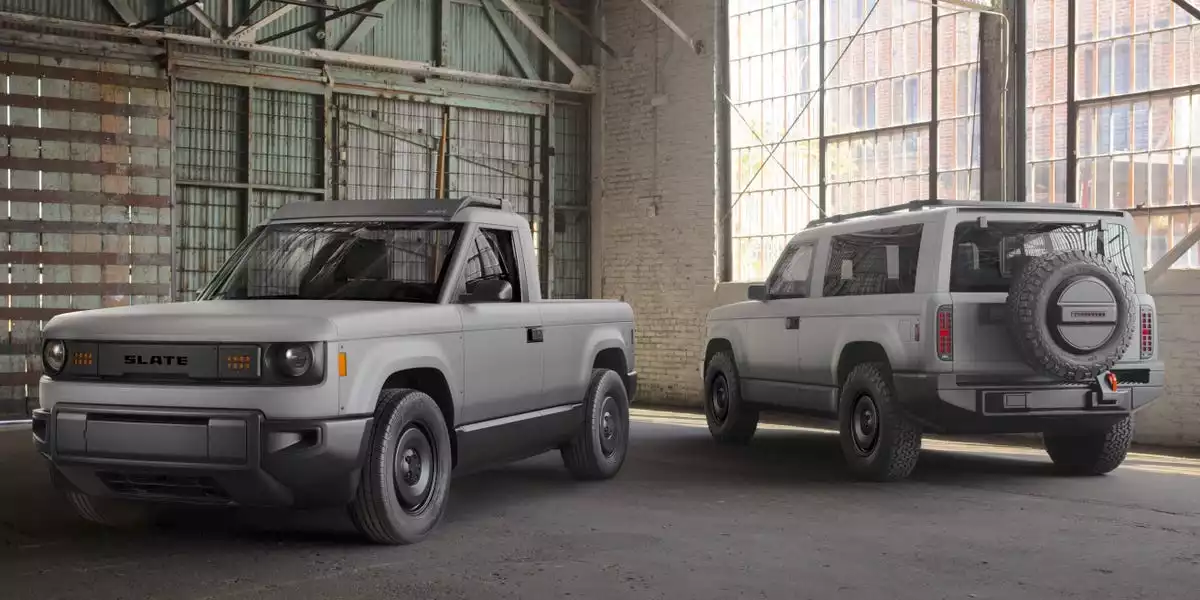
Slate Auto’s unveiling of a 14.5-foot electric micro-truck priced at $24,950 lands like a deliberate provocation in a U.S. auto market where affordability has become the exception rather than the norm. With fewer than 5% of new vehicles recently selling below the $25,000 threshold, Slate’s entry is less a conventional product launch than a thesis: that a meaningful slice of buyers may prefer utility and price discipline over the feature-saturated, software-heavy direction of modern vehicles.
The timing is equally telling. EV demand has cooled from its earlier surge, and consumers are navigating higher interest rates, elevated insurance costs, and persistent inflation in vehicle production inputs. Against that backdrop, Slate’s stated 205-mile range and stripped-down cabin—no touchscreen, no built-in audio, manual controls in place of powered conveniences—signals a strategic bet on right-sized electrification rather than maximalist specifications.
This is not an attempt to outmuscle full-size electric pickups like the Ford F-150 Lightning or Rivian R1T. Instead, Slate appears to be carving out a distinct category: a micro-truck for urban and suburban tasks, where parking footprint, purchase price, and operating cost can matter more than towing bravado or long-haul range.
Minimalist engineering as a reliability and cybersecurity strategy
Slate’s most consequential design choice may be what it omits. By stepping away from integrated infotainment stacks and power-operated hardware, the company is implicitly challenging an industry assumption that digital abundance is synonymous with progress. The technological implications are practical:
- Lower electrical and software complexity: Fewer integrated systems can reduce failure points and simplify diagnostics, potentially improving mean time between failures (MTBF)—a metric that matters to both cost-conscious consumers and fleet operators.
- Reduced cybersecurity exposure: Modern infotainment and connected features expand the attack surface. A minimalist baseline can narrow that surface, particularly if optional connectivity is modular and tightly scoped.
- Faster iteration cycles: A simplified platform can accelerate validation and manufacturing readiness, while pushing feature experimentation into optional modules rather than the core vehicle.
The 205-mile range also reflects a disciplined battery strategy. Rather than competing on maximum range—a costly arms race—Slate’s positioning suggests optimization for cost per kilowatt-hour and manageable pack sizing. That trade-off aligns with real-world usage patterns for many households and small businesses, where daily driving and light hauling rarely demand 300+ miles between charges.
This approach could also influence supplier dynamics. A vehicle that is intentionally less dependent on high-end infotainment silicon may be less exposed to semiconductor volatility, while relying on more standardized components that can be sourced from a broader supplier base. In an industry still sensitive to supply-chain shocks, that simplification is not merely aesthetic—it is operational risk management.
The real business model: a modular ecosystem and accessory-led margins
Slate’s differentiation does not end with a low sticker price; it arguably begins there. The company is leaning into extensive personalization—200+ accessories and tech upgrades—turning the base truck into a configurable platform. Economically, this resembles playbooks perfected in consumer electronics:
- Entry price as a wedge: A low base price expands the addressable market and reduces purchase friction.
- Accessories and upgrades as margin engines: Higher-margin add-ons can lift lifetime customer value, offsetting thin margins on the core vehicle.
- Feature unbundling as strategy: Instead of bundling every buyer into the same cost structure, Slate can let customers pay only for what they want—storage solutions, tech pods, audio, convenience features, or software-enabled enhancements.
If executed well, modularity can create a durable ecosystem with network effects: third-party accessory makers, installers, and community-driven customization trends that keep the platform culturally relevant. It also creates a pathway for over-the-air (OTA) software upgrades—not necessarily as a default, but as an optional layer—allowing Slate to monetize features over time without forcing every buyer into a subscription-first relationship.
There is, however, a balancing act. Modularity must remain coherent: too many configurations can complicate support, warranty policies, and service workflows. The winners in platform businesses tend to be those that enforce clear interface standards, ensuring add-ons feel native rather than improvised.
Bezos-backed optionality: fleets, last-mile logistics, and a new micro-truck category
Jeff Bezos’s backing adds a strategic subtext that goes beyond consumer retail. A low-cost, customizable EV platform is naturally compatible with fleet economics, especially in last-mile delivery and service operations where:
- routes are predictable,
- daily mileage is constrained,
- downtime is expensive,
- and customization (racks, bins, lockboxes, signage) is a direct productivity lever.
That raises the prospect of business-to-business demand—from logistics providers, municipalities, campuses, and small trades—where a minimalist base vehicle can be tailored into specialized work units. Even without explicit partnerships, the adjacency to Amazon’s logistics orbit invites market speculation about pilots, procurement synergies, or a broader push toward specialized urban delivery vehicles.
At the industry level, Slate’s move pressures incumbents on a sensitive front: affordability. If a credible sub-$25,000 EV arrives at scale, established OEMs may be forced to respond with:
- simplified trims that unbundle features,
- new low-cost EV platforms optimized for urban use,
- or partnerships that formalize aftermarket ecosystems rather than treating them as peripheral.
Policy dynamics could amplify the impact. Incentive frameworks that effectively reward lower-cost EVs—especially those that meet domestic sourcing and eligibility requirements—could make minimalist vehicles disproportionately attractive to price-sensitive buyers. Meanwhile, a wave of affordable new EVs would inevitably ripple into the used market, reshaping residual values and financing assumptions for entry-level internal combustion and older EV models alike.
Slate Auto’s micro-truck is ultimately a referendum on a question the industry has sidestepped for years: whether the next phase of electrification is driven by ever-more features, or by pragmatic utility at a price people can actually pay. If Slate can deliver on manufacturing execution and sustain quality while scaling a modular ecosystem, it may not just sell a small truck—it may help redraw the value map of the American EV market.

 By
By

 By
By
 By
By
 By
By
 By
By
 By
By
 By
By