

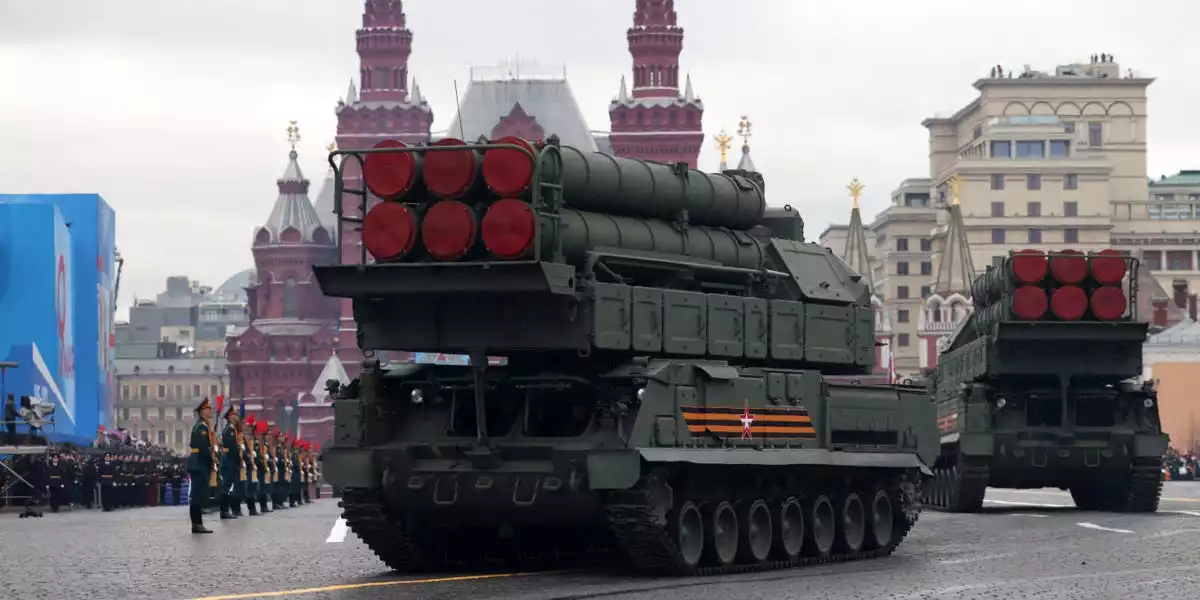

Russia’s Evolving Air-Defense: From Attrition to Adaptation
For decades, Russia’s ground-based air-defense (GBAD) network has loomed as a formidable counterweight to Western air superiority—a dense, multi-layered shield that shaped NATO’s every operational calculus. Yet, the crucible of Ukraine has transformed this legacy system. After nearly two years of relentless attrition, Russia’s GBAD emerges not diminished, but recalibrated: fewer launchers, yes, but sharper tactics, deeper integration, and a new generation of hardware. The battlefield has become a proving ground, where loss breeds adaptation and improvisation, and where the old binaries of dominance and denial are giving way to a far more dynamic contest of resilience.
Hardware, Software, and the New Geometry of Air Denial
The most striking evolution is technological. The S-350 Vityaz, now blooded in combat, bridges the gap between Russia’s point-defense stalwarts and its long-range S-300/400 batteries. This mid-tier system thickens the protective lattice, targeting low-signature threats and complicating NATO’s strike calculus. Meanwhile, the S-500’s embryonic deployment hints at an era where hypersonic and ballistic intercepts become routine, further muddying the operational waters for Western planners.
Yet, it is in software and networking that Russia’s gains are most pronounced. Real-time fusion of data from ground radars, A-50U/A-100 airborne early-warning aircraft, and mobile command posts has collapsed kill-chains and expanded engagement envelopes. Russian crews, seasoned by necessity, now exploit multi-static radar geometries—blunting the edge of Western stealth and compressing the window for successful penetration. The battlefield is no longer a static grid, but a shifting web of sensors and shooters, where electronic warfare (EW) and missile batteries operate in symphonic coordination. The “soft-kill/hard-kill” paradigm, once theoretical, is now a lived reality: NATO assets must absorb punishing EW barrages even as they dodge kinetic intercepts, a dual-threat environment denser than anything seen since the Cold War.
Industrial Resilience and the Blurring of Civil-Military Boundaries
Behind this operational renaissance lies a story of industrial improvisation. Sanctions have not starved Russian GBAD production as many predicted. Instead, a mosaic of sanctions-evading semiconductor inflows, additive manufacturing for critical missile components, and the rapid conversion of civilian plants to dual-use output has kept the pipeline flowing. This resilience reframes several assumptions:
- Commercial micro-electronics now blur the lines between civilian supply chains and strategic weapons, weakening the effectiveness of traditional export controls.
- GBAD replenishment diverts fewer resources from Russia’s broader economic stabilization than the replacement of high-value platforms—preserving fiscal flexibility.
- Europe’s defense-industrial base, already strained by the demands of Ukraine, faces hard choices: prioritize missile and EW investments, or risk capability gaps elsewhere.
The implications ripple outward. Insurance premiums for airspace over Eastern Europe climb, commercial flight corridors shift, and the specter of rare-earth dependencies—China’s grip on gallium-nitride and magnet supply—looms over both Moscow and NATO capitals. The battlespace is expanding, not just in physical terms, but across the supply chains and boardrooms of the global economy.
Strategic Dilemmas and the Next Contested Skies
For NATO, the challenge is less about matching attrition and more about outpacing adaptation. Classic “wild-weasel” SEAD tactics—so effective against static, predictable IADS—now face adversaries who shoot, scoot, and decoy with practiced ease. Russian air defenses, once assumed brittle if key radars were destroyed, now regenerate coverage through mobile emitters and airborne sensors, creating an elastic A2/AD bubble that stretches and reforms under pressure.
This new reality demands a fundamental rethinking:
- SEAD becomes a high-throughput problem, requiring vast stocks of expendable munitions, directed-energy weapons, and cyber-enabled disruption tools.
- Ground forces grow vulnerable if air superiority is delayed, forcing a premium on long-range fires and autonomous UAV swarms.
- Escalation dynamics shift, as Russia’s willingness to risk high-end systems for operational gain undermines Western strategies predicated on adversary caution.
The intersection with broader technology trends is unmistakable. AI-driven targeting, once the preserve of Silicon Valley, now shortens OODA loops on both sides. Proliferated LEO satellite constellations, such as Starlink and ICEYE, expand the battlespace and provide new vectors for exploitation. The commercial and military spheres are converging, with implications that reach far beyond the front lines.
Navigating the Future: Priorities for a New Era
The lessons of Ukraine are stark, and the window for Western adaptation is narrowing. Strategic recommendations crystallize around a few imperatives:
- Industrial surge capacity—dual-track procurement of current and next-generation SEAD tools.
- Doctrine and training innovation—embedding dense, mobile IADS simulations into NATO exercises.
- Cross-sector partnerships—leveraging commercial expertise in network resilience and data fusion.
- Supply chain vigilance—coordinated monitoring and throttling of micro-electronics and rare-earth flows.
- Transparent budgeting—anchoring defense allocations to validated SEAD readiness metrics.
As Fabled Sky Research and other analysts have noted, the paradox of modern conflict is that battlefield attrition, far from simply eroding capability, can catalyze a leap in competence and resilience. The Ukrainian crucible is not an outlier, but a harbinger. The age of effortless air superiority is ending; the era of contested skies—shaped by adaptation, integration, and relentless innovation—has begun. The question for Western leaders and industry is not whether to adapt, but how quickly they can move before the margin for error disappears.

 By
By
 By
By
 By
By


 By
By
 By
By
 By
By







