

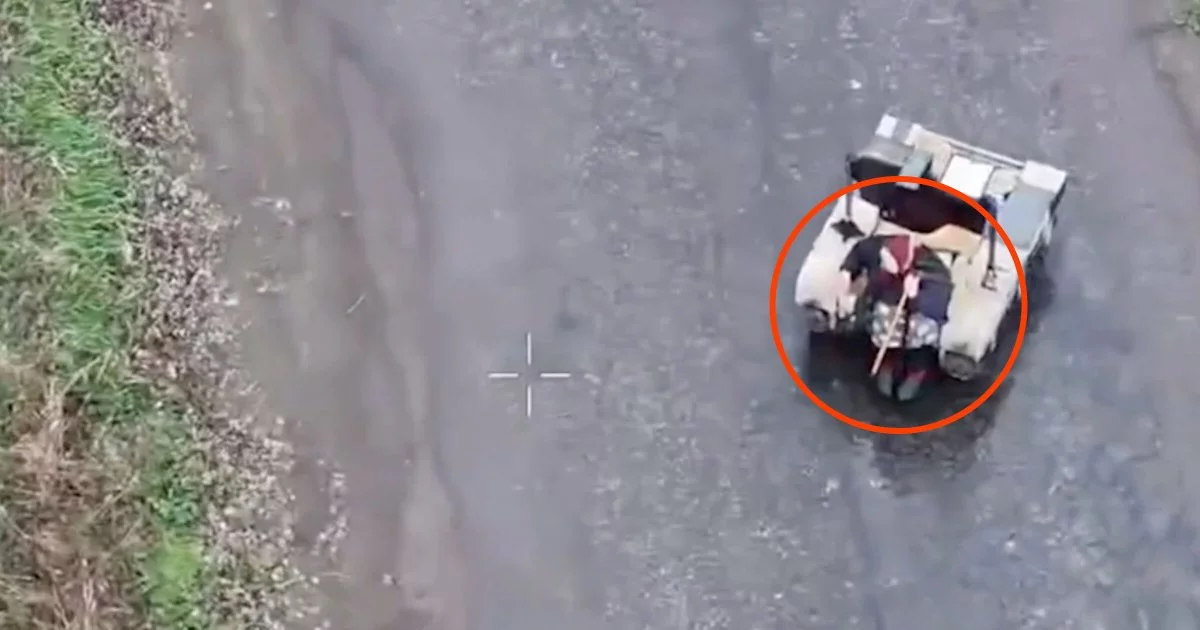

A battlefield evacuation that reframes what “unmanned” can mean
The reported evacuation of 77-year-old Antonina Horuzha from Lyman by a remote-guided unmanned ground vehicle (UGV) operated by Ukraine’s 3rd Army Corps is more than a striking vignette from a contested front. It is a signal event in the evolution of modern warfare—one in which robotics are no longer confined to reconnaissance, logistics, or strike support, but are increasingly tasked with direct civilian protection and humanitarian assistance under fire.
Two details make the episode especially instructive for defense planners, technologists, and investors tracking the unmanned systems market. First is the multi-platform choreography: a UGV performing the physical extraction while a separate surveillance drone provided overwatch and navigation support. Second is the human element embedded in the machine: a plainly worded label—“grandma, sit down”—that functioned as a low-tech interface for a high-stress, high-stakes interaction. Together, they illustrate a central truth of contemporary defense technology: the decisive advantage often lies not in any single platform, but in the system-of-systems integration and the human-machine relationship that makes those systems usable when conditions are chaotic.
Interoperability in action: why UGV–UAS teaming is becoming a doctrine, not a demo
The Lyman rescue underscores the accelerating convergence between unmanned aerial systems (UAS) and unmanned ground vehicles (UGV)—a pairing that is quickly becoming foundational to battlefield operations and, increasingly, to non-kinetic missions such as evacuation and aid delivery. In practical terms, the aerial drone’s overwatch can compensate for the ground robot’s limited line-of-sight, while the UGV can traverse rubble, narrow streets, and covered routes that may be inaccessible—or too risky—for manned vehicles.
From a technology standpoint, this kind of mission depends on a stack of capabilities that must work reliably in contested electromagnetic environments:
- Low-latency video and control links to enable precise remote piloting and rapid decision-making
- Real-time sensor fusion (even if distributed across platforms) to interpret obstacles, threats, and route options
- Navigation resilience when GPS is degraded, spoofed, or unavailable
- Operational interoperability—the ability for aerial and ground assets to share targeting, mapping, and situational awareness without friction
Even if the specific UGV platform remains undisclosed, the operational pattern is clear: multi-domain unmanned teaming is moving from experimental deployments to routine field practice. For militaries watching Ukraine closely, the implication is not merely that robots can do more, but that force structure and training must adapt to a world where unmanned assets are integral to maneuver, protection, and civil-affairs outcomes.
Trust, signaling, and the overlooked design frontier in human–robot interaction
The label affixed to the UGV—simple, empathetic, and directive—may prove as consequential to future design thinking as any sensor package. In high-stress environments, civilians and non-specialist users are not “operators”; they are frightened people making split-second judgments about whether a machine is safe to approach, ride, or obey. The message “grandma, sit down” is a reminder that human–machine interaction (HMI) in conflict zones is not only a UI problem—it is a trust and compliance problem.
This points to an emerging design requirement for defense robotics used near civilians:
- Clear intent signaling (visual cues, text, audio prompts, universally understood symbols)
- Psychological safety features that reduce panic and ambiguity
- Fail-safe behaviors that prioritize non-combatant protection when communications degrade
- Accessible interaction models for elderly, injured, or disabled evacuees
In other words, the next competitive edge in unmanned ground systems may not be purely autonomy or armor—it may be human-centered engineering that enables robots to function credibly as rescue assets, not just tactical tools. As autonomy advances—obstacle avoidance, route planning, and limited self-navigation—the operator burden can drop, but the requirement for civilian-facing clarity will only rise.
Business, procurement, and the dual-use flywheel reshaping robotics markets
From an industry perspective, the Lyman evacuation is a microcosm of a broader procurement reality: active conflict compresses innovation cycles and accelerates adoption. Demand is rising not only for drones and loitering munitions, but for modular UGVs, encrypted communications, hardened sensors, and AI-assisted navigation—capabilities that sit at the intersection of defense primes, agile startups, and adjacent commercial robotics players.
Several market dynamics are becoming more visible:
- Defense procurement diversification: militaries are increasingly willing to source from non-traditional vendors that can iterate quickly and deliver at scale
- Dual-use spillovers: technologies built for battlefield resilience—secure comms, ruggedized perception, anti-jam navigation—can migrate into civilian sectors such as disaster response, industrial inspection, and critical infrastructure maintenance
- Supply-chain reconfiguration: pressure to secure components (compute, radios, optics) is likely to drive on-shoring, vertical integration, and tighter public–private partnerships
- Capital and consolidation: heightened demand can attract venture funding into dual-use robotics while also encouraging M&A as firms seek to assemble complete autonomy-and-comms stacks
Yet the same dependency on remote guidance and data links exposes a strategic vulnerability: cyber-physical attack surfaces. Jamming, spoofing, interception, and intrusion are not edge cases; they are predictable countermeasures. This makes communications hardening and resilient autonomy—including degraded-mode operation and safe-stop behaviors—less a technical upgrade than a prerequisite for mission credibility.
The strategic subtext is equally important. A robotic evacuation under fire functions as humanitarian action, but it also shapes narratives of capability and legitimacy. As unmanned systems take on roles that blend protection, logistics, and public perception, they become instruments of hybrid warfare in the broadest sense—where operational success is measured not only in territory held, but in lives preserved and legitimacy sustained.
What happened in Lyman suggests a future in which the most consequential robotics deployments are not always the loudest. Sometimes they are quiet, remote-guided, and labeled with a sentence that turns a machine into a lifeline—while signaling to the world that the definition of military technology is expanding to include civilian rescue as a core mission outcome.

 By
By
 By
By

 By
By
 By
By

 By
By
 By
By







