

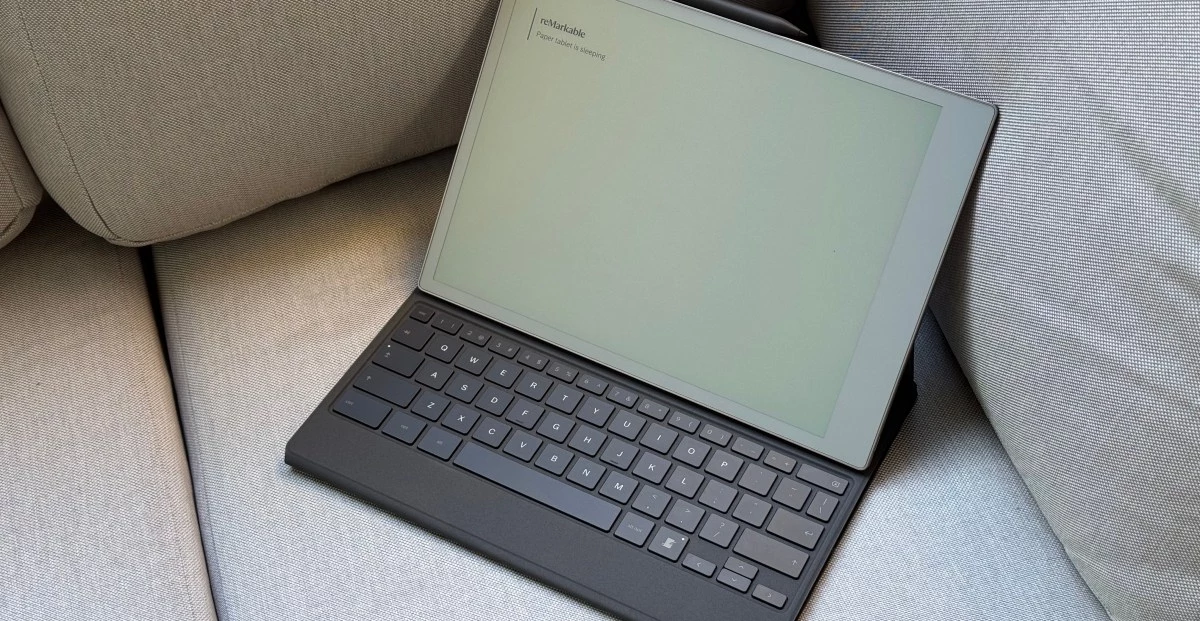

The Rise of Purpose-Built Productivity: Remarkable’s Paper Pro and the New Minimalism
In an era when our devices clamor for attention with every vibration, ping, and pop-up, the launch of the Remarkable Paper Pro tablet and its companion Type Folio keyboard reads as a manifesto for digital restraint. The Norwegian company’s latest offering is not another attempt to outpace the iPad or Surface in raw performance or feature count. Instead, it is a deliberate retreat from the chaos—a single-purpose, e-ink-based workflow machine whose greatest asset may be what it refuses to do.
The Paper Pro’s debut, with its 11.8-inch color-capable Canvas e-ink display, upgraded Marker Plus stylus, and the tactile precision of the Type Folio keyboard, signals a maturation of the “focused hardware” thesis. Early adopters, undeterred by a price tag that rivals entry-level laptops, are gravitating toward a device that promises cognitive clarity over computational horsepower. This is not a niche for Luddites, but a calculated response to the mounting evidence that digital noise erodes productivity and well-being.
—
Engineering for Focus: Design Choices that Shape Behavior
The Paper Pro’s hardware is a study in intentional limitation. Its e-ink panel, while slower to refresh than LCD or OLED counterparts, is no accident—it is a bulwark against the high-stimulus distractions of modern apps. The limited CPU and GPU profile means there will be no video calls, no games, no social feeds. Instead, users find week-long battery life and a device that invites deep work rather than shallow multitasking.
The Type Folio keyboard, with its 1.3 mm key travel and overall carry weight under 0.7 kg, addresses a longstanding criticism of e-ink tablets: that they are ill-suited for serious writing. Here, the mechanics are precise, the ergonomics credible. Remarkable’s design philosophy is not about latency or screen brightness—it is about protecting the “flow state,” a concept that has migrated from psychology journals to C-suite wellness agendas.
On the software front, the shift to a $2.99/month cloud subscription marks a strategic pivot. Synchronizing notes across devices, while raising the product’s lifetime value, also opens the door to enterprise integration—secure PDF workflows, compliance-safe annotations, and, potentially, a future of API-driven extensibility. The architecture remains cloud-agnostic, but the absence of third-party APIs is a calculated hedge against platform bloat.
—
Economics, Supply Chains, and the Price of Focus
The economics of the Paper Pro are as carefully engineered as its hardware. Large-format color e-ink panels now account for up to 45% of the bill of materials, and recent tariff hikes on Chinese-made substrates have nudged retail prices upward. Remarkable’s decision to absorb only part of these increases underscores the limited price elasticity in its target market—buyers here are paying for a promise: less noise, more focus.
The move toward a blended hardware-plus-SaaS model is more than a revenue play. Even a modest attach rate for the subscription service could yield millions in annual recurring revenue, smoothing the cyclical nature of hardware refreshes. But the supply chain remains a wild card. Color e-ink capacity is still constrained; E Ink Holdings’ planned expansion in Taiwan will be pivotal. Freight costs and geopolitical tensions may soon prompt a shift in final assembly closer to European markets, echoing strategies from Kobo and Boox.
—
The Strategic Stakes: Minimalism as a Competitive Advantage
The Paper Pro is not alone in this new landscape. Kindle Scribe, Onyx Tab, and Lenovo’s e-ink ThinkBook all point to a broader migration of e-ink from leisure reading to the productivity stack. Yet, where Apple and Microsoft continue to bet on convergence—one device to rule them all—Remarkable’s wager is the opposite: that intentional limitation is the ultimate feature.
This is not merely a consumer trend. Gartner forecasts that by 2027, a quarter of Global 2000 firms will subsidize single-purpose writing devices for high-focus roles. The implications ripple across procurement, HR, and IT: distraction-light devices may soon be as much a part of employee well-being strategies as flexible hours or mental health days.
For device makers, the lesson is clear: a diversified portfolio—high-function tablets for some, focused devices for others—will be essential. SaaS providers should consider SDK hooks for e-ink endpoints, capturing attention otherwise lost to digital abstinence. And for enterprise buyers, the opportunity to empirically measure the ROI of focus—be it in code commits or legal briefs—may prove irresistible.
By crystallizing the cognitive benefits of minimalism into tangible hardware, Remarkable has reignited a debate that is no longer philosophical. For executives and investors alike, the question of whether productivity is best served by adding features or removing them is fast becoming a strategic imperative.

 By
By
 By
By
 By
By
 By
By

 By
By

 By
By







