

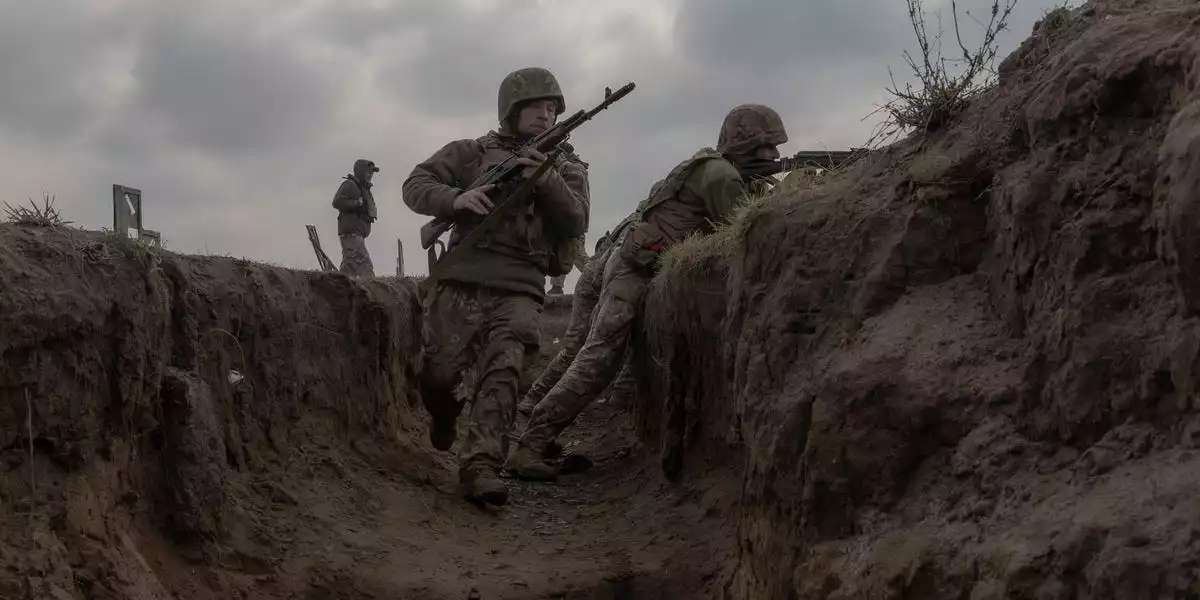

From Textbook Trenches to Agile Fortifications: The Ukrainian Rewriting of Battlefield Engineering
The British Army’s Operation Interflex, once a one-way conduit for NATO-standard tactics, has evolved into a crucible where conventional military wisdom is being re-forged by the realities of Ukraine’s embattled frontlines. What began as a program to impart Western infantry doctrine has become a dynamic exchange, with Ukrainian improvisation and battlefield ingenuity reshaping the very foundations of force protection and survivability. In this new theater, the textbook is less a guide than a relic—rapid adaptation, not symmetry, is the order of the day.
The Collapse of Classical Engineering and the Rise of Minimum Viable Fortification
Traditional British entrenchment—survey, clear, dig, reinforce—was predicated on time, order, and uncontested ground. In the drone-laden, artillery-swept fields of Ukraine, such luxuries have evaporated. Ukrainian units, under constant threat from overhead surveillance and precision fires, have pioneered a doctrine of “minimum viable fortification.” Here, speed trumps elegance: trenches are dug in minutes, not hours, their forms dictated by necessity and terrain rather than by geometry or regulation.
This new approach is uncannily reminiscent of agile software development—release early, iterate under pressure, and adapt continuously. The battlefield itself becomes a laboratory, each fortification a prototype subjected to relentless real-world testing. Western doctrine, long wedded to methodical engineering cycles, is being forced to absorb these lessons. Expect to see a formalization of rapid, iterative field engineering, enabled by lightweight mechanization and portable sensor suites, as militaries seek to keep pace with the tempo of modern conflict.
Drones, Booby-Traps, and the New Economics of Defense Innovation
The omnipresence of drones—commercial quadcopters and military UAS alike—has collapsed the window for concealment. Trenches now bristle with anti-drone overhead cover and thermal masking, spurring demand for a new class of lightweight, heat-dissipative materials. The proliferation of booby-traps and improvised area-denial devices signals a shift toward autonomous and semi-autonomous defenses, creating an under-regulated market ripe for innovation in AI-enabled mine detection and acoustic signature mapping.
This evolution is reshaping defense spending. Capital is flowing away from heavy earth-moving equipment and toward modular entrenchment kits, deployable camouflage, and small-unit electronic warfare gear. Civilian sectors, too, are taking note: technologies developed for heat-signature management and rapid earthworks are finding applications in wildfire mitigation and disaster relief. The training market is responding in kind, with demand surging for VR and AR simulations that replicate the chaotic, unpredictable geometries of real-world trenches—far removed from the parade-ground perfection of old.
Cross-Sector Ripples: Construction, Supply Chains, and Organizational Agility
The Ukrainian model of field fortification bears a striking resemblance to rapid-deployment construction in dense urban environments. Robotics and 3D-printing firms, once focused on emergency housing, are now exploring “print-a-trench” solutions for military and disaster-response applications. The supply chains that sustain these efforts are hyper-local, with frontline units sourcing materials—saplings, scrap metal, consumer drones—from their immediate environment. This mirrors broader trends in civilian manufacturing, where resiliency and near-shoring are increasingly valued over efficiency.
Perhaps most profoundly, the Ukrainian experience is a case study in the power of bottom-up innovation. Squads empowered to improvise and adapt have outpaced the rigid hierarchies of traditional command structures. The return on investment for this kind of decentralized decision-making is clear, not only on the battlefield but in the boardroom, where agile transformations are rewriting the rules of organizational behavior.
Strategic Horizons: Investment, Doctrine, and the Ethics of Adaptation
For defense investors and industry leaders, the message is clear: overweight portfolios toward small-form drone counter-systems, lightweight fortification materials, and combat telemedicine platforms. These sectors are poised for double-digit growth as NATO procurement adapts to the lessons of Ukraine. Training providers that integrate real-time frontline data will command a premium, while firms in sensor-fusion and AI-targeting must prepare for heightened regulatory scrutiny as the ethical boundaries of autonomous area-denial are tested.
Operation Interflex, in its current incarnation, exemplifies a new model of cross-allied innovation—one that privileges fluid knowledge exchange and frontline feedback over top-down technology transfer. The implications extend well beyond the trenches of eastern Ukraine. As resilience, speed, and decentralization become the new design imperatives, those who internalize these lessons—whether in defense, disaster response, or the broader industrial landscape—will shape the future of security and survivability in an age of relentless uncertainty.

 By
By
 By
By
 By
By
 By
By
 By
By


 By
By







