

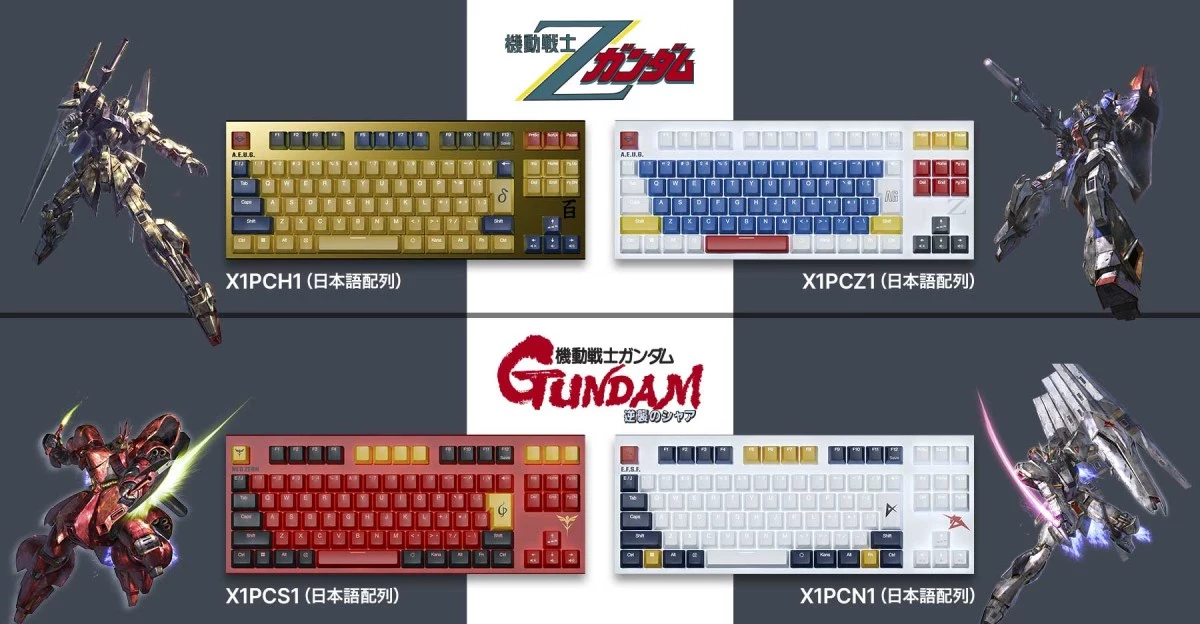

Gundam Meets Topre: The New Frontier of Collector-Grade Keyboards
Few partnerships in the world of consumer technology feel as inevitable—and as quietly radical—as the recent accord between Japanese switch-maker Topre and Bandai Namco’s storied Mobile Suit Gundam franchise. On the surface, the collaboration is a collector’s dream: four meticulously crafted keyboards, each an homage to iconic mecha—Z Gundam, Hyaku Shiki, Nu Gundam, and Sazabi—engineered atop the revered Realforce GX1 chassis. But beneath the lacquered keycaps and subtle colorways lies a deeper story about the convergence of nostalgia, premium hardware, and the evolving desk economy.
Strategic Calculus: Beyond Toys, Into the Workspace
Bandai Namco’s Gundam empire, long synonymous with plastic model kits and animated epics, is now orchestrating an ambitious expansion into lifestyle hardware. The move is as much about economics as it is about culture. With core model-kit revenues hovering near $1 billion annually, the company is seeking new vectors for monetization—ones that appeal to an aging, increasingly affluent fanbase. The Realforce partnership is a calculated foray into a niche, price-insensitive market: professional-grade mechanical keyboards.
For Topre and its Realforce marque, the benefits are equally compelling. The premium keyboard segment—once the domain of hardcore gamers and programmers—has blossomed into a crossroads of hybrid work, PC gaming, and “desk-scape” curation. By aligning with Gundam, Realforce gains a halo effect among design-conscious professionals who may never have encountered Topre’s electro-capacitive technology. The dual English/JIS layouts, a rarity in Japanese hardware, signal a deliberate push beyond domestic borders, laying the groundwork for future global expansion.
Technology as Trojan Horse: Topre’s Subtle Disruption
At the heart of the collaboration is a technological gambit. Unlike the ubiquitous MX-compatible switches that dominate the mechanical keyboard landscape, Topre’s electro-capacitive actuation offers a unique blend of analog precision and uniform force curves. For enthusiasts accustomed to hot-swappable, RGB-laden boards, the Gundam editions serve as a “Trojan horse”—a gateway into Topre’s proprietary ecosystem. The hope is to convert curiosity into loyalty, seeding a new generation of users who value tactile nuance over modding flexibility.
Yet, the collaboration is not without its blind spots. The absence of hot-swap sockets and open-source firmware (such as QMK or VIA) remains a sticking point for the modder community. Here, emotional branding does some heavy lifting: the allure of a limited-edition Gundam keyboard may offset, at least temporarily, the lack of technical modularity. Still, the market’s appetite for customization is unlikely to wane, and aftermarket keycap makers are poised to capitalize on any gaps left by Topre’s minimalism.
Economics of Scarcity: Premium Pricing and the Desk Economy
The economics of this collaboration are as precise as the keyboards themselves. Historical data from themed peripherals—think ROG’s Gundam Scope or Evangelion-branded GPUs—suggests that launch premiums of 30–70% over base models are not only possible but expected. With a projected MSRP of $350–400 and a limited run of 5,000 to 10,000 units, the incremental revenue could reach $4 million, with disproportionately high margins thanks to the collectible nature of the product.
This pricing power is underwritten by a demographic sweet spot: the median age of mechanical keyboard enthusiasts aligns almost perfectly with Gundam’s most engaged spenders—knowledge workers in their thirties and forties, whose disposable income and nostalgia are both peaking. The channel strategy—combining domestic e-commerce with select overseas allocations—enables a scarcity-driven marketing approach, testing international price sensitivity while preserving the cachet of exclusivity.
The Future of IP-Driven Hardware: Lessons and Projections
The Realforce x Gundam collaboration is more than a limited-edition drop; it is a harbinger of how entertainment IP and hardware manufacturing are converging in the age of the premium desk. As the pandemic-era shift to hybrid work normalizes higher spending on desktop aesthetics, brands are racing to differentiate not on specs, but on story. Expect to see similar moves in microphones, webcams, and other peripherals—each leveraging beloved franchises to capture the hearts (and wallets) of digitally native professionals.
For hardware executives, the message is clear: scarcity, narrative, and cross-media synergy are the new levers of growth. Whether through staggered releases, bundled accessories, or synchronized launches with streaming content, the path forward favors those who can blend engineering excellence with cultural resonance. And as Japanese manufacturers like Topre embrace global licensing and ESG-friendly production, the stage is set for a new era of desk-bound collectibles—where every keystroke is a nod to both heritage and innovation.

 By
By

 By
By
 By
By
 By
By
 By
By
 By
By








