
A darkening basin that complicates the “quiet Mars” narrative
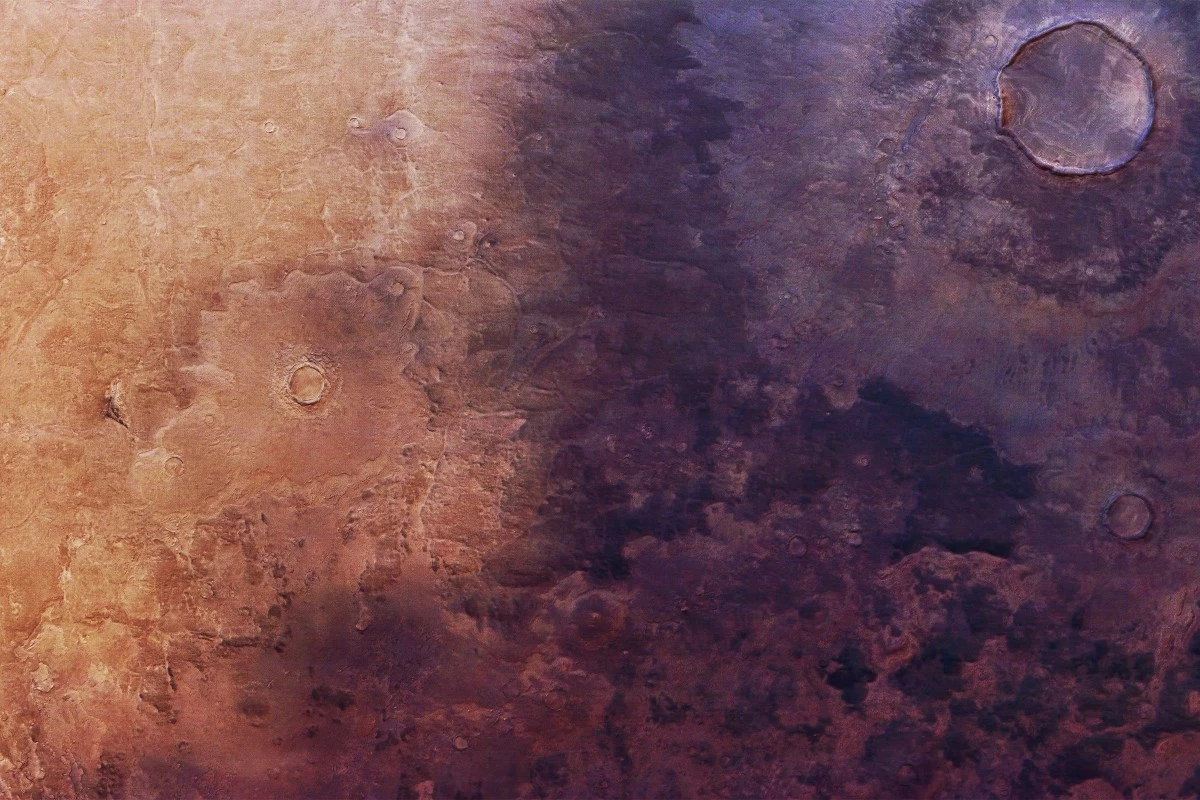
New high-resolution comparisons between Viking-era imagery (1976) and European Space Agency Mars Express observations (2024) point to a striking transformation in Utopia Planitia—a vast northern basin frequently linked to hypotheses of an ancient Martian ocean. A dark, mafic-rich surface unit—associated with olivine and pyroxene—appears to have advanced hundreds of kilometers across terrain previously dominated by lighter, ochre-toned dust. The pace implied by the record—measured in decades rather than millennia—lands uncomfortably against the long-standing shorthand of Mars as geologically “dead.”
Two competing explanations frame the debate:
- Fresh volcanic ash deposition, later redistributed by prevailing winds, implying a more recent or ongoing source of volcanic material than many models assume.
- Accelerated dust removal and erosion, exposing an older, darker volcanic substrate that had been masked by bright dust, implying a shift in aeolian (wind-driven) dynamics rather than new volcanism.
Either pathway signals a planet whose surface can change quickly enough to matter for mission design, risk modeling, and the economics of future operations. The key analytical challenge now is separating new material emplacement from exposure of existing material—a distinction that will hinge on mineralogical fingerprints, grain-size distributions, and the geometry of the deposit’s leading edge.
What Mars Express is really showing: remote sensing as a strategic instrument
Beyond the geological intrigue, the Utopia Planitia observations underscore how far planetary remote sensing has progressed. The leap from Viking’s pioneering global reconnaissance to today’s higher-cadence, higher-resolution orbital datasets is not merely aesthetic; it is operational. Modern workflows increasingly combine:
- Hyperspectral and multispectral mineral mapping to distinguish mafic signatures from dust coatings
- Change-detection algorithms that quantify boundary migration and albedo shifts across time
- Cross-mission calibration to ensure that “change” is not an artifact of lighting, viewing angle, or sensor drift
This matters because the most valuable planetary insights now emerge from time-series interpretation, not single snapshots. If the dark unit is truly expanding as a coherent deposit, analysts will look for patterns consistent with transport and settling—downwind tails, dune interactions, and thickness proxies. If it is exposure-driven, the telltales may include scoured corridors, dust depletion zones, and transitions aligned with topography and wind stress.
From a materials science perspective, the mineralogy itself is consequential. Olivine and pyroxene are not just compositional trivia; they are indicators of crustal formation conditions and thermal history. Their mechanical behavior—abrasiveness, cohesion, electrostatic charging—also feeds directly into engineering constraints for surface systems. A Martian regolith rich in mafic grains can be a different operational environment than one dominated by fine, bright dust, affecting everything from wheel wear to seal integrity to optical sensor contamination.
Implications for exploration architecture, ISRU, and landing-site economics
For mission planners and the emerging commercial ecosystem around Mars, the most disruptive element is not the color change—it is the implied rate of environmental change. A landing zone selected for benign surface conditions could, in principle, evolve on timescales relevant to mission lifetimes and program schedules. That pushes architecture toward adaptability:
- Dynamic landing-site certification, updated with more frequent orbital revisits
- On-site sensing suites capable of real-time dust and surface-property assessment
- Operational contingencies for mobility, power generation, and thermal control under shifting surface conditions
The news also intersects with in-situ resource utilization (ISRU)—the linchpin concept for sustainable Mars operations. Mafic-rich regolith can be attractive for oxygen production pathways (for example, through high-temperature processing), and mineral exposures can guide where to search for hydrated phases or subsurface volatiles. If Utopia Planitia’s surface is actively reworking, it becomes both an opportunity and a complication: opportunity because exposures may reveal more diagnostic geology; complication because variability can undermine assumptions about feedstock consistency for processing plants.
Commercially, rapid change detection on Mars is not a niche scientific service—it is a potential market category. A credible cadence of surface-change monitoring would drive demand for:
- High-revisit orbital imaging and spectroscopy
- AI-driven anomaly detection tuned to planetary environments
- End-to-end analytics pipelines that translate raw pixels into operational decisions (hazard maps, resource indicators, traverse planning)
In that sense, Utopia Planitia is not only a basin on Mars; it is a test case for how the space economy may monetize planetary data—turning observation into actionable intelligence for both public missions and private ventures.
Why this matters to the space economy and Earth industries watching closely
The broader context is a space sector widely forecast to expand toward trillion-dollar scale by 2040, with resource exploration frequently cited as a long-horizon driver. Evidence that Mars may be more dynamically active than assumed can accelerate interest—scientific, political, and financial—because it reshapes the perceived risk-reward profile of operating there. A Mars that changes measurably within decades is a Mars that demands better forecasting, better robotics, and better governance.
Policy dynamics are likely to follow. Renewed scientific uncertainty tends to influence how agencies and legislatures prioritize budgets across planetary science, human exploration, and technology demonstration. It also sharpens the case for international coordination on resource activity, because investors price uncertainty—especially geopolitical and legal uncertainty—into every long-duration plan.
Finally, the technology spillovers are tangible. The same toolchain used to interpret a Martian ash-like deposit—spectroscopy, dust-tolerant robotics, terrain change modeling—maps directly onto terrestrial needs such as:
- Volcanic hazard monitoring and ash dispersion forecasting
- Geothermal exploration and subsurface characterization
- Mining analytics in abrasive, low-visibility environments
Utopia Planitia’s darkening surface is, at face value, a planetary science puzzle. At a deeper level, it is a reminder that Mars is not a static backdrop for exploration narratives—it is an active operating environment. The organizations that treat planetary change as a first-class engineering and business variable, rather than a scientific footnote, will be best positioned as Mars shifts from destination to domain.

 By
By
 By
By

 By
By
 By
By

 By
By
 By
By