
Aerial policing moves from niche tool to mainstream infrastructure
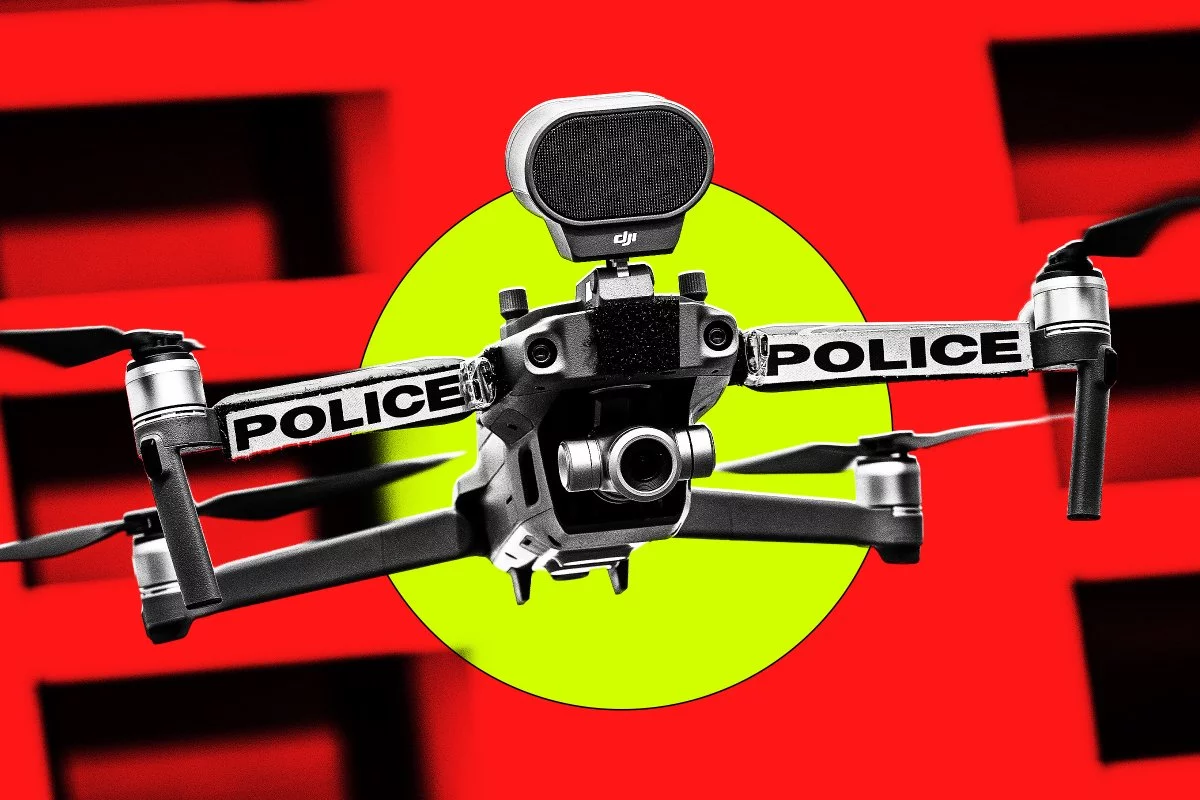
Unmanned aerial vehicles (UAVs) have shifted from specialized equipment to standard operating capability across U.S. law enforcement. With more than 1,500 departments now deploying drones, the technology is no longer an experiment—it is becoming part of the baseline “public safety stack,” used for missions that span search-and-rescue, traffic incidents, perimeter security, and crowd monitoring.
Los Angeles offers a particularly visible case study. During two high-profile anti-Trump demonstrations—the January 31 “ICE Out” protest and the March 28 “No Kings” protest—the LAPD reportedly flew drones at least 31 times and 32 times respectively. Notably, drone surveillance in both events occurred before any formal dispersal order, and both protests ended with dozens of arrests. That sequencing matters because it places UAVs not merely as documentation tools, but as early-stage situational awareness instruments that can shape operational decisions long before a crowd is deemed unlawful.
Officially, agencies often frame drone use as incident-commander-directed and focused on “specific criminal activity.” Yet internal acknowledgments that drones are also used for broad crowd-size estimation highlight a recurring tension: the same platform that can locate a missing person can also enable persistent monitoring of lawful assembly, raising questions about First Amendment protections, privacy expectations in public spaces, and the adequacy of current oversight.
The technology curve: cheaper airframes, smarter sensors, faster analytics
The rapid adoption of police drones is not simply a policy choice; it is a market and engineering outcome. Three dynamics are accelerating deployment and expanding capability.
Off-the-shelf quadcopters now support payloads that would have been exotic a decade ago:
- High-resolution optical zoom for identification at distance
- Infrared / thermal imaging for night operations and search-and-rescue
- In some configurations, multispectral sensing that can enhance detection and classification
As costs fall below common procurement thresholds, drones become easier to purchase quickly, sometimes without the extended scrutiny applied to larger capital assets. Modular payload systems further reduce friction: the same drone can be reconfigured from a humanitarian tool (thermal search) to a surveillance platform (stabilized zoom) with minimal delay.
Modern UAVs increasingly carry onboard compute capable of basic computer vision. Even when agencies deny “facial recognition,” adjacent functions can still be powerful:
- Face detection (not necessarily identification)
- Gait and movement pattern analysis
- Crowd-density and flow metrics useful for containment or dispersal planning
Edge-to-cloud pipelines also change the governance profile. Selective upload—saving only “flagged” footage—can reduce bandwidth and storage costs, but it can also create oversight blind spots if the triggers for flagging are opaque or inconsistently logged.
The most consequential capability may be administrative rather than aerodynamic: the ability to generate, store, and integrate data at scale. Many departments still lack standardized practices for:
- Flight-path logging and mission metadata
- Retention schedules and deletion verification
- Documented analytic triggers (what caused footage to be stored, shared, or escalated)
As drone feeds connect into citywide command centers, inconsistent integration with record-management systems can weaken chain-of-custody integrity, complicating both accountability and evidentiary reliability.
The business of “public safety tech”: budgets, vendors, and data spillover
Drones are also winning because they fit the economic constraints of modern policing. Helicopters are expensive to operate and politically visible; drones are comparatively low-cost, quiet, and scalable. Under municipal budget pressure, UAVs are often positioned as a cost-effective alternative to manpower-intensive aerial assets, even when total cost of ownership—training, maintenance, software subscriptions, storage, and compliance—remains unclear.
At the same time, a growing ecosystem is forming around law-enforcement UAV use:
- Federal grants and vendor financing can accelerate procurement
- A rising Drone-as-a-Service (DaaS) sector offers per-hour surveillance and operations support
- Startups market plug-and-play analytics as “public safety” solutions, lowering technical barriers for agencies
This commercialization creates a subtle but important boundary issue: when third parties operate aircraft or process footage, questions multiply around data stewardship, subcontractor access, retention, and secondary use.
The spillover effects extend beyond policing. UAV-derived crowd metrics are increasingly attractive to:
- Insurers modeling event risk
- Event promoters optimizing logistics
- Real estate and retail exploring foot-traffic analytics
That cross-industry convergence matters because tools built for commercial optimization can be repurposed for protest monitoring with minimal modification—blurring the line between consumer analytics and state surveillance.
Civil liberties, regulatory lag, and the strategic risk of losing legitimacy
The most acute debate is not whether drones can help public safety—they can—but whether their use in politically sensitive contexts erodes democratic norms. Persistent aerial monitoring can reduce protester anonymity, and even if footage is not used immediately, it can be retained, subpoenaed, reanalyzed, or combined with other datasets later. The chilling-effect concern is structural: if people believe attendance at a lawful protest may be cataloged, fewer may participate.
Regulation has struggled to keep pace. Federal aviation rules prioritize airspace safety, not constitutional constraints. State and municipal privacy laws vary widely, creating a patchwork that can both restrain and inadvertently encourage experimentation in jurisdictions with weaker guardrails.
For agencies, the strategic risk is legitimacy. High-visibility drone deployments at protests can:
- Invite litigation and public-records scrutiny
- Intensify skepticism toward broader smart city initiatives
- Undermine community-policing narratives if transparency is limited
For technology providers, the reputational risk is also real. As drones become nodes in a wider urban sensor web—fixed cameras, license-plate readers, 5G-connected command platforms—vendors may face growing pressure to embed privacy-by-design features such as tamper-evident logs, configurable retention controls, and audit-friendly APIs.
The LAPD’s protest deployments illustrate the central tension of the drone era: UAVs can be a precision tool for safety, but without rigorous governance they can also become a low-friction mechanism for mass observation. The next phase of adoption will be decided less by flight time and battery life than by whether institutions can build credible, enforceable rules that keep technological advantage aligned with constitutional trust.

 By
By

 By
By
 By
By

 By
By
 By
By