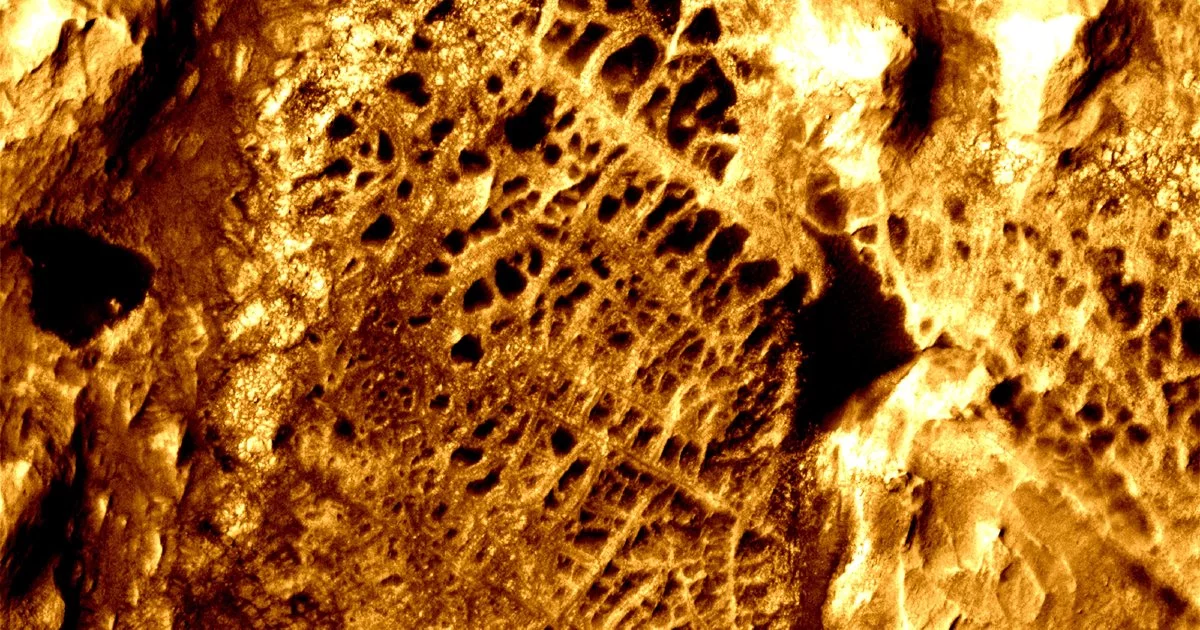

Boxwork ridges at Mount Sharp: a groundwater signature written in stone
Six months into a focused campaign at the foothills of Mount Sharp (Aeolis Mons), NASA’s Curiosity rover is turning a long-noted orbital curiosity into a ground-level narrative about Mars’s watery past. The target is a field of six-foot-high “boxwork” mineral ridges—a spiderweb-like lattice that, from orbit, looked like a geological oddity and, on the ground, reads like a record of subsurface plumbing.
The prevailing interpretation is elegantly simple: ancient groundwater moved through fractures in bedrock, depositing minerals that later hardened. Over time, wind-driven erosion stripped away the softer surrounding material, leaving the mineralized fractures standing as ridges. What makes this site strategically important is not merely the geometry—it’s what the ridges imply about where water once was, and for how long.
Curiosity’s instruments are now “ground-truthing” what the Mars Reconnaissance Orbiter (MRO) first flagged in 2006 using HiRISE imagery. That orbital-to-surface linkage matters because it validates a full remote-sensing pipeline: detect a candidate feature from space, then confirm composition and formation mechanisms with in-situ measurements. In this case, Curiosity’s drill and spectrometers are identifying clay-bearing materials and saline-crystallized minerals, strengthening the case that liquid water was not a brief visitor but a persistent agent shaping the mountain’s lower flanks.
Key scientific implications emerging from the boxwork campaign include:
- Mineral deposition by groundwater, consistent with fracture-filling processes rather than surface runoff alone
- Clays and salts that often form in water-mediated environments, offering potential chemical gradients relevant to habitability
- A stronger basis for interpreting similar orbital features elsewhere on Mars, improving future landing-site selection and exploration prioritization
The elevation puzzle: extending Mars’s habitable window and the search for past life
The most provocative element of the briefing is the “elevation puzzle.” Boxwork ridges appearing at Mount Sharp’s heights suggest that Mars once sustained a groundwater table elevated enough to influence geology well above what many models would assume for a drying planet. If groundwater persisted at these elevations, it implies a longer-lived hydrologic system—one that could have expanded the habitable window for microbial life.
From a planetary habitability standpoint, the significance is less about any single mineral and more about the environmental stability implied by repeated or sustained water-rock interaction. Groundwater systems can provide:
- Protection from radiation compared with surface environments
- Chemical energy sources through water-rock reactions
- Long-duration niches that remain viable even as surface conditions deteriorate
This is also why Curiosity’s transition toward sulfate-rich layers is closely watched. Sulfates often signal a shift toward more arid, evaporative conditions, potentially marking a climatic turning point. The mission’s next steps—moving from boxwork terrain into sulfate-bearing strata—create a natural timeline: from wetter conditions that support clays to later environments where salts and sulfates may dominate. For Mars climate evolution, that stratigraphic progression is a powerful organizing framework, helping scientists reconstruct how the planet moved from a more Earth-like past to the cold desert seen today.
Autonomy under constraint: why narrow Martian hollows matter to Earth industries
The boxwork region is not just scientifically rich—it is operationally unforgiving. NASA engineers are reportedly planning precise navigation through narrow hollows to avoid immobilizing the rover. On Mars, where real-time joystick driving is impossible, this becomes a proving ground for onboard autonomy, terrain classification, and hazard avoidance.
That engineering reality is increasingly relevant beyond space exploration. The same autonomy stack required to thread a rover through tight, uneven corridors has clear analogues in terrestrial settings where communications are intermittent and the cost of failure is high. The Curiosity campaign highlights a broader trend: space robotics as a stress test for AI systems that must make safe decisions with limited compute, limited power, and incomplete information.
Commercially resonant technology themes include:
- Autonomous navigation in constrained environments, applicable to subterranean mining, offshore inspection, and disaster-response robotics
- Miniaturized in-situ geochemical analysis, demonstrated through laser-based spectroscopy and X-ray diffraction approaches that can inspire portable mineral assay and environmental monitoring tools
- Orbital-to-surface data fusion, a template for integrating satellite imagery with edge sensors—relevant to precision agriculture, infrastructure monitoring, and climate-resilience analytics
In business terms, this is how NASA missions often create value: not by direct productization, but by forcing breakthroughs in reliability, miniaturization, and decision-making under uncertainty—capabilities that later diffuse into the private sector.
Investment, policy, and strategic signals: ISRU, partnerships, and technology leadership
Curiosity’s boxwork findings also land amid a shifting economic and geopolitical landscape. Evidence consistent with extensive ancient groundwater—especially at elevation—reinvigorates discussion around in-situ resource utilization (ISRU), particularly water extraction. Even if Curiosity is not an ISRU mission, its science can influence how investors and strategists evaluate the feasibility of future architectures for sustained exploration.
The briefing points to several second-order effects executives will recognize:
- Space technology as an economic multiplier, sustaining high-skilled supply chains in software, materials, and specialty components
- Long-horizon R&D discipline, reinforcing that meaningful planetary science and exploration capability is built over decades, not quarters
- Cross-industry AI collaboration opportunities, where autonomy and hazard-avoidance methods can be adapted and licensed into industrial robotics domains
- Policy and regulatory evolution, as stronger habitability narratives intensify debates around planetary protection and, eventually, off-Earth resource rights
Curiosity’s work on Mount Sharp is, at one level, a meticulous geological investigation of mineral ridges. At another, it is a live demonstration of how modern exploration blends remote sensing, edge autonomy, and high-fidelity chemistry to convert distant imagery into actionable understanding—an approach that is steadily becoming the blueprint for how advanced technology systems will operate on Earth as well as on Mars.

 By
By
 By
By

 By
By


 By
By
 By
By