


Artemis 3’s late-2028 bet: when lunar ambition meets commercial reality
NASA’s Artemis 3 mission—now aiming for a crewed lunar landing by late 2028—is increasingly defined by a single, high-stakes premise: that commercial lunar landers from SpaceX and Blue Origin can mature from ambitious prototypes into flight-proven systems on a schedule that leaves little room for compounding setbacks. NASA’s own documentation, suggesting it may test “one or both” landers—or possibly neither—reads less like hedging and more like institutional candor about the volatility of today’s heavy-lift and lunar-landing development environment.
The strategic logic remains sound. By leaning on private providers, NASA is attempting to seed a durable lunar economy, diversify innovation pathways, and avoid the cost structure of bespoke, government-only spacecraft. Yet the operational reality is stark: a crewed landing is only as credible as the end-to-end chain—rocket performance, lander integration, orbital operations, and the unforgiving dynamics of descent to the lunar South Pole. In that chain, launch reliability and systems integration are not supporting details; they are the mission.
Blue Origin’s Mark 1 milestone—and the hard boundary between test chambers and flight
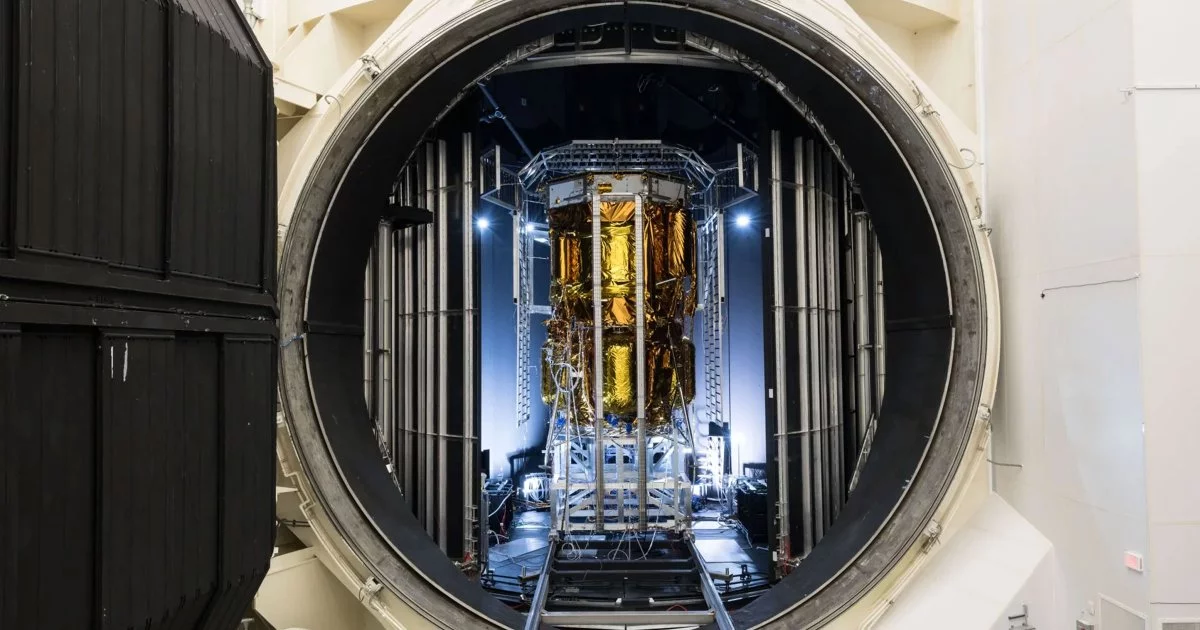
Blue Origin’s Mark 1 “Blue Moon” prototype has cleared a meaningful engineering gate with thermal-vacuum testing at NASA’s Johnson Space Center, validating structural integrity and key subsystems under space-like conditions. For lunar hardware, this matters: thermal extremes, vacuum-driven material behavior, and subsystem interactions can expose failure modes that remain invisible in conventional ground testing. Mark 1’s planned role—a cargo delivery to the lunar South Pole later this year—positions it as a learning vehicle rather than a human-rated system, with insights intended to shape the eventual crewed Mark 2 lander.
Still, the most consequential risk is not inside the chamber. It’s in the transition from controlled validation to real-world flight environments—particularly the vibrational loads, staging interfaces, and operational complexity of launch. That is where the recent New Glenn failure, which ended in a self-destruct following a communications-satellite launch anomaly, becomes more than a headline. It introduces uncertainty into the very mechanism that must deliver Mark 1—and later, crew-capable variants—into the correct trajectory and operational envelope.
Key implications for Artemis 3 readiness include:
- Ground validation vs. flight qualification: thermal-vacuum success supports subsystem confidence, but doesn’t certify integrated performance under launch and ascent stresses.
- Single-point dependencies: if New Glenn’s reliability questions persist, Blue Origin’s lander timeline may face cascading integration and certification delays.
- Human-rating gravity: even if Mark 1 succeeds as cargo, the leap to crewed operations demands stringent verification across propulsion, avionics, fault tolerance, and abort contingencies.
Blue Origin’s approach signals methodical engineering discipline; the market will judge it by whether that discipline translates into repeatable flight outcomes.
Starship’s promise remains theoretical until orbital success becomes routine
SpaceX’s Starship Version 3 continues to represent the most transformative upside—and one of the most uncertain near-term variables—in the Artemis architecture. Preparatory ignition tests and nearby road closures suggest an imminent test flight, but the program still lacks what Artemis ultimately requires: a demonstrated orbital launch and recovery cadence that proves the vehicle can support complex mission profiles, including the operational choreography implied by lunar missions.
SpaceX’s development philosophy—rapid iteration, learning through failure—has historically produced breakthroughs in reusability and cost reduction. But Artemis 3 is not merely a launch problem; it is a systems-of-systems problem. For Starship to become a dependable lunar lander platform, it must show maturity across:
- Orbital operations reliability, including sustained vehicle health and controlled reentry profiles
- Propellant management, especially for long-duration missions and multi-burn sequences
- Operational repeatability, the difference between a successful test and a dependable transportation system
NASA’s schedule pressure amplifies the stakes. A single successful flight is a milestone; a pattern of success is a capability. Artemis 3 requires the latter.
The business, supply-chain, and geopolitical stakes of a delayed—or accelerated—lunar return
Artemis is not just a NASA program; it is an industrial policy instrument shaping the next decade of the commercial space sector. The decision to rely on two providers is designed to foster competition and resilience, but the current landscape still carries a shared vulnerability: both lander pathways depend on heavy-lift systems that have not yet demonstrated stable, routine performance in the configurations Artemis will demand.
From an economic standpoint, the outcomes bifurcate sharply:
- Investor confidence in long-horizon space infrastructure could soften, particularly for suppliers tied to lunar timelines.
- The commercial lunar market may struggle to prove near-term revenue logic beyond government demand.
- NASA may face pressure to add interim capabilities, reshaping procurement and partnership strategies.
- A high-value supply chain could solidify across avionics, thermal systems, propulsion components, precision structures, and life-support technologies.
- Starship-scale manufacturing could accelerate economies of scale in stainless-steel fabrication and methane-oxygen engine production.
- Blue Origin’s Mark 1 production experience could catalyze specialized suppliers, from insulation to cryogenic fluid handling.
Strategically, the Artemis 3 focus on the lunar South Pole is inseparable from geopolitics. The region’s potential water-ice resources underpin in-situ resource utilization (ISRU)—a prerequisite for sustained presence and a lever of influence in cis-lunar space. Any U.S. schedule slippage widens the window for competitors, while also increasing the value of allied contributions from Europe and Japan or niche innovations from startups offering navigation sensors, descent instrumentation, or modular surface interfaces.
The deeper story is that Artemis 3 has become a referendum on whether the United States can translate commercial dynamism into mission-grade dependability on a timetable shaped by both engineering physics and geopolitical urgency. The next 18–24 months—defined by orbital tests, integration proof points, and whether rockets and landers perform as a unified stack—will determine whether late 2028 is a credible landing target or the start of another recalibration in humanity’s return to the Moon.

 By
By



 By
By

 By
By
 By
By







