
Gamma-Ray Mysteries and the New Cartography of the Cosmos
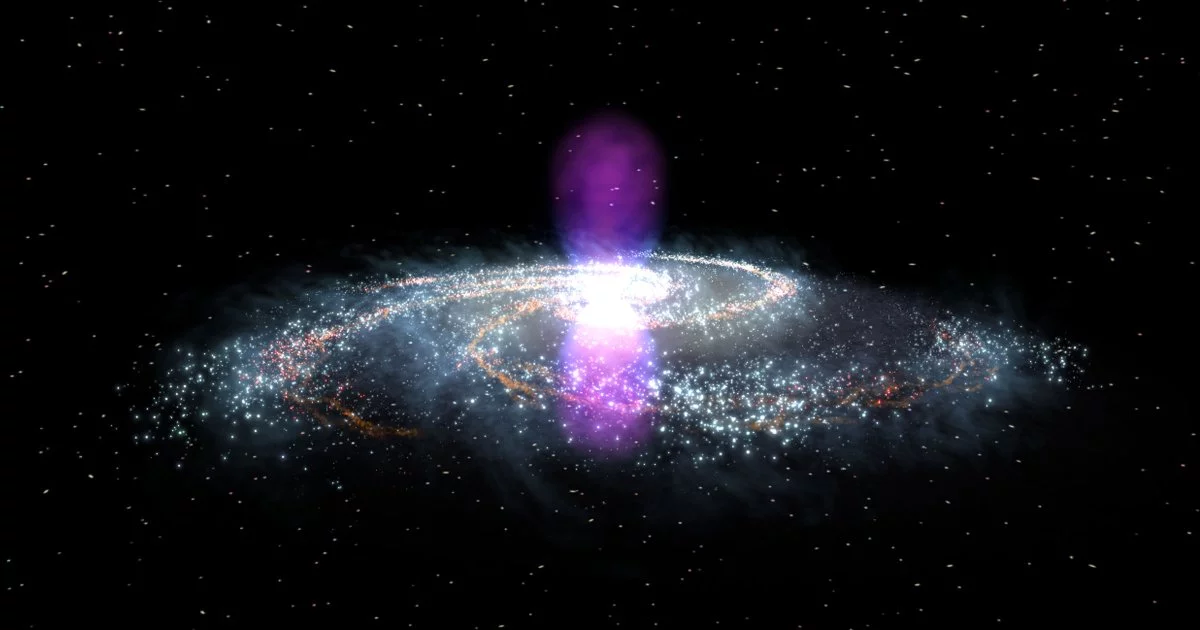
At the heart of our galaxy, a silent enigma pulses: a diffuse halo of gamma rays, luminous yet inscrutable, radiating from the Milky Way’s core. For a decade, astrophysicists have debated its source, oscillating between two contenders—annihilating dark-matter particles, the universe’s invisible scaffolding, or a swarm of millisecond pulsars, the cosmic metronomes of collapsed stars. Recent simulations, published in *Physical Review Letters*, have sharpened this debate, presenting a “dark-matter density map” whose contours echo the gamma-ray glow captured by NASA’s Fermi telescope. Yet the riddle remains unsolved, with the decisive evidence now entrusted to the next generation of observatories: the Cherenkov Telescope Array (CTA), a €400 million marvel soon to rise in La Palma and the Atacama Desert.
The Technological Renaissance: Sensors, Supercomputing, and Galactic Digital Twins
The CTA is not merely a telescope; it is a convergence of frontier technologies. Its ultra-fast photomultipliers, silicon photonic arrays, and cryogenic electronics represent the bleeding edge of sensor innovation—components whose supply chains intertwine with those of LiDAR systems, autonomous vehicles, and EUV lithography. The same technologies that will parse the faintest cosmic signals are already transforming terrestrial industries.
But the hardware is only half the story. The deluge of data—petabytes of faint gamma signatures—demands exascale computation and AI-assisted signal extraction. Here, probabilistic machine learning and Bayesian neural networks, honed in the crucible of astrophysics, have become indispensable not only for mapping the galaxy but also for financial risk modeling, pharmaceutical simulations, and climate forecasting. The creation of a “digital twin” of the Milky Way, a physics-informed model of dark-matter density, signals a new era: simulation as strategic capability, with implications stretching from aerospace to automotive design.
Strategic and Economic Ripples: From Capex to Geopolitics
The CTA’s construction is emblematic of a broader resurgence in “Big Science” infrastructure—ITER’s fusion ambitions, the ELT’s search for exoplanets, the SKA’s radio arrays. For vendors of specialty glass, compound semiconductors, and superconducting nanowires, these projects offer multi-year demand visibility and the promise of technology transfer. Historically, such fundamental-physics programs have seeded dual-use breakthroughs: charge-coupled devices from Hubble, the World Wide Web from CERN.
The CTA’s multinational architecture—European leadership, American detectors, Japanese mirrors, and Chilean skies—reflects a shifting landscape of scientific soft power. For executives, these projects are more than scientific curiosities; they are bellwethers of future export-control regimes, talent flows, and intellectual property clusters. Early involvement in CTA-adjacent consortia can yield transferable IP in quantum sensors, wide-bandgap materials, and edge computing—technologies with the potential to upend sectors from mineral exploration to defense ISR.
Lessons for Business: White Space, Platform Risk, and the Art of Detection
The cosmic mystery at the galaxy’s center offers a rich metaphor for the business world. Just as 26% of the universe’s mass remains invisible—dark matter, mapped only by its gravitational pull—many enterprises harbor “corporate dark matter”: under-instrumented data, dormant patents, and intangible assets waiting to be illuminated. Firms that invest in advanced analytics to chart these hidden domains can unlock untapped value.
The duality of explanations—pulsars or dark matter—mirrors the ambiguity of technology-stack bets in industry, from RISC-V to ARM. Maintaining optionality until the data matures is a prudent capital allocation stance. Meanwhile, the race to detect faint cosmic signals parallels the quest for higher resolution in consumer-behavior telemetry. Companies that master algorithmic noise reduction will differentiate themselves through actionable insight density.
For decision-makers, the implications are clear:
- Monitor critical supply chains in photonics, superconducting nanowires, and cryogenic ASICs—strategic partnerships here can secure future growth.
- Hedge compute pathways as exascale demand from astrophysics strains both cloud and on-premises GPU inventories.
- Position for quantum-sensing crossover, as dark-matter search techniques migrate into mineral exploration and infrastructure mapping.
- Leverage science branding to attract talent and burnish ESG credentials.
- Scenario-plan for a “smoking-gun” moment—a conclusive dark-matter detection could rewrite textbooks and trigger regulatory and funding shocks across sectors.
The gamma-ray enigma at the Milky Way’s center is more than an astronomical curiosity. It is a crucible for innovation, a proving ground for the technologies and strategies that will define the next decade. Those who recognize the early signals—who see not just the stars, but the patterns in their flicker—will be best positioned to seize the future.

 By
By
 By
By

 By
By
 By
By

 By
By
 By
By