

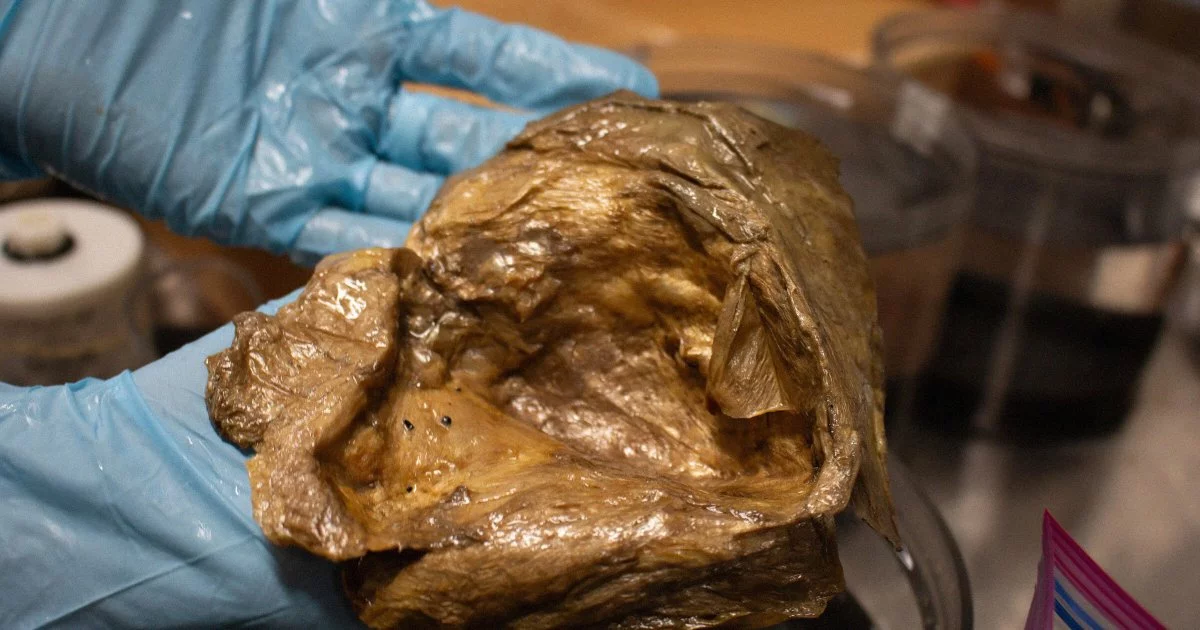

From “golden orb” to genomic certainty: how deep-sea mystery became a case study in modern science
A molten-gold sphere pulled from more than two miles beneath the Gulf of Alaska is the kind of image that travels faster than the science behind it. When NOAA’s Okeanos Explorer first encountered the smooth, pocked “golden orb,” speculation predictably ranged from the whimsical—an alien artifact—to the plausible—sponge, egg case, unknown invertebrate. What ultimately resolved the mystery was not a single “aha” moment, but a layered, methodical process that reflects where frontier research is heading: integrated sensing, careful sample handling, and molecular verification at genome scale.
After a 30-year odyssey of inquiry—intensified by roughly two and a half years of focused analysis—the object has now been definitively identified as tissue from Relicanthus daphneae, a deep-sea anemone. The confirmation relied on a multidisciplinary toolkit: morphological assessment, spirocyst cell analysis (a hallmark of cnidarians), and whole-genome sequencing. The result is more than a tidy answer to a viral curiosity. It is a demonstration of how deep-ocean exploration is evolving into a high-precision, data-rich enterprise—one that increasingly resembles advanced aerospace or semiconductor R&D in its reliance on instrumentation, pipelines, and cross-domain expertise.
For business and technology leaders watching the “blue economy,” the episode underscores a practical truth: the deep sea is not only a biodiversity frontier; it is also a proving ground for robotics, imaging, bioinformatics, and data governance—capabilities with spillover value far beyond marine biology.
The enabling stack: robotics, imaging, and the shift from morphology to molecular taxonomy
The deep ocean is hostile to traditional fieldwork. Extreme pressure, low temperatures, and the logistical constraints of ship time make every minute and every manipulation count. In this context, the “golden orb” investigation highlights how exploration has become inseparable from engineering.
Key technological implications stand out:
- Advanced sensing and robotics
Deep-sea vehicles equipped with high-resolution cameras and manipulator arms enabled intact recovery—no small feat when even minor damage can erase diagnostic features. The integration of in situ imaging with precision retrieval is setting a benchmark for next-generation ROVs (remotely operated vehicles) and AUVs (autonomous underwater vehicles), reducing specimen degradation and improving chain-of-custody for scientific evidence.
- Whole-genome sequencing as a taxonomic accelerant
Where classical taxonomy often depended on visible traits, deep-sea organisms frequently defy easy classification due to convergent forms, fragile structures, or incomplete specimens. The use of whole-genome sequencing signals a broader transition: from morphology-only identification to molecular-driven discovery, where genetic signatures can resolve ambiguity and map evolutionary relationships with far greater confidence.
- Cloud-scale bioinformatics and faster decision loops
The coupling of sequencing with modern bioinformatics—often cloud-enabled—compresses the time between collection and interpretation. Even when full analysis is not “real time,” the direction of travel is clear: faster pipelines enable faster hypothesis testing, better mission planning, and more efficient use of expensive offshore operations.
Just as importantly, the investigation illustrates the operational value of structured collaboration. NOAA and Smithsonian expertise—zoology, molecular biology, ocean engineering—functioned as a mission-specific consortium rather than siloed labs. That model is increasingly relevant to other frontier domains, from polar research to space biology, where capital intensity and complexity demand coordinated, outcome-driven teams.
Commercial signals: marine biotech, novel biomaterials, and the economics of biodiversity data
A deep-sea anemone may sound distant from boardroom priorities—until one considers what cnidarians represent in applied science. The identification of spirocyst-rich tissue renews attention on a class of biological mechanisms that can be translated into products: adhesion, elasticity, bioactive compounds, and resilience under extreme conditions.
Potential market dynamics include:
- Marine biotechnology and biomaterials pipelines
Cnidarian biology has long intrigued researchers for its unique cellular tools. Discoveries like this can catalyze interest in bio-inspired adhesives, medical device coatings, drug delivery mechanisms, and sustainable polymers. For venture capital and corporate R&D, the strategic question becomes less “Is this organism strange?” and more “Is there defensible IP in the chemistry, structure, or genetics?”
- Ecosystem services valuation as an investment narrative
Each new identification strengthens the economic case for ocean conservation by making biodiversity more legible—and therefore more measurable. Better understanding of deep-sea trophic networks can improve models used in fisheries management, offshore energy planning, and environmental risk assessment, with downstream relevance for insurers, regulators, and ESG-linked capital.
- Infrastructure demand and supply-chain opportunity
Ultra-deep exploration requires specialized vessels, sensors, autonomy software, and data systems. As demand grows, so does the market for shipbuilding upgrades, undersea networking, precision instrumentation, and analytics platforms. The likely financing pattern mirrors space and satellite markets: public–private co-investment to share risk and amortize high upfront costs.
In this light, the “golden orb” is not merely a solved puzzle; it is a small but telling indicator of how deep-ocean science can seed commercial ecosystems—provided institutions can translate discoveries into reproducible datasets, partnerships, and governance frameworks.
Strategy and governance: data sovereignty, ESG pressure, and the race to map the unseen
As deep-sea exploration becomes more capable, it also becomes more strategic. Genetic sequences and geospatial maps are not just scientific artifacts; they are assets. The question of who collects them, who stores them, and who can commercialize them is moving toward the center of ocean policy.
Several forces are converging:
- Ocean data sovereignty and access regimes
Nations increasingly view subsea mapping and biodiversity catalogs as elements of strategic advantage. The balance between collaborative norms and protectionist approaches—shaped by frameworks such as UNCLOS and evolving biodiversity agreements—will influence access to samples, funding pathways, and commercialization rights.
- ESG and regulatory scrutiny for offshore industries
High-profile discoveries amplify public awareness of deep-sea fragility, raising expectations for companies operating offshore—oil and gas, seabed mining, fisheries, subsea cables. ESG reporting is gradually shifting from broad commitments to measurable indicators, and ocean-health metrics are becoming harder to ignore.
- Frontier science as a brand and talent lever
Technology, pharma, and materials companies increasingly support blue-tech research to signal innovation leadership. The narrative power of “mysteries solved” is not trivial: it helps translate complex science into stakeholder trust, recruitment appeal, and long-horizon credibility.
The deep ocean remains largely unmapped, biologically under-described, and technologically demanding—exactly the combination that tends to produce both breakthroughs and competition. The “golden orb” story lands as a reminder that the next era of advantage may belong to organizations that can integrate robotics, genomics, and governance into a coherent exploration strategy, turning the planet’s least understood environment into a disciplined engine of discovery and innovation.

 By
By


 By
By
 By
By

 By
By
 By
By







