

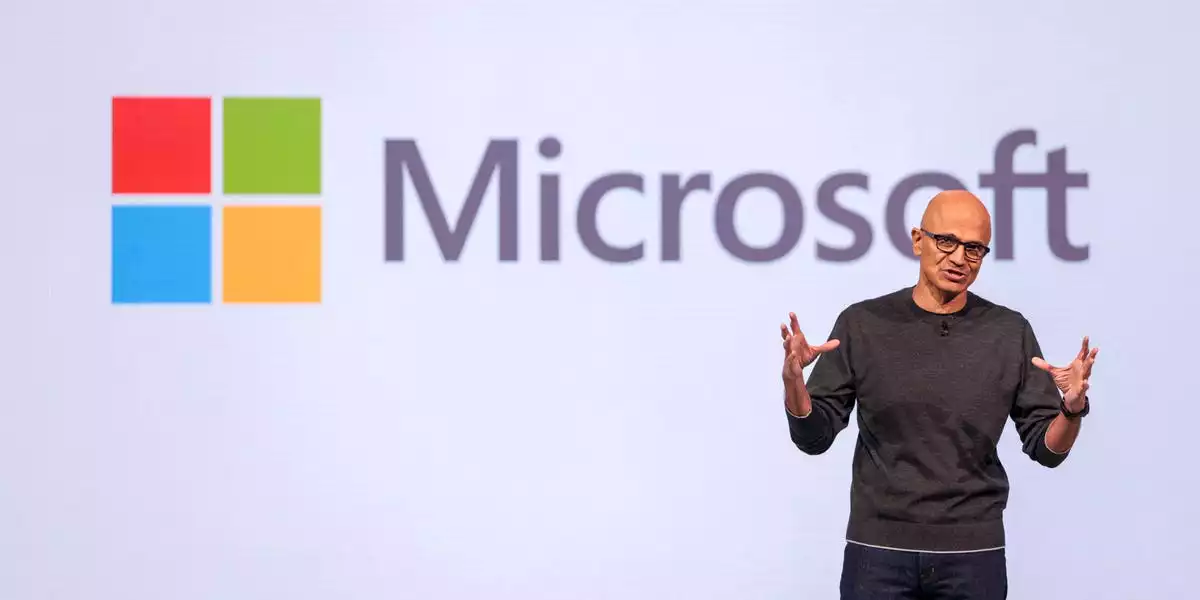

A measured workforce trim signals Microsoft’s next operating model for the AI era
Microsoft’s expected workforce reduction—fewer than 2.5% of its roughly 220,000 employees—lands less like a blunt austerity move and more like a calibrated rebalancing of where the company believes durable value will be created. Coming after May’s 6,000-role reduction and July’s 9,000-role cut, the latest action suggests a continuing shift from broad organizational scaling to precision cost management—particularly in functions most exposed to automation, product-led growth, and changing enterprise buying patterns.
The market context is unusually intense. Microsoft’s share price has fallen about 19% over the past month, a drop framed by investors as a referendum on a central question: Will generative AI expand Microsoft’s core software economics—or compress them? Wall Street’s scrutiny reflects a broader anxiety across Big Tech: AI can lift productivity and create new revenue streams, but it can also cannibalize legacy licensing, alter customer expectations around pricing, and increase infrastructure costs.
Microsoft’s concurrent voluntary retirement program for U.S. employees aged 70+, with roughly one-third participation among eligible staff, adds another layer to the story. It indicates a preference for de-risking workforce transitions through optionality where possible, while still making targeted reductions where strategic priorities have shifted.
Where the cuts are aimed—and what that reveals about Microsoft’s AI priorities
The reported focus on sales, consulting, and the Xbox gaming division is telling. These are not peripheral areas; they are customer-facing engines and brand-defining businesses. Yet they are also domains where AI and cloud delivery models are reshaping the cost-to-serve equation and the mechanisms of growth.
Key signals embedded in the targeting include:
- Sales and consulting are being reweighted toward productized AI delivery. As Microsoft embeds AI into Microsoft 365, Dynamics, GitHub, and Azure, the company can increasingly rely on in-product adoption loops and standardized implementation patterns. That reduces the need for some traditional motions, even as it increases demand for higher-skill roles in solution architecture, data governance, and security.
- Consulting faces a near-term execution risk. Enterprise AI deployments are rarely “plug-and-play.” If reductions outpace redeployment and upskilling, Microsoft could encounter friction in Copilot rollouts, data readiness projects, and change management, potentially slowing time-to-value for customers and delaying revenue recognition for AI add-ons.
- Xbox is being treated as both a business and a proving ground. With new Xbox CEO Asha Sharma signaling a strategic “reset,” the division appears poised for realignment around cloud streaming, subscriptions, and AI-enhanced content pipelines—a pivot away from purely volume-driven console economics.
This is the subtle but important subtext: Microsoft is not merely “adding AI.” It is reorganizing around AI as a platform layer—one that changes how software is sold, implemented, supported, and monetized.
Xbox’s “reset” and the strategic value of gaming as an AI laboratory
Gaming is often misunderstood in enterprise narratives as a consumer-side distraction. For Microsoft, Xbox can function as an innovation lab for AI workloads that are difficult to replicate elsewhere: real-time rendering, low-latency networking, large-scale community operations, and interactive content generation. A leaner, more focused Xbox organization could be designed to accelerate experiments that later strengthen Azure’s differentiation.
Areas where Xbox can serve as a high-visibility AI testbed include:
- AI-assisted content creation (procedural world building, asset generation, localization) that reduces development cycle time
- Smarter NPC behavior and adaptive storytelling, which stress-test inference performance and orchestration
- Trust and safety automation, including moderation and anti-toxicity systems at massive scale
- Cloud streaming optimization, showcasing Azure’s ability to deliver consistent real-time experiences
If Microsoft chooses to operationalize these capabilities as reusable Azure services—rather than keeping them as internal gaming advantages—Xbox becomes a strategic amplifier for Microsoft’s broader AI platform story. The “reset,” then, is not only about portfolio pruning or org design; it’s about clarifying what Xbox is *for* in a company increasingly defined by AI infrastructure and developer ecosystems.
Investor pressure, margin discipline, and the monetization challenge that matters most
A sub-2.5% reduction can support near-term margin management, but it is unlikely to be the decisive lever if investors remain concerned about revenue mix and pricing power. The larger determinant is whether Microsoft can monetize AI at scale without eroding the economics of its existing franchises.
The tension is structural:
- AI features can raise willingness to pay, but customers increasingly demand clear ROI metrics and may resist broad bundle price increases.
- AI workloads increase compute costs, making unit economics and pricing architecture central to profitability.
- If AI reduces the need for certain seats or services, Microsoft must offset that with new consumption models (per-user tiers, per-agent pricing, per-API usage, or vertical solutions).
Against that backdrop, the timing of these workforce actions—near fiscal turnover—functions as a form of shareholder signaling: Microsoft is willing to make granular adjustments rather than wait for macro conditions to force larger, more disruptive cuts. Yet the credibility of that signal will ultimately be measured in execution: faster AI deployment outcomes, clearer packaging, and evidence that Copilot-era growth is additive rather than merely substitutive.
Microsoft’s next chapter is increasingly defined by a single operational mandate: move capital and talent from legacy delivery models into AI-native platforms—without breaking the customer experience that made the legacy model so resilient. The workforce changes are a visible mechanism of that mandate, but the real test will be whether the company can translate organizational reshaping into durable AI revenue, defensible margins, and a product experience that keeps enterprises—and developers—locked into its ecosystem.

 By
By
 By
By

 By
By
 By
By
 By
By









