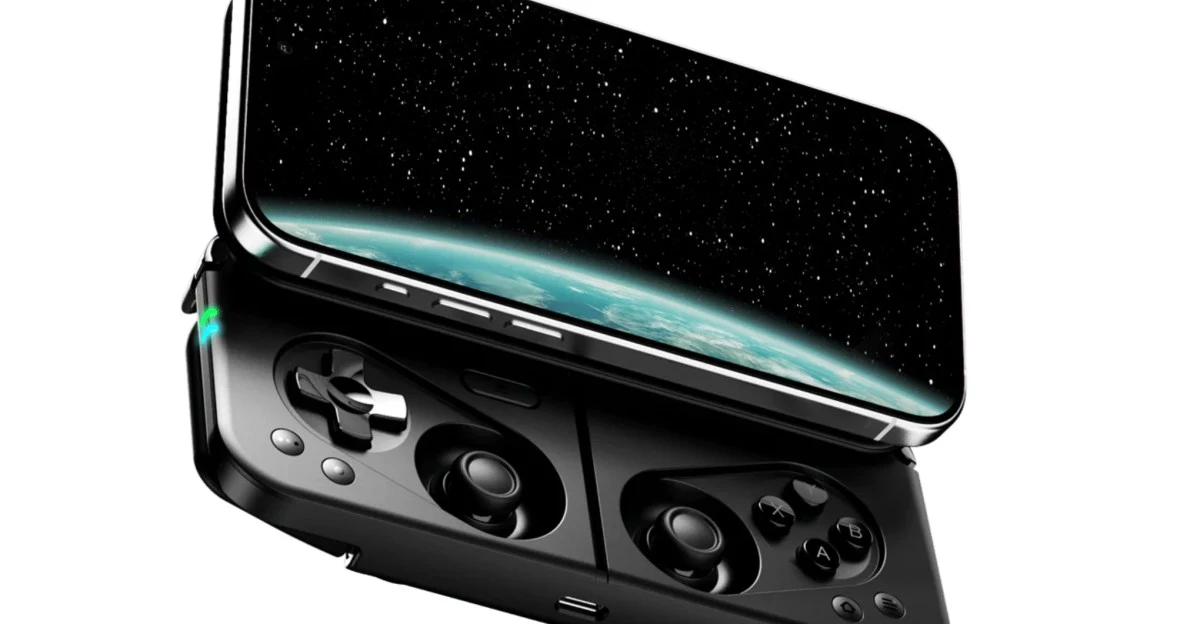

A controller that treats the smartphone like a console—without asking consumers to buy a new device
OhSnap’s MCON controller arrives at a moment when smartphone gaming is no longer a casual sideline but a primary entertainment channel—and increasingly, a gateway to cloud and cross-platform play. The product’s core proposition is straightforward: turn a phone into a more console-like system through full-size controls, improved ergonomics, and fast pairing, while avoiding the friction that has historically plagued mobile controllers (awkward clamps, inconsistent fit, and portability trade-offs).
The most market-relevant shift is pricing. After debuting at $150, the MCON now retails at $99.99, aligning with its 2025 Kickstarter early-bird level. That repositioning matters because it places the device within the “impulse upgrade” band for many players—especially those weighing whether to spend on a controller versus a new handheld, a premium console pad, or a subscription bundle. In a climate of cautious discretionary spending across North America and Europe, a sub-$100 accessory that upgrades an existing phone can read as a pragmatic luxury: meaningful performance and comfort gains without a platform switch.
Just as importantly, the MCON’s design signals a broader industry reality: the smartphone is being reinterpreted as a modular computing surface—a screen that can be rapidly “completed” by attachable input hardware, not unlike the way tablets gained productivity legitimacy through keyboard ecosystems.
Magnetic modularity and mechanical design move from novelty to platform strategy
Where many mobile controllers compete on button feel or brand recognition, MCON’s differentiator is architectural: a modular magnetic attachment system that works across devices via MagSafe, OhSnap’s “Pixelsnap” magnetic approach, and an adhesive ring for phones without native magnetic alignment. This is more than convenience. It hints at an emerging accessory “standard” driven not by a platform owner, but by a third-party hardware company that is effectively building a universal docking expectation.
That universality lowers adoption barriers in two ways:
- For consumers: fewer compatibility worries across iPhone and Android, and less fear of obsolescence when upgrading phones.
- For accessory makers and partners: a clearer target for add-ons, bundles, and future modular extensions—potentially influencing how smartphone OEMs think about back-of-phone real estate and magnetic alignment.
The mechanical execution reinforces that platform ambition. A spring-loaded pop-up mechanism reveals the controls, while fold-out palm grips and accessible shoulder buttons aim to solve a persistent problem in mobile play: fatigue and cramped hands during longer sessions. This is a subtle but meaningful evolution—mobile gaming hardware is increasingly judged not only by portability, but by whether it can sustain “console-length” play sessions without discomfort.
Component choices also matter. The inclusion of GameSir’s TMR sticks (tunneling magnetoresistance) positions MCON closer to premium controller expectations—promising precision and responsiveness that historically commanded higher prices. If that performance holds at scale, it pressures the mid-tier controller market by making “good enough” analog input less defensible as a cost-saving compromise.
Cross-platform pairing reflects the cloud era’s demand for device-agnostic peripherals
MCON’s Bluetooth pairing across iOS and Android, with stated anticipation for platforms such as the Nintendo Switch 2, underscores a market direction that has been building for years: peripherals are becoming platform-agnostic by necessity. As cloud gaming expands—across services like Xbox Cloud Gaming and PlayStation Plus streaming—players increasingly expect their controller to follow them, not the other way around.
This shift has strategic implications:
- Hardware becomes the stable layer while screens and operating systems become interchangeable endpoints.
- Controller identity becomes portable, enabling consistent muscle memory and control profiles across devices.
- Ecosystem value migrates to software, where mapping, profiles, and cloud-synced configurations can differentiate otherwise similar hardware.
For OhSnap, this is both an opportunity and a competitive requirement. Incumbents such as Razer, 8BitDo, and GameSir have brand gravity and distribution muscle. MCON’s path to durable differentiation likely depends on whether it remains a clever one-off accessory—or evolves into an ecosystem with software features that reduce churn and increase switching costs. The most defensible next steps would include custom button mapping, profile libraries, and cross-device sync, potentially aligned with cloud gaming services for near-instant configuration.
Manufacturing lessons, margin logic, and the next battleground for mobile gaming hardware
Early production samples reportedly showed minor magnet-peeling issues, now addressed for mass manufacturing. While not unusual for magnet-and-adhesive assemblies, the episode highlights a reality of modern hardware: the winners are often those who can iterate quality control quickly, especially when dealing with neodymium magnets, polymers, and tight mechanical tolerances. Post-COVID supply chains have improved in responsiveness, but they remain exposed to rare-earth price volatility and shipping cost swings—variables that can quietly erode margins in precisely the sub-$100 segment MCON is targeting.
From a business perspective, the current pricing suggests a deliberate strategy: broaden the addressable market while relying on volume scaling and potentially follow-on revenue. The accessory market tied to smartphone gaming—often estimated at well over $100 billion in annual gaming revenue on the software side—creates room for high-margin hardware that is not bundled by OEMs and not trapped in race-to-the-bottom pricing.
The more intriguing upside is adjacency. A magnetic, modular controller architecture could plausibly extend into:
- AR/VR and extended reality inputs, where lightweight, attachable controls could complement eyewear experiences
- Education and enterprise training, where precise smartphone-based input can power simulations and remote instruction
- Analytics-driven gameplay, if future firmware enables telemetry and performance insights as a service layer
MCON ultimately reads as a compact thesis about where gaming is headed: screens are abundant, compute is mobile, and control is the missing ingredient. If OhSnap can pair its mechanical distinctiveness with software depth and partnerships—telco bundles, retail placements, or cloud-gaming co-branding—the controller category may stop being an accessory afterthought and start looking like a strategic interface layer in the next phase of entertainment computing.

 By
By


 By
By
 By
By
 By
By
 By
By
 By
By