

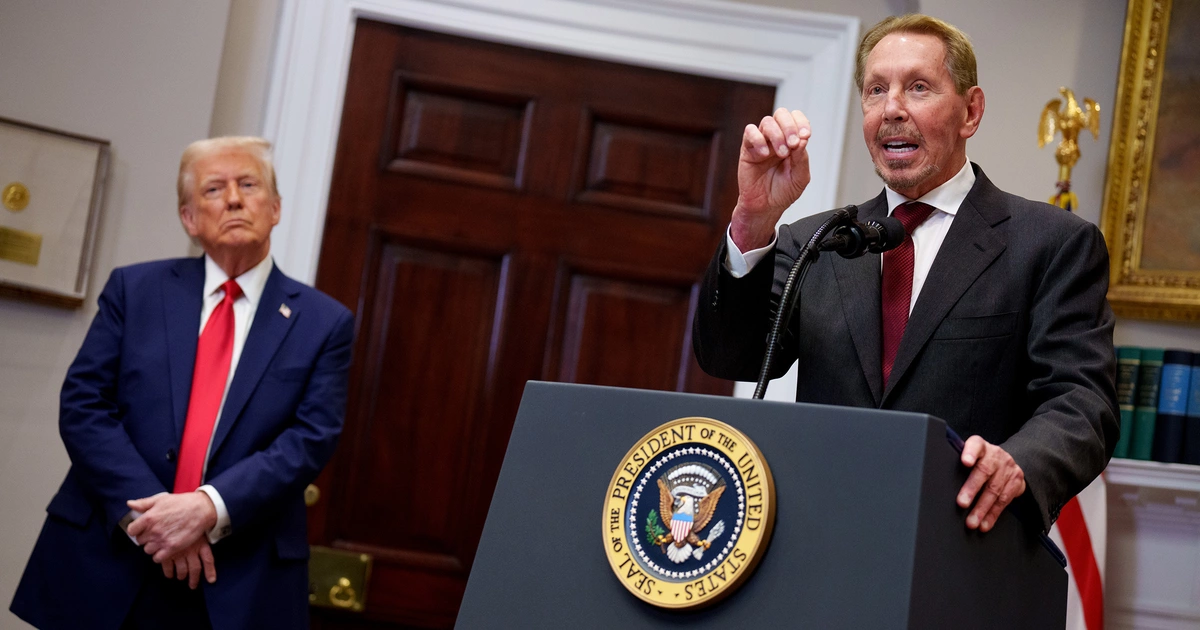

The Ellison Orbit: Redrawing the Map of AI, Media, and Political Power
In the evolving theater of American technology and media, few figures have managed to recalibrate the axis of influence as deftly as Larry Ellison. Once lionized as the brash co-founder of Oracle, Ellison now stands at the nexus of cloud infrastructure, generative AI, and mass-market content—his reach extending from the server racks that drive machine learning to the screens that shape public consciousness. The latest maneuvers—spanning multibillion-dollar compute deals with OpenAI, a starring role in the proposed $500 billion “Stargate” AI initiative, and a family stake in the Skydance–Paramount media empire—signal not just ambition, but a deliberate redrawing of the boundaries between technology, politics, and culture.
From Compute Utility to Algorithmic Gatekeeper
The $300 billion compute commitment to OpenAI is more than a windfall for Oracle’s Generation 2 cloud; it is a declaration of intent to become the essential substrate for AI innovation. In an era where the velocity of progress is throttled by access to GPU clusters, Ellison’s Oracle is transforming itself into a quasi-public utility—a critical infrastructure provider whose hardware and software underpin the next wave of artificial intelligence. The Stargate proposal, with its echoes of Cold War defense-industrial policy, would enshrine Oracle at the heart of a national AI build-out, effectively institutionalizing its cloud as a strategic asset.
This gravitational pull is not limited to raw compute. With the anticipated TikTok settlement, Oracle is poised to assume custodianship of the app’s recommendation algorithm and U.S. user data. In practical terms, this hands Ellison de facto control over the decision logic that influences the attention and sentiment of 150 million Americans. The convergence of compute logs from OpenAI and engagement signals from TikTok offers a feedback loop of unprecedented richness—one that can be leveraged to fine-tune large language models, optimize ad-tech, and, potentially, steer cultural narratives.
- Key Leverage Points:
– Exclusive access to AI training and inference telemetry
– Control over algorithmic curation for a mass-market social platform
– Institutionalization as a national-security partner, muting regulatory headwinds
Content, Cloud, and the New Vertical Integration
Ellison’s ambitions are not confined to the digital substrate. Through his family’s Skydance–Paramount deal, with an eye toward Warner Bros Discovery and CNN, the Ellison orbit is assembling a vertically integrated stack that spans cloud infrastructure, AI, distribution, and intellectual property. This architecture enables a self-reinforcing loop: proprietary content can seed in-house generative AI models, while AI-generated media can be funneled back into streaming platforms and social feeds. The result is a closed ecosystem where both the means of production and the channels of distribution are under unified control—a dynamic reminiscent of early 20th-century conglomerates, but turbocharged for the age of synthetic media.
This convergence yields several competitive asymmetries:
- Bargaining Power: Owning both compute and IP catalogs reduces dependence on external licensors and GPU vendors.
- Cross-Subsidization: Profits from cloud services can offset streaming losses, while blockbuster IP attracts users whose data further enriches AI models.
- Regulatory Positioning: Framed as a bulwark against foreign platforms, this consolidation may evade the antitrust scrutiny that historically dogs media mergers.
Geopolitical and Economic Reverberations
The implications of this consolidation ripple far beyond the boardroom. The Stargate initiative signals a bipartisan appetite for on-shoring AI capacity, mirroring the logic of the CHIPS Act and foreshadowing similar moves in Europe and India. As GPU lead times stretch and supply concentrates, smaller AI firms may find themselves squeezed by rising costs and dwindling access—a widening “compute divide” that threatens to stratify the industry.
Meanwhile, Oracle’s mastery of government procurement and its newfound political alignment—Ellison’s pivot from Democratic donor to Republican strategist—provide the legislative air cover often lacking for Big Tech. This alignment could shape emerging standards for AI safety, data locality, and algorithmic transparency, potentially locking out open-source alternatives and entrenching Oracle’s architectural advantage.
- Critical Watch Points for Decision Makers:
– Terms of Stargate funding and IP ownership
– Regulatory requirements tied to TikTok algorithm management
– Paramount shareholder votes and subsequent media M&A moves
– GPU supply-chain vulnerabilities, especially amid tightening export controls
– Congressional sentiment post-2024 elections
The architecture Ellison is constructing—spanning compute, algorithms, and narrative—represents a new digital-industrial complex, one whose center of gravity is shifting from Silicon Valley to the corridors of Austin and Washington. For competitors, policymakers, and enterprise buyers, these moves are not isolated events but the scaffolding of a durable, self-reinforcing power structure in the age of generative AI. The question is no longer whether this convergence will reshape the landscape, but how—and who will be left with agency in its shadow.

 By
By
 By
By

 By
By
 By
By
 By
By

 By
By







