

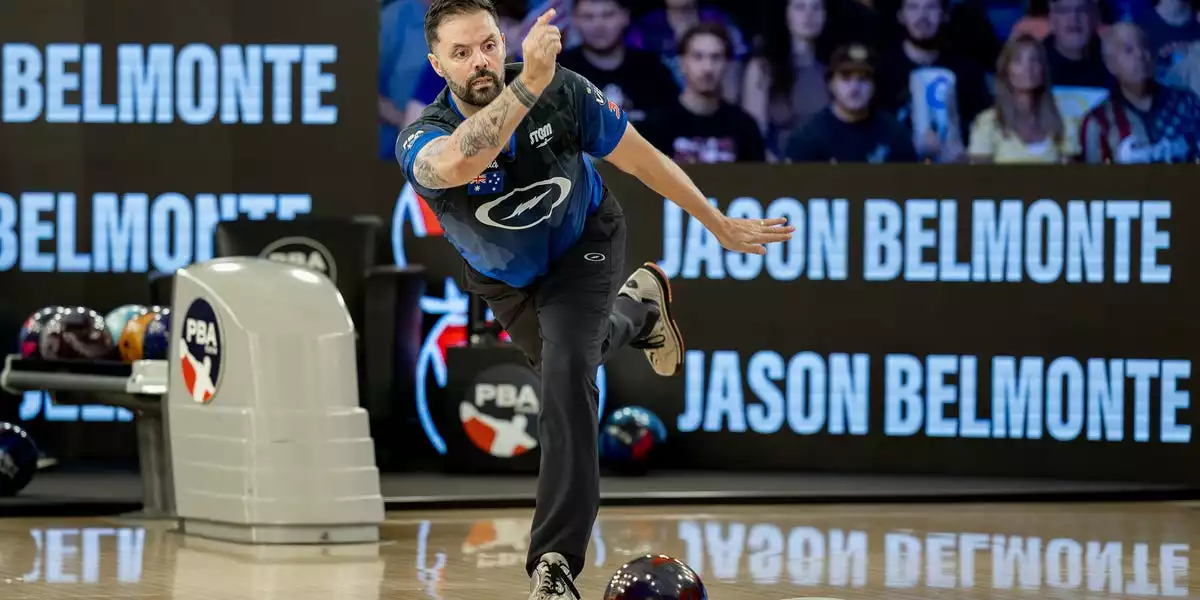

A grassroots innovation that rewired elite bowling’s performance ceiling
Jason “Belmo” Belmonte’s rise to 32 Professional Bowlers Association (PBA) titles is often framed as athletic dominance, but the more instructive story is how a single technical deviation—his two-handed delivery—became a durable competitive advantage in a sport long governed by orthodox form. Unlike many performance revolutions that arrive through institutional coaching pipelines, Belmonte’s technique reads as bottom-up innovation: a self-developed solution shaped by repetition, constraints, and experimentation rather than a top-down playbook.
That origin matters. His parents’ mid-1980s decision to open a small-town bowling center created an unusually rich “test lab”—a place where time on lanes was accessible, iteration was cheap, and unconventional mechanics could be refined without immediate gatekeeping. In business terms, the bowling center functioned as an incubator asset: a localized venue that quietly produced global-grade intellectual property in the form of a replicable technique and a compelling athlete narrative.
Belmonte’s early proof points—most notably a perfect game at 16 in Asia that delivered a US$16,000 bonus—did more than validate talent. They validated the *economic viability* of a niche path. Later international success, including periods of earning up to US$100,000 in a month, provided the cash flow and confidence to pursue the PBA circuit seriously. Even then, the arc wasn’t frictionless: early setbacks on tour were met with persistence and, notably, encouragement from PBA leadership—an institutional signal that the “new model” belonged at the top level.
For competitive sports, this is the familiar moment when incumbents must respond: once a challenger proves that a different method can win repeatedly, the ecosystem—coaches, equipment makers, training centers, and youth programs—faces a choice between resisting change or operationalizing it.
Sports technology’s next frontier: turning a signature technique into a data model
Belmonte’s two-handed approach is not only a stylistic hallmark; it is a measurable system—release angles, rev rate, axis rotation, timing, and repeatability. That makes it fertile ground for sports technology, particularly as bowling centers and training programs look for differentiated offerings in a competitive leisure market.
A plausible next phase is the industrialization of technique through sensor-based analytics and high-speed video, where the two-handed model becomes a dataset rather than a mystery. The opportunity is less about novelty and more about standardization: once performance variables are captured consistently, training becomes more scalable, coaching becomes more portable, and product development becomes more targeted.
Key technology implications for the bowling ecosystem include:
- Inertial Measurement Units (IMUs) and wearable sensors to quantify wrist/arm motion, timing, and stability across repetitions
- Computer vision and high-speed video analysis to map release mechanics and lane interaction with greater precision
- Machine-learning coaching platforms that translate elite patterns into individualized drills for amateurs and aspiring pros
- A potential need for standardized performance data architecture, enabling interoperability between OEMs, software providers, and training facilities
For equipment manufacturers and training brands, the strategic value lies in building turnkey performance systems—bundled hardware, software, and coaching protocols that can be deployed across bowling centers. For bowling centers themselves, early adoption could create a defensible position: not just as entertainment venues, but as measurable development hubs that attract serious learners, leagues, and sponsorship activations.
The business of niche excellence: monetization, sponsorship strategy, and the long tail
Belmonte’s career also illustrates a modern sports economy reality: niche dominance can be disproportionately monetizable when paired with authenticity, repeatable success, and a community that feels underserved by mainstream sports coverage. Tournament purses remain central, but the durable upside comes from the portfolio around competition—sponsorships, media rights, appearances, and brand partnerships that benefit from frequent tour touchpoints.
For corporate partners, the appeal is precision. A niche star can deliver:
- High-intent audiences with strong product affinity (equipment, apparel, accessories, training services)
- Credibility-driven conversion, where performance legitimacy functions like product validation
- Recurring exposure through tournaments and content cycles, enabling sustained campaigns rather than one-off spikes
Belmonte’s personal narrative strengthens that commercial flywheel. The “origin story”—a family-run bowling center that became the crucible for a disruptive technique—creates a brand asset that sponsors can activate across formats: co-branded product launches, loyalty programs, instructional content, and targeted promotions tied to measurable performance themes.
The family bowling center itself is a parallel business case. It represents asset-based entrepreneurship with optionality: remain a single-site experiential venue with local loyalty, or evolve into a prototype for a broader brand footprint through licensing, franchising, or a training academy model. In an era where experiences are increasingly packaged and scaled, the center is not merely sentimental real estate—it is a potential platform asset.
Legacy engineering: turning competitive dominance into a scalable post-tour enterprise
Belmonte’s sustained dominance over roughly 18 years underscores a final strategic lesson for high performers and the businesses around them: the peak competitive window is also the best time to design what comes next. With a current three-year contract horizon referenced in the material, the runway for codifying expertise into scalable offerings is clear.
The most durable post-competition pathways tend to convert tacit skill into structured IP:
- Digital academies and subscription coaching platforms built on repeatable methodology
- Licensed training systems for bowling centers that want a branded development program
- Commentary and media formats that translate expertise into audience trust and sponsorship inventory
- Merchandise and equipment collaborations grounded in data-backed performance narratives
For business and technology leaders, the Belmonte story is a reminder that innovation often begins where institutions aren’t looking—inside small venues, family businesses, and self-directed experimentation loops. When that innovation is paired with measurable performance, strategic sponsorship alignment, and deliberate legacy planning, it doesn’t just win tournaments; it reshapes the market’s expectations of what “elite” looks like and how it can be built, packaged, and scaled.

 By
By
 By
By
 By
By
 By
By



 By
By







