
A founder steps into the machinery of global real estate services
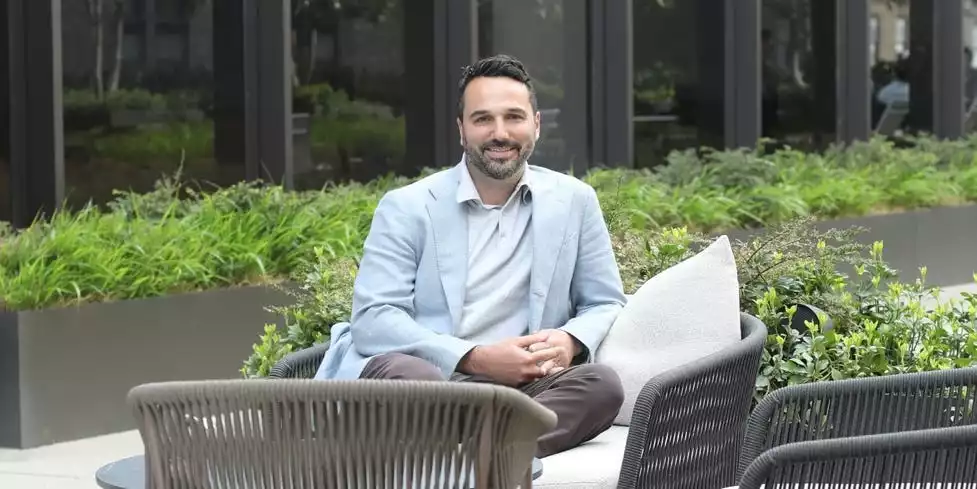
Jamie Hodari’s move from co-founder and CEO of Industrious to a senior executive role at CBRE is more than a personal career transition—it is a signal of how the flexible workspace category is being absorbed into the operating core of institutional commercial real estate. Following CBRE’s roughly $800 million acquisition of Industrious, Hodari now sits inside an organization of extraordinary scale: about 95,000 employees and stewardship over roughly 8 billion square feet. His remit—building operations and experience management—places him at the intersection of facilities execution, tenant expectations, and technology-enabled service delivery.
This is where the story becomes strategically instructive. Industrious built its brand on a hospitality-forward promise: warmth, trust, and community as a product. CBRE, by contrast, is a global platform optimized for consistency, risk management, and operational breadth. Hodari’s task is not simply to “bring Industrious to CBRE,” but to translate a startup’s intangible strengths into repeatable systems without sanding off the very edges that made the company distinctive.
Key elements shaping this transition include:
- Leadership recalibration at scale: moving from direct founder-led influence to a model that relies on frameworks, delegation, and alignment across geographies.
- Experience as an operational discipline: elevating “workplace experience” from a brand concept to a measurable, managed service line.
- A succession moment with strategic meaning: the search for Industrious’s next CEO becomes a proxy for how much autonomy CBRE intends to preserve.
The acquisition as a marker of coworking’s maturation—and CRE’s risk rebalancing
The CBRE–Industrious deal reflects a broader consolidation arc in coworking and flexible office. After years in which the sector was defined by rapid expansion, uneven unit economics, and headline volatility, the market is increasingly being shaped by large real estate services firms that can integrate flex offerings into diversified portfolios. For CBRE, Industrious is not merely a brand; it is a mechanism to meet clients where office demand has become more conditional, more variable, and more sensitive to macroeconomic pressure.
With interest rates elevated and corporate finance teams scrutinizing long-term liabilities, flexible workspace can function as a balance-sheet release valve—shifting commitments from fixed leases toward variable costs. That shift has second-order effects across the commercial real estate ecosystem:
- Occupancy risk migrates toward operators and platform owners who can price, diversify, and manage it.
- Ancillary revenue opportunities expand through experience services, facilities management, and data-driven workplace optimization.
- Office demand becomes more “portfolio-like,” with enterprises mixing HQ footprints, satellite spaces, and on-demand capacity.
Hodari’s stance—downplaying adversarial rivalries and emphasizing collaborative growth—also reads as a pragmatic recognition that the category is moving from brand battles to platform competition. The differentiator is less “who has the loudest footprint” and more “who can deliver reliable experience, measurable outcomes, and flexible terms” across markets.
AI, social platforms, and the new executive playbook for workplace experience
Hodari’s experimentation with AI tools and his increased use of LinkedIn as a communication channel are not side notes; they are emblematic of how leadership is evolving in service-heavy, distributed organizations. In modern commercial real estate operations, the frontier is not only physical—lobbies, HVAC, security, cleaning—but also digital: service orchestration, sentiment capture, and personalization at scale.
On the technology side, the direction of travel is clear. AI in building operations and experience management increasingly points toward:
- Predictive maintenance and analytics that anticipate failures and reduce downtime.
- Automated service workflows (ticket triage, routing, resolution tracking) that compress response times.
- Occupant experience personalization, using patterns and feedback to tailor services without turning the workplace into a sterile algorithm.
Yet Hodari’s emphasis on maintaining authentic human engagement highlights the central tension: efficiency is not the same as hospitality. AI can streamline operations, but the Industrious ethos—trust, warmth, community—depends on human judgment, emotional intelligence, and the subtle cues that make a space feel cared for rather than merely managed.
His social media engagement points to another emerging norm: executives using public platforms to create transparency and cultural continuity across large, dispersed teams. Done well, this can strengthen alignment and reduce the distance between leadership and frontline operations. Done poorly, it can devolve into performative messaging or information overload. The strategic question for CBRE is whether these tools become part of a disciplined communications architecture—or remain personality-driven.
Succession, culture, and the next phase of flexible workspace under CBRE
The search for a successor to lead Industrious’s 200 global locations may become the most revealing near-term indicator of CBRE’s integration strategy. Hodari’s stated priority—finding a leader who balances ambition with empathy—speaks directly to the M&A challenge that often determines whether acquisitions create durable value: preserving intangible assets.
In flexible workspace, those assets include:
- Customer loyalty rooted in experience, not just square footage or pricing.
- Employee engagement in service delivery, where frontline behavior defines the brand.
- A coherent culture that can survive scaling pressures and corporate governance.
Mentorship from CBRE CEO Bob Selentic suggests Hodari is absorbing the operating cadence of a global enterprise—decision discipline, repeatability, and accountability. The opportunity is a hybrid model: institutional rigor paired with startup-level care. If CBRE can codify “human-centric operations” without diluting them, it gains a competitive advantage in a market where office usage is increasingly optional and experience becomes the reason to show up.
This is ultimately what makes the Hodari transition worth watching: it is a live test of whether the future of commercial real estate belongs to those who merely manage buildings—or to those who can operate workplaces as adaptive, data-informed, community-centered services at global scale.

 By
By
 By
By
 By
By
 By
By

 By
By
 By
By