


Turning a destructive phenomenon into a precision cleanup tool
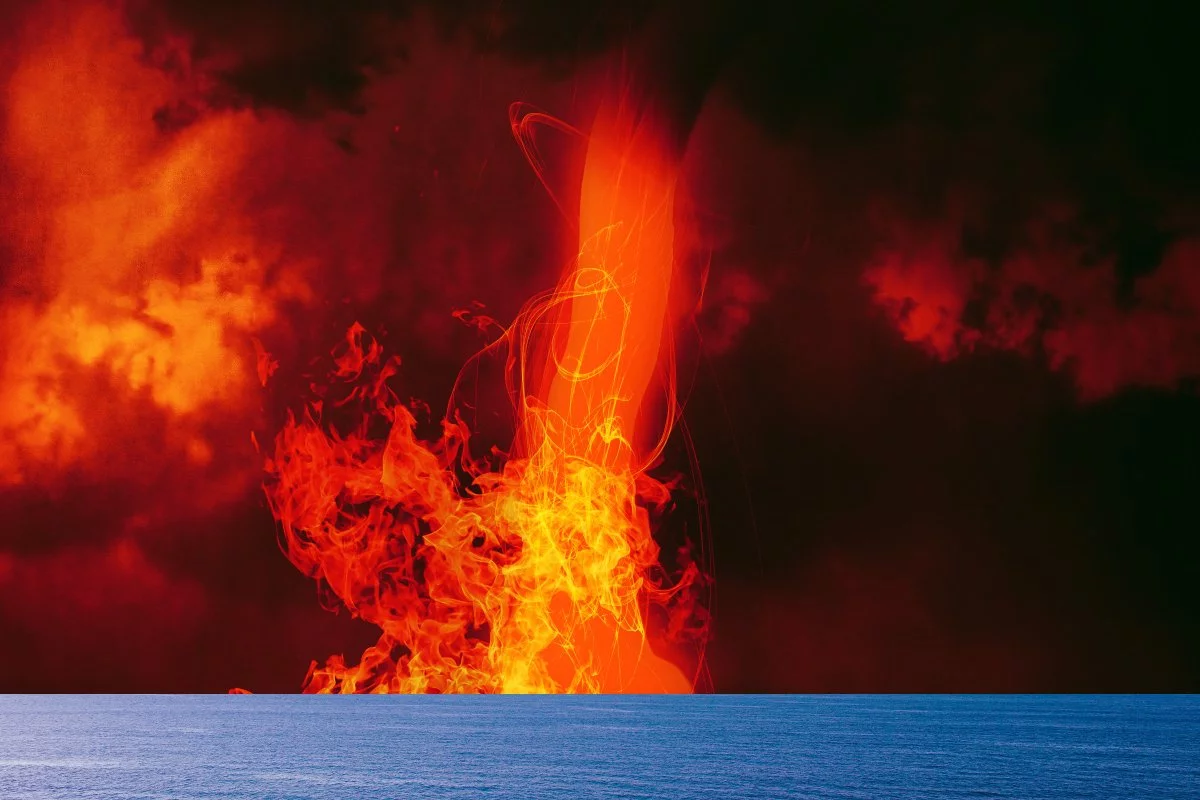
Texas A&M University researchers are proposing an arresting reframing of a well-known hazard: fire tornadoes—more formally “fire whirls”—as an engineered instrument for oil-spill remediation. In laboratory trials reported in *Fuel*, the team used a triangular enclosure to generate 17-foot fire whirls that burned away up to 95% of crude oil, while producing about 40% less soot than conventional in-situ burning. The experiments also indicate faster combustion, suggesting response timelines could be materially shortened—an outcome with direct implications for environmental damage, operational risk, and cleanup cost.
For decades, in-situ burning has remained a controversial but sometimes necessary tactic in major marine spills: it can remove large volumes of oil quickly, yet it trades one environmental burden (surface oil) for another (air emissions and residues). The Texas A&M work positions controlled fire whirls as a potential third path—not abandoning combustion-based response, but upgrading its physics. The significance lies less in the spectacle of a vortex flame and more in the possibility of a more complete, hotter, better-mixed burn that reduces particulate formation and accelerates oil removal.
Why vortex-driven combustion changes the soot-and-speed equation
At the heart of the approach is a combustion insight: fire whirls intensify mixing and heat transfer. A vortex draws in air with strong angular momentum, producing a concentrated flame column with elevated temperatures and improved oxygen delivery. In practical terms, that can shift the burn toward more complete oxidation—one of the key levers for reducing soot and unburned hydrocarbons.
Several technical mechanisms are doing the heavy lifting:
- Enhanced heat feedback to the fuel surface: The rotating flame structure can increase radiative and convective heat transfer, sustaining faster evaporation of volatile components in crude oil.
- Improved oxygen entrainment and mixing: Vortex-driven airflow can reduce local oxygen-starved zones that typically generate soot precursors.
- Higher effective residence time in hot zones: Hydrocarbon fragments and soot nuclei may spend longer in high-temperature regions where they can oxidize rather than escape as particulates.
If these lab results translate to field conditions, the operational payoff could be substantial. Faster burn rates mean less time for oil to spread, emulsify, or reach shorelines—often the point at which remediation becomes dramatically more expensive and ecologically disruptive. Lower soot output also matters because soot is not merely a visibility issue; it is a public health and regulatory flashpoint, influencing air quality impacts on coastal communities and response crews.
That said, the leap from a controlled rig to open water is non-trivial. The same dynamics that make a fire whirl efficient also make it sensitive to wind shear, wave action, and variable fuel thickness. The engineering challenge is to preserve the beneficial vortex structure while ensuring predictable behavior under real-world meteorology.
From lab rig to offshore deployment: autonomy, sensing, and “digital twin” control
Commercial viability will depend on whether controlled fire whirls can be generated, stabilized, and shut down with the reliability expected of modern spill-response operations. This is where the story becomes as much about robotics and monitoring as it is about combustion.
A plausible deployment architecture would combine modular hardware with closed-loop control:
- Unmanned surface vessels (USVs) and drones: Autonomous platforms could transport compact vortex-generation modules and ignition systems, reducing human exposure near flames and toxic fumes.
- Optical, thermal, and particulate sensors: Real-time measurement of flame temperature, plume opacity, soot concentration, and burn completeness would enable operators to tune vortex intensity and detect off-nominal behavior early.
- Digital twin modeling: High-fidelity simulations—calibrated with field data—could pre-plan parameters for spill geometry, oil type, sea state, and wind, then update recommendations as conditions evolve.
This is also where scalability questions concentrate. A 17-foot laboratory fire whirl demonstrates principle; an offshore response requires:
- Containment strategies to keep oil within a controllable burn footprint (often via booms or herding agents)
- Ignition and suppression protocols that meet maritime safety standards
- Redundant controls to prevent unintended spread of fire or destabilization of the vortex under gusts
The opportunity is that spill response is already becoming more instrumented and autonomous. Controlled fire whirls could fit into that trajectory—a combustion module integrated into a broader sensor-and-robotics stack.
Regulation, ESG economics, and the emerging market for cleaner in-situ burning
Even with promising soot reductions, regulators will focus on the full emissions profile: CO₂, CO, NOₓ, volatile organic compounds, and any hazardous air pollutants associated with crude oil combustion. Wildlife impacts—particularly from thermal plumes, smoke dispersion, and residue deposition—will also shape permitting. For agencies tasked with balancing rapid oil removal against air quality and ecological harm, the key question will be comparative: Is a controlled fire whirl measurably better than existing in-situ burning under realistic conditions?
If the answer trends positive, the economic implications are immediate:
- Shorter cleanup durations can reduce vessel time, labor, and logistics—often the largest cost centers in major incidents.
- Lower soot and improved burn completeness could reduce liability exposure and strengthen the case for approval in sensitive regions.
- Insurance and underwriting dynamics may shift if cleaner combustion can be demonstrated consistently, potentially rewarding operators with improved terms.
A parallel market could emerge for technology providers. Demand would not be limited to vortex generators; it would extend to integrated control systems, ruggedized sensors, autonomous deployment platforms, and modeling software. Texas A&M’s work also raises the prospect of licensing, joint ventures, or spin-outs—an increasingly common pathway for university-origin climate and environmental technologies.
The broader strategic context is hard to ignore. As ESG scrutiny intensifies and maritime environmental standards tighten, oil-spill response becomes a competitive differentiator. Controlled fire whirl remediation—if validated at sea—could offer operators a way to lower the environmental risk premium attached to offshore production and transport. The next decisive step is not rhetorical ambition but empirical proof: multi-stakeholder pilot programs that measure burn efficiency, plume chemistry, residue outcomes, and ecosystem effects under the messy variability of real oceans. If those trials hold, a phenomenon once synonymous with uncontrolled disaster may become a disciplined tool of environmental triage—fast, measurable, and engineered for accountability.

 By
By
 By
By
 By
By
 By
By


 By
By








