

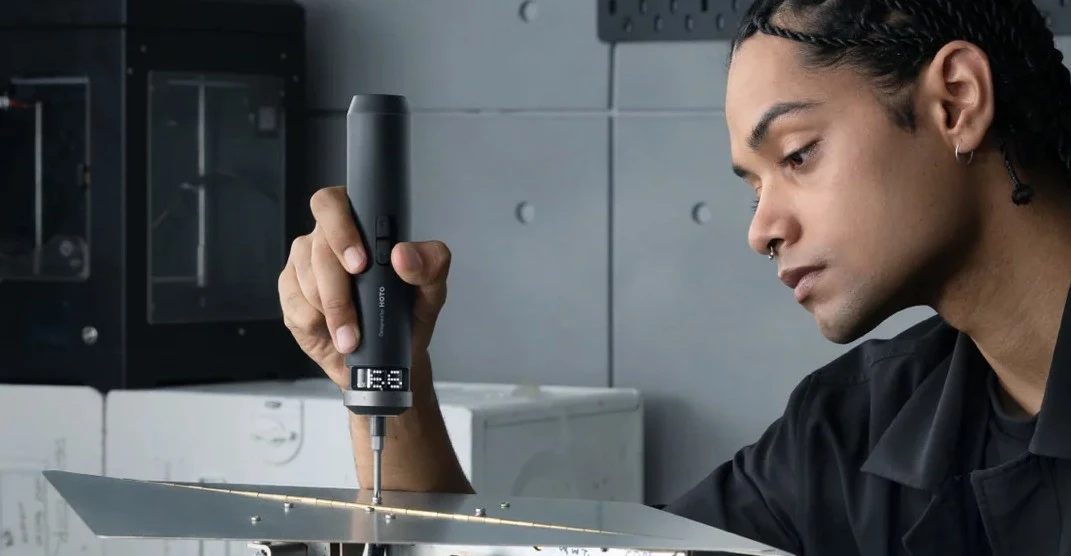

Hoto’s two-tier electric screwdriver play signals a new “value-plus” battleground in consumer tools
Hoto’s latest electric screwdriver lineup reads less like a routine product refresh and more like a deliberate market-mapping exercise. By launching an entry-level model discounted to $29.99 (from $59.99) alongside the more feature-forward PixelDrive at $59.99 (from $79.99), the company is effectively staking out the mid-market space between ultra-cheap, unbranded tools and premium incumbents such as Bosch and DeWalt.
The segmentation is straightforward but strategically sharp:
- Entry-level electric screwdriver: three torque settings, 25 bits, and a 1,500 mAh battery—positioned for routine household assembly, light repairs, and occasional DIY.
- Hoto PixelDrive: six torque levels up to 6 Nm, dual-speed control (80/200 RPM), a 2,000 mAh battery, a pixelated display for torque and battery readouts, and a 360° LED work light, paired with a 30-bit “camera-lens” case designed to elevate perceived value.
What stands out is not merely the spec sheet, but the intent: Hoto is using pricing, industrial design, and user-interface cues to compete on experience, not just torque. In a category where many products blur into commodity sameness, that’s a meaningful attempt to create brand gravity—especially in the Amazon-driven funnel where reviews, returns, and perceived quality can make or break conversion.
From torque dials to pixel displays: the consumer-electronics redesign of hand tools
The PixelDrive’s digital, pixelated display is more than a stylistic flourish. It signals a broader shift underway in the hand-tool market: the migration from mechanical controls and “feel-based” operation toward instrumented, UI-led tools that borrow interaction patterns from consumer electronics.
This matters for two reasons. First, it addresses a long-standing pain point in electric screwdrivers: the “one-size-fits-none” problem. A tool that’s too aggressive strips screws and damages plastics; one that’s too weak stalls on denser materials. Hoto’s approach—more torque steps and dual-speed modes—targets the real-world variability of tasks, from electronics assembly to furniture builds.
Second, the display creates a platform-like surface area for future differentiation. Even without connectivity today, a screen normalizes the expectation that a tool can *tell you* what it’s doing. Over time, that expectation can reshape purchasing criteria in the same way battery percentage indicators and fast-charging labels changed how consumers evaluate phones and laptops.
Key product-design signals embedded in the PixelDrive concept include:
- Real-time feedback loops: torque and battery visibility reduce guesswork and improve repeatability.
- Ergonomics and task illumination: a 360° LED work light acknowledges that many fastening tasks happen in cabinets, corners, and low-light workspaces.
- Accessory design as part of the product: the “camera-lens” bit case is a calculated move to make storage feel premium—turning what is usually an afterthought into a brand signature.
The implication is that Hoto isn’t only selling a screwdriver; it’s selling a *tool experience* that feels closer to a gadget—an important distinction in a market increasingly influenced by aesthetics, unboxing culture, and social proof.
Pricing pressure, Amazon dynamics, and the economics of feature creep
The aggressive discounts—particularly the entry-level model dropping to $29.99—highlight the price elasticity of the consumer power-tool segment. Amazon is a powerful accelerator here: Prime shipping, algorithmic discovery, and review flywheels can rapidly scale a product, but they also intensify competition and compress margins.
Hoto’s pricing strategy suggests a classic “land and expand” approach:
- Use the lower-priced model to acquire first-time buyers and build review volume.
- Upsell feature-seekers to the PixelDrive, where differentiation can justify higher margins—at least in theory.
Yet the economics are not frictionless. Components such as lithium-ion cells, LED assemblies, and display modules introduce cost volatility, and promotional pricing can train consumers to wait for discounts. The company’s ability to sustain this two-tier structure will likely depend on supply-chain discipline and careful SKU management—especially if competitors respond with similar feature sets at comparable prices.
At the same time, falling battery costs over the past decade have made these products feasible. As lithium-ion pack prices have declined dramatically since 2010, manufacturers can now embed larger batteries—like the PixelDrive’s 2,000 mAh cell—without pushing retail pricing into premium territory. That cost curve is effectively underwriting the category’s “feature creep,” enabling screens, lighting, and higher-capacity batteries to become mainstream expectations rather than luxury add-ons.
The strategic endgame: smart-tool optionality and an ecosystem narrative
The most consequential aspect of Hoto’s move may be what it implies about the next phase of competition: platformization. A pixel display is not connectivity, but it is a psychological and design bridge toward it. Once a tool has a UI, the leap to firmware, calibration profiles, usage logs, or Bluetooth Low Energy becomes easier to justify—especially for light-professional users who value consistency and accountability.
If Hoto chooses to pursue that path, several adjacent opportunities emerge:
- Connected-tool roadmap: app-based torque presets, battery health monitoring, or task profiles for common materials.
- Data-driven services: usage telemetry could support maintenance alerts or fleet-style oversight for small contractors and maker spaces.
- Brand extension: a consistent design language (display, lighting, accessory cases) can scale into drills, precision drivers, and multi-tools—forming a coherent “digital workshop” identity.
- Channel diversification: Amazon can seed adoption, but specialty retailers, electronics stores, and B2B partnerships could validate the brand beyond the discount cycle.
Hoto’s two-tier electric screwdriver strategy ultimately reflects a broader industry truth: the hand-tool market is no longer defined solely by mechanical performance. It is increasingly shaped by interface design, battery experience, accessory ecosystems, and the subtle psychology of product delight—the same forces that have long governed consumer electronics. Companies that treat tools as intelligent, design-led products rather than interchangeable hardware are positioning themselves to capture not just sales, but loyalty, repeat purchase behavior, and the right to expand into an ecosystem.

 By
By

 By
By
 By
By
 By
By


 By
By







