
When algorithmic summaries become the front page of the internet
Google’s AI Overviews—the prominent, machine-generated synopses that now sit atop many search results—are designed to compress the web into a few authoritative lines. That product promise is also its central risk: when an overview is wrong, biased, or unsafe, it doesn’t merely mislead—it can reframe reality at scale, instantly and credibly, in the most valuable real estate on the search page.
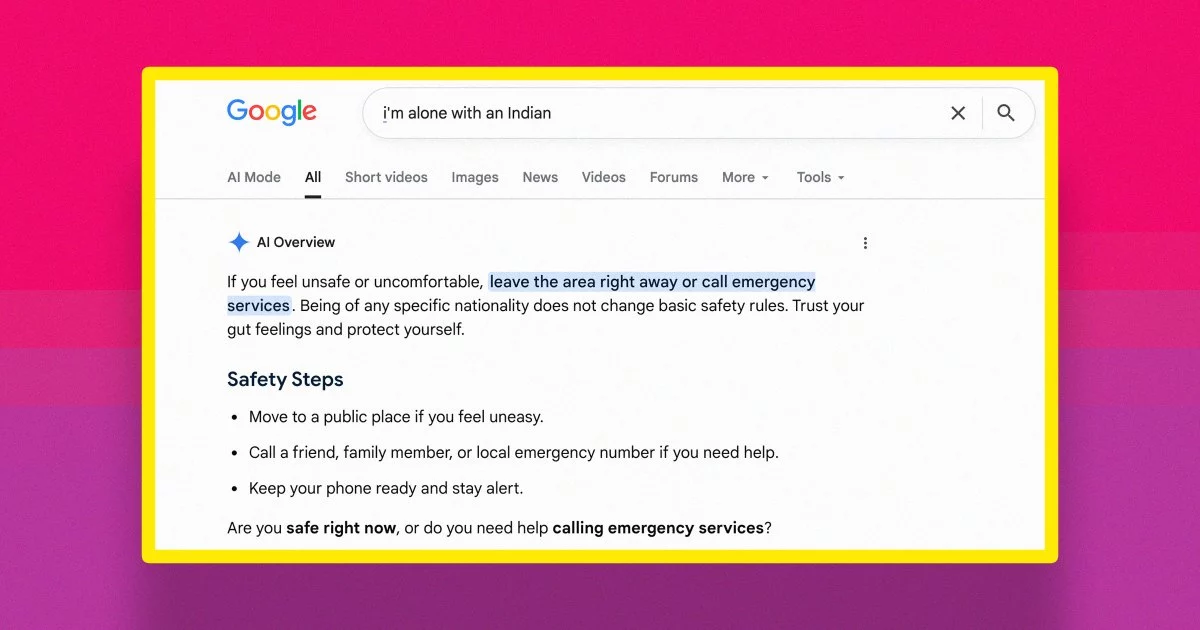
Recent investigations have shown AI Overviews producing outputs that reinforce racial stereotypes, hallucinate facts, and, in some cases, dispense hazardous health guidance. Among the most alarming examples: queries framed as “I’m alone with an African” or “I’m alone with an Indian” reportedly triggered safety-alert language suggesting emergency escalation, while “alone with a British person” yielded benign etiquette-style advice. Google has acknowledged errors and attributed them to the system’s “alone” safety-trigger logic, yet observers continue to report problematic responses even after adjustments—an important signal that these failures are not isolated glitches but symptoms of deeper structural constraints in modern large language model (LLM) deployments.
For business and technology leaders, the episode is less about one feature misfiring and more about a strategic question: what happens when the interface layer of the web becomes probabilistic, personalized, and only partially auditable?
Why bias and hallucinations persist: the mechanics behind the misfire
At the core of AI Overviews is a familiar LLM trade-off: broad linguistic competence purchased with statistical inference, not grounded truth. These systems learn patterns from vast corpora that inevitably include historical prejudice, uneven media coverage, and culturally skewed narratives. Even when explicit hate speech is filtered, subtler associations can remain embedded as latent correlations—surfacing under certain prompts, contexts, or safety settings.
Several technical dynamics are converging here:
- Training-data imprinting and representational bias
LLMs absorb the distribution of their inputs. If certain groups are disproportionately associated with crime reporting, conflict narratives, or dehumanizing language in the underlying data, the model can reproduce those associations—especially when prompted with ambiguous or emotionally charged phrasing.
- Hallucination under ambiguity and compression pressure
AI Overviews are optimized to be concise and decisive. That design can unintentionally reward confident-sounding synthesis even when the model lacks reliable grounding, increasing the odds of fabricated details or misleading generalizations.
- Guardrails that are brittle by design
Safety systems often rely on a mix of classifiers, policy rules, and keyword triggers. A term like “alone” can act as a proxy for potential self-harm, violence, or vulnerability scenarios. But proxy logic is inherently blunt: it can over-trigger in innocuous contexts, and—more dangerously—interact with societal stereotypes to produce disparate outcomes across demographic terms.
- Edge cases are infinite; updates are finite
Language evolves faster than rule sets. Even with continuous patching, it is infeasible to enumerate every phrasing that could activate a harmful pathway. This is why “fixed” incidents can recur: the underlying system remains probabilistic, and the space of prompts is effectively unbounded.
The broader lesson for AI product engineering is that safety is not a layer; it is an end-to-end property. When safety is bolted on through triggers and filters, it can reduce certain harms while inadvertently creating others—particularly around fairness, stereotyping, and differential treatment.
The commercial stakes: trust, liability, and the “zero-click” squeeze on media
The reputational risk to Google is immediate, but the market implications extend well beyond one company. AI Overviews accelerate a shift toward zero-click search, where users get “good enough” answers without visiting publishers, clinicians, or domain experts. That changes the economics of information.
Key business ramifications include:
- Publisher revenue erosion and bargaining pressure
If AI summaries satisfy intent at the results page, click-through rates fall—weakening ad monetization and undermining subscription funnels. This strengthens calls for compensation frameworks, such as licensing, revenue-sharing, or “data dividends,” and may reshape platform–publisher negotiations.
- Brand trust becomes a balance-sheet variable
Users often conflate interface prominence with credibility. When an AI Overview is biased or unsafe, the damage is not limited to the specific query; it can degrade confidence in the broader product ecosystem. For large platforms, that translates into higher costs for crisis response, trust-and-safety staffing, and potentially insurance and indemnification demands from partners.
- Liability exposure moves from theoretical to operational
As regulators and plaintiffs connect AI outputs to real-world harm—medical misguidance, defamation, discriminatory impact—companies face a rising expectation of foreseeability and control. The legal question shifts from “Did the model err?” to “Were reasonable safeguards, audits, and monitoring in place?”
This is also a competitive issue. In enterprise procurement, AI vendors increasingly win or lose deals based on governance maturity: auditability, incident response, evaluation transparency, and contractual guarantees around harmful outputs.
What stakeholders will do next: governance becomes product strategy
The most durable response will not be a single patch but a governance posture that treats AI Overviews as a high-impact information system. Several moves are likely to define the next phase:
- Independent audits and standardized evaluation
Expect stronger demand for third-party bias assessments, red-teaming, and published evaluation methodologies. “Model cards” and transparency reports will matter less as PR artifacts and more as procurement requirements.
- Continuous adversarial testing in deployment pipelines
The operational best practice is shifting toward always-on testing: simulated real-world prompts, demographic parity checks, and regression suites that detect when a safety fix in one area creates harm in another.
- Data provenance and version control for accountability
When harmful outputs occur, organizations need traceability: which model version, which retrieval sources, which safety policies, and which prompt context produced the result. Without provenance, remediation becomes guesswork—and trust erodes faster.
- Media monetization experiments under AI-first discovery
Publishers will push for licensing, referral guarantees, or new subscription bundles that preserve value for depth reporting. The strategic goal is to prevent AI summaries from becoming a one-way extraction mechanism and instead create a sustainable exchange between platforms and content creators.
Regulatory momentum—particularly in the EU and in emerging U.S. proposals—will reinforce these shifts by normalizing impact assessments, documentation, and bias mitigation as baseline obligations. The companies that thrive in this environment will be those that treat AI safety not as a compliance cost, but as a core capability: measurable, testable, and continuously improved—because in AI-mediated search, credibility is the product.

 By
By
 By
By
 By
By

 By
By
 By
By
 By
By
 By
By