

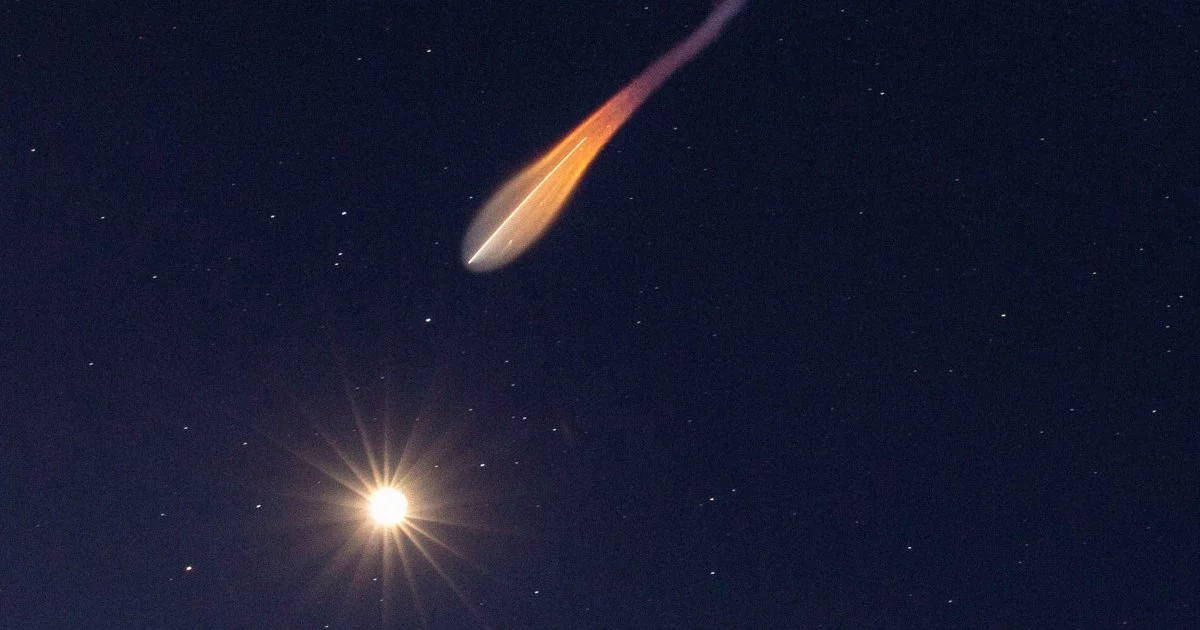

A new kind of exhaust: measuring what rocket reentry leaves behind
A peer-reviewed study in *Communications Earth & Environment* has put hard numbers on a question the space economy has largely treated as theoretical: what exactly is deposited into the upper atmosphere when rockets come home. Using resonance lidar observations from Germany, researchers directly detected a high-altitude lithium plume tied to the reentry of a SpaceX Falcon 9 upper stage—a signature observed roughly 62 miles (about 100 km) above Europe.
The reported quantity is striking for its specificity and scale: around 66 pounds (≈30 kg) of lithium per vehicle, released as the stage’s structure ablates and vaporizes. This is not combustion exhaust in the conventional sense; it is materials-derived pollution, created when high-performance alloys are converted into atoms, ions, and oxides under extreme aerothermal heating.
For business and technology leaders, the significance is twofold:
- Scientific: the industry now has a credible observational method to quantify reentry-derived metals in situ, rather than inferring them from models.
- Strategic: the measurement arrives just as satellite constellations scale toward tens of thousands of spacecraft, multiplying reentry events and turning a niche atmospheric input into a potentially material environmental variable.
Why aluminum–lithium alloys are now part of the climate conversation
The plume’s source is not mysterious. Many launch vehicles use aluminum–lithium alloys because they deliver a prized engineering tradeoff: high strength at low mass, enabling greater payload capacity and better economics per kilogram to orbit. Yet the same design choice has an externality: during reentry, these alloys can fragment, oxidize, and disperse reactive constituents at altitudes where atmospheric chemistry is both delicate and under-sampled.
This is where the study’s methodological breakthrough matters. Ground-based resonance lidar—long used to probe metal layers in the upper atmosphere—now appears capable of attributing and quantifying rocket-related metal injections. That creates a new accountability pathway: what can be measured can be tracked, compared, regulated, insured, and priced.
From an atmospheric science perspective, the concern is not that lithium is “toxic” in a conventional ground-level sense, but that metal atoms and metal oxides can participate in catalytic cycles and aerosol formation processes that influence:
- Ozone chemistry, particularly if reaction pathways resemble known catalytic depletion mechanisms (even if the exact kinetics for lithium and aluminum compounds remain uncertain at these altitudes).
- Radiative balance, as metal-oxide aerosols can alter how energy is absorbed and scattered in the mesosphere–stratosphere interface region.
- Cloud microphysics, including potential interactions with noctilucent cloud formation and other high-altitude phenomena that climate models still struggle to represent with confidence.
The key point is not a settled verdict of harm; it is the emergence of a credible mechanism plus a measurable signal, which is often the moment when environmental risk moves from academic debate to boardroom agenda.
The satellite boom meets an unpriced externality
The commercial space market is built on cadence. Constellations for broadband, Earth observation, and defense resilience are driving a future where launch rates and end-of-life reentries become routine industrial activity, not exceptional events. SpaceX’s Starlink is the most visible example, but it is far from alone: multiple operators and governments are planning large fleets, and many architectures presume shorter satellite lifetimes, which increases turnover and reentry frequency.
That growth trajectory creates a classic economic tension: services scale faster than environmental accounting frameworks. If upper-atmospheric deposition becomes a recognized externality, the cost stack could shift in several ways:
- Compliance and reporting costs: emissions inventories may expand beyond CO₂-equivalent accounting to include reentry-derived metals and oxides, requiring new measurement, modeling, and disclosure practices.
- Design and materials costs: pressure to reduce ablation products could drive new alloys, coatings, or structural approaches, potentially increasing unit costs in the near term while creating differentiation for early adopters.
- Operational constraints: mission planning could face new requirements around controlled reentry corridors, altitude profiles, or disposal strategies that minimize chemical injection into sensitive layers.
At the same time, the study hints at a new commercial layer forming around the space economy—one that looks less like launch services and more like environmental intelligence infrastructure. If lidar and complementary sensing can operationalize reentry plume monitoring, a market emerges for:
- Atmospheric-impact analytics sold to regulators, insurers, and ESG-focused investors
- Risk models that translate reentry frequency and vehicle composition into probabilistic environmental exposure
- Verification services that support “green launch” claims with independent measurement
In other words, measurement does not only enable regulation; it also enables productization.
Regulation, ESG pressure, and the competitive advantage of transparency
Policy tends to follow observability. As international bodies such as COPUOS and standards organizations like ISO continue shaping space sustainability norms, the industry should anticipate that emissions reporting could broaden—potentially resembling aviation’s evolution toward standardized carbon accounting frameworks, but adapted to space’s unique chemistry and altitude regimes.
This intersects with national security and procurement in a subtle way. Governments that rely on proliferated constellations for resilience may still demand environmental stewardship clauses in contracts, especially as public scrutiny rises and as allied markets—particularly in Europe—apply tighter expectations around environmental impact.
For corporate governance, the immediate pressure point is disclosure. Investors integrating environmental risk will increasingly ask not only “How many launches?” but also:
- What materials are being ablated on reentry?
- What is the modeled and measured deposition per mission class?
- What mitigation roadmap exists, and how is it verified?
Companies that can answer these questions with credible data may find that transparency becomes a competitive asset—reducing reputational risk, improving regulatory posture, and potentially lowering insurance friction. The space sector’s next phase of growth will not be defined solely by payload mass and launch cadence, but by whether it can scale while treating the upper atmosphere as a shared, measurable, and governable environment rather than an invisible sink for industrial byproducts.

 By
By


 By
By
 By
By

 By
By
 By
By







