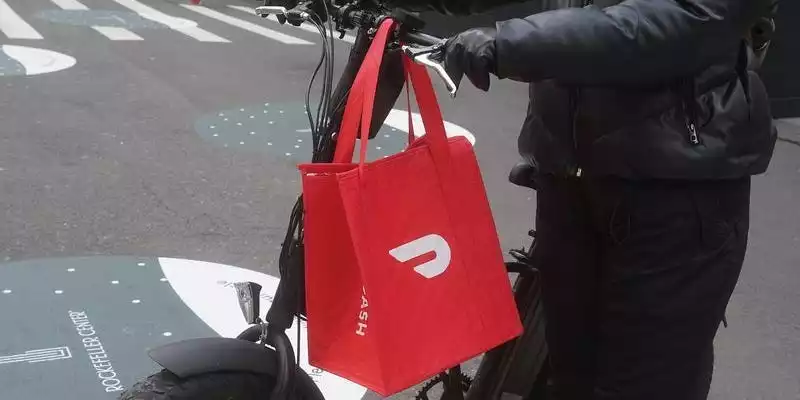

DoorDash Tasks and the quiet redefinition of “last-mile” work
DoorDash’s launch of DoorDash Tasks marks a notable expansion of what an on-demand delivery platform can be—and what it can ask of its workforce. Rather than focusing solely on moving goods from point A to point B, the company is piloting non-delivery micro-assignments that look more like retail operations support and field data collection than traditional gig driving. Early examples include in-store shelf photography and tagging to assess grocery inventory conditions, as well as hands-on assistance for AI-enabled autonomous delivery vehicles.
This shift matters because it reframes DoorDash’s driver network as a flexible, distributed labor layer that can be deployed across the physical economy—stores, sidewalks, parking lots, and pickup zones—where digital systems still struggle to perceive reality reliably. In practical terms, DoorDash is testing whether its existing marketplace can become a real-world sensing and verification network, not just a delivery fleet.
The early economics, however, reveal a tension at the heart of the experiment. Reports of roughly $36 for 30 minutes of photo-tagging may sound attractive in isolation, yet it can compare unfavorably with peak delivery earnings in many markets. That gap underscores a central question for the model: can micro-tasks be priced in a way that attracts participation without eroding the platform’s delivery capacity—or triggering worker dissatisfaction and churn?
Human-in-the-loop AI: turning gig workers into field annotators
From a technology perspective, DoorDash Tasks sits squarely in the emerging category of human-in-the-loop AI—systems that depend on people to gather, validate, and label real-world data so algorithms can learn faster and perform more reliably. What distinguishes this approach from classic remote labeling marketplaces is the field-based, geolocated nature of the work. A shelf photo taken at a specific store, at a specific time, under real lighting and stocking conditions, can be far more valuable than synthetic datasets or generic image libraries.
Key technological implications include:
- Richer training data for computer vision and inventory intelligence
Shelf images and annotations can improve models that estimate stock levels, detect planogram compliance, and identify out-of-stocks—capabilities retailers and consumer packaged goods (CPG) brands increasingly treat as strategic.
- A potential proprietary data moat
If DoorDash can collect high-frequency “ground truth” observations across many stores, it can build datasets that are difficult for pure software competitors to replicate quickly. Over time, that can translate into defensible retail-tech products and differentiated logistics performance.
- A pragmatic bridge toward autonomy
Autonomous delivery systems often struggle with edge cases—unstructured environments, ambiguous signage, crowded storefronts, and indoor navigation. Embedding humans in early operational loops can accelerate mapping, exception handling, and safety validation while autonomy matures.
This is also where DoorDash’s move aligns with broader industry patterns. Uber, Instacart, and others have explored adjacent labor models that monetize downtime and expand platform utility. The common thread is that the gig workforce becomes not only a service provider but also a data acquisition layer—a way to make the physical world legible to software.
The economics of micro-tasking: utilization gains vs. earnings friction
DoorDash’s strategy can be read as supply-side arbitrage: instead of hiring specialized contractors for store audits or field operations, it can redeploy its existing driver pool during demand lulls. For a platform business, that is an attractive lever—higher utilization of an already-onboarded workforce can improve unit economics and smooth volatility.
Yet the labor dynamics are delicate. Micro-tasking introduces a new set of worker expectations and comparisons:
- Opportunity cost is immediate and visible
Drivers can quickly benchmark a task’s payout against a delivery run they could have taken instead. If tasks consistently underpay relative to delivery, participation may be sporadic, undermining data quality and coverage.
- Retention risk may rise if the work feels like “more for less”
Even if tasks are optional, the perception of downward pressure on earnings can push workers toward competing platforms or alternative income sources.
- Regulatory scrutiny could intensify as roles diversify
As gig work expands beyond delivery into quasi-operational and tech-adjacent functions, policymakers may revisit questions of job definition, worker protections, and classification. The more the work resembles structured operational support rather than discrete delivery gigs, the more complex the regulatory optics become.
For DoorDash, the challenge is to design incentives that make tasks attractive without destabilizing the core delivery marketplace. That likely means dynamic pricing, clearer task ladders, and potentially differentiated roles for workers who opt into more specialized assignments.
Retail-tech convergence and the race to own real-time shelf truth
Strategically, DoorDash Tasks signals a platform aiming to move up the value chain—from marketplace logistics to retail intelligence and automation readiness. The convergence is not subtle: retailers, brands, and ad networks increasingly compete on real-time availability, local assortment accuracy, and fulfillment reliability. In that environment, shelf-level truth becomes a commercial asset.
Several forward-looking outcomes appear plausible:
- DoorDash as a data-as-a-service provider
Shelf imagery and inventory signals can be packaged into tiered analytics offerings for retailers and CPG brands, potentially creating recurring B2B revenue streams that are less cyclical than consumer delivery demand.
- A workforce that evolves as automation improves
As computer vision and autonomous systems mature, routine photo capture may decline. The remaining human roles may shift toward supervision, exception handling, and high-variance scenarios—work that machines struggle to generalize.
- Partnership opportunities across the AI-logistics ecosystem
Mapping firms, retail media networks, and autonomous vehicle developers all need real-world validation data. DoorDash’s distributed presence could make it a valuable collaborator—provided it can maintain quality, compliance, and trust.
DoorDash Tasks ultimately reads as an early blueprint for a future where on-demand platforms compete not only on delivery speed and selection, but on who can most effectively orchestrate the human-machine continuum—using people to capture reality, using AI to interpret it, and using automation to scale it. The winners in that future will be the companies that treat gig labor not as a stopgap, but as a strategically governed interface between the physical world and digital infrastructure.

 By
By
 By
By

 By
By
 By
By

 By
By
 By
By