
A privately funded undersea habitat returns to US waters—this time as a platform business
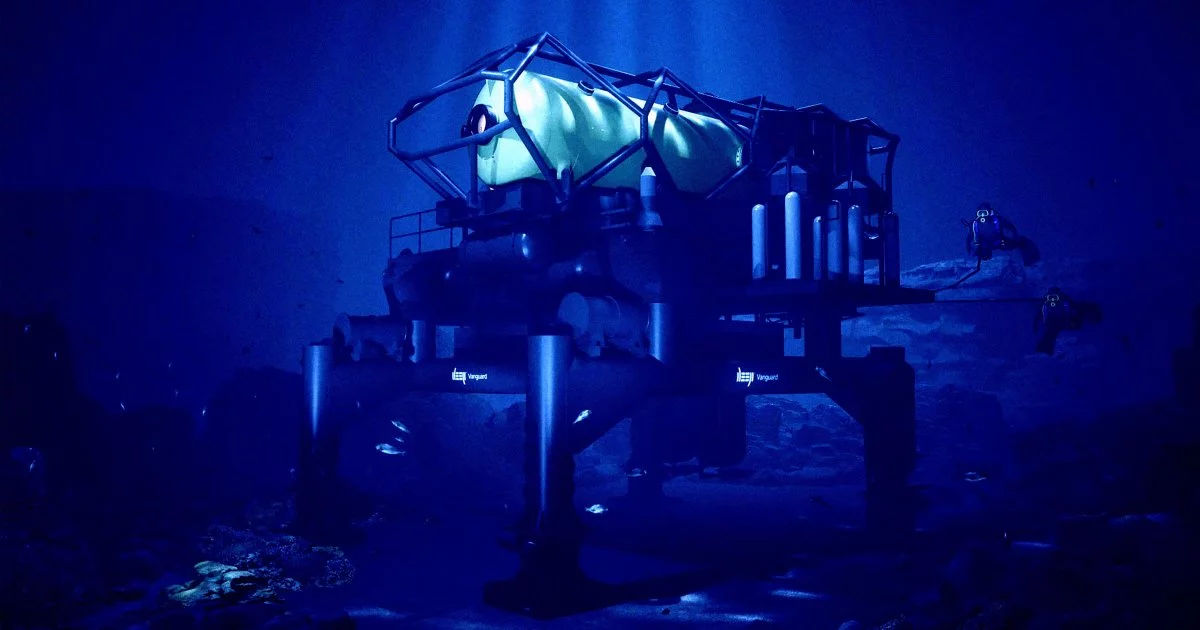
DEEP’s deployment of Vanguard, a 35×8-foot underwater habitat positioned 56 feet below the surface on Florida’s Tennessee Reef, is more than a novel engineering milestone. It signals a renewed push to industrialize “persistent presence” in the ocean—an approach that has been historically rare in US waters since the era of public or quasi-public facilities such as the Aquarius Reef Base (1986).
What makes Vanguard strategically distinctive is not only that it is privately funded, but that it is anchored to the seabed rather than treated as a relocatable experiment. That design choice implies long-term site stewardship, repeatable operations, and the potential for standardized deployments—traits that align more closely with a scalable infrastructure model than a one-off scientific outpost.
The habitat’s configuration is intentionally pragmatic: four bunks, a small galley, a multi-function bath/lab space, a moon pool and dive chamber, and a semi-autonomous support buoy supplying oxygen, power, and communications. The “camper-van” sensibility is not a limitation; it is a product thesis. If DEEP can make undersea living routine, trainable, and operationally predictable, it can turn subsea residency into a service layer for research, restoration, and applied ocean technology.
Engineering reality: life-support autonomy, modularity, and the data backbone
Underwater habitats are ultimately judged by their uptime, safety margins, and operational simplicity—not by their novelty. Vanguard’s reliance on a semi-autonomous buoy is therefore central to its credibility. For sustained deployments, the buoy must deliver:
- Reliable oxygen generation and management, likely via electrolysis-based systems with robust monitoring
- Redundant power architecture, where hybrid approaches (battery plus backup generation) reduce single points of failure
- Two-way communications and data links that can support both safety telemetry and high-volume scientific data streams
The modular design is equally consequential. Historically, subsea habitats have tended to be bespoke, expensive, and difficult to replicate. Vanguard’s more standardized footprint hints at a future where habitats can be manufactured in series, deployed with repeatable procedures, and upgraded through component swaps rather than major rebuilds. That is how frontier infrastructure becomes investable.
The most commercially catalytic layer, however, may be the data architecture. Persistent human presence is valuable, but it becomes exponentially more valuable when paired with real-time sensor arrays, robotics, and continuous environmental monitoring. This is where the concept of an ocean “digital twin” becomes practical: a live, data-fed model of reef conditions that enables remote collaboration, predictive analytics, and faster intervention cycles. In effect, Vanguard can function as a field node in a broader AI-enabled ocean observability stack.
Why in-situ presence still matters in an AUV/ROV world
A natural question for executives and technologists is whether underwater habitats are being leapfrogged by AUVs (autonomous underwater vehicles) and ROVs (remotely operated vehicles). Those tools are powerful, and in many contexts cheaper. Yet they also impose constraints that persistent human presence can reduce: limited mission duration, weather-dependent deployment windows, and the friction of repeatedly mobilizing crews and vessels.
Vanguard’s proposition is that certain categories of work improve materially when researchers can live at the site—especially where timing, iteration, and hands-on judgment matter. DEEP’s call for proposals—offering five-day residencies (after two-week training) and awards up to $50,000—targets use cases where proximity can change outcomes, including:
- Reef restoration experiments that require frequent adjustments and rapid feedback
- Human–machine collaboration trials, where divers and robotics operate as a coordinated system
- High-frequency ecological monitoring, capturing short-lived events that periodic visits can miss
This is also why subsea habitats remain a compelling analog for space operations, echoing the logic behind NASA’s NEEMO missions. The analog value is not marketing flourish; it is operational: constrained environments, life-support dependency, procedural discipline, and human factors under isolation. If DEEP can demonstrate repeatable, safe missions, it strengthens the case for partnerships spanning ocean science, robotics, and aerospace-adjacent R&D.
The blue-economy calculus: revenue models, ESG alignment, and regulatory proof points
Vanguard arrives amid a broader “blue economy” inflection, where capital is increasingly attentive to marine biotech, offshore aquaculture, subsea infrastructure, and climate adaptation. The business question is whether the habitat can translate its capabilities into a durable mix of funding and revenue.
Potential funding vectors include public research grants (NOAA, NSF, and international equivalents), venture-backed deep-tech collaborations, and corporate R&D programs seeking measurable ESG outcomes. Reef restoration in particular maps cleanly to biodiversity and climate resilience narratives—an advantage when sustainability-linked budgets are under pressure to show tangible impact.
At the same time, the capex-to-ROI equation will be scrutinized. The habitat must demonstrate that its cost is justified by the incremental value of:
- Long-duration, high-resolution datasets
- Faster experimental iteration and reduced mobilization overhead
- Improved intervention success rates in restoration and monitoring
DEEP may also explore diversified revenue models—premium scientific expeditions, branded research programs, or controlled experiential offerings—though credibility will hinge on maintaining scientific rigor and avoiding the perception that research is secondary to spectacle.
Finally, Vanguard’s location in US waters makes it a live test of permitting, compliance, and environmental stewardship. Regulatory alignment is not a footnote; it is the scalability gate. If DEEP can operate transparently within marine protected area constraints and demonstrate low-impact procedures, it builds a template for replication across jurisdictions—an essential step if undersea habitats are to evolve from singular installations into a networked category of ocean infrastructure.
Vanguard’s real significance lies in its attempt to make subsea residency repeatable and economically legible: a modular habitat, supported by semi-autonomous systems, positioned as a platform for science, restoration, and human–machine experimentation. If DEEP can prove reliability, attract top-tier research partners, and build a data-driven operating model that regulators and stakeholders trust, the project could help shift undersea habitats from historical curiosity to modern, investable infrastructure for the next phase of ocean innovation.

 By
By
 By
By


 By
By
 By
By
 By
By