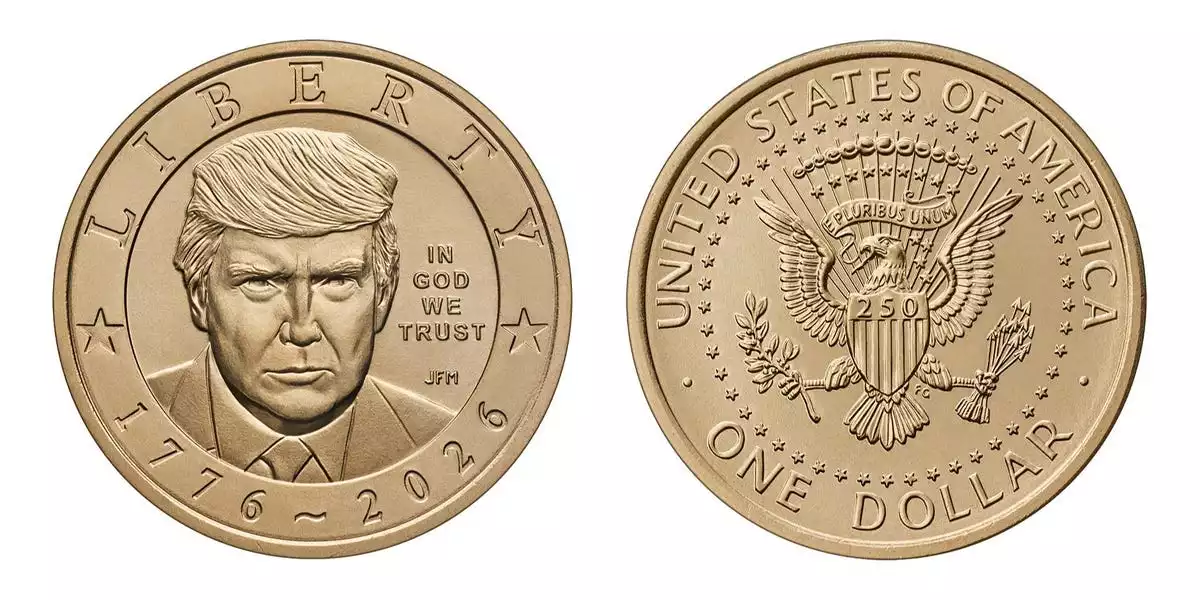

A commemorative coin that collides with statutory guardrails and institutional process
The U.S. Treasury’s unveiling of a new $1 “gold-toned” commemorative coin—bearing a forward-facing portrait of former President Donald Trump alongside “In God We Trust” and “1776–2026”—has rapidly become more than a design dispute. Framed as part of the nation’s 250th anniversary (America 250) in 2026, the proposal lands at the intersection of currency governance, political symbolism, and administrative authority.
At the center of the controversy is a long-standing legal and cultural norm: U.S. coinage is designed to project continuity and shared civic identity, not living political power. Federal statutes have historically restricted depictions of living individuals on U.S. coins, a constraint intended to prevent currency from becoming a tool of personal glorification or partisan messaging. The Treasury’s apparent reliance on the Circulating Collectible Coin Redesign Act of 2020 has not quieted critics, largely because the move appears to lack clear Congressional authorization for this specific design and reportedly bypasses mandated advisory review.
Equally consequential is the process question. U.S. coin design is typically shaped through institutional channels—most notably the Citizens Coinage Advisory Committee (CCAC) and the Commission of Fine Arts (CFA)—which exist to ensure aesthetic integrity, historical appropriateness, and public legitimacy. When those guardrails are perceived as optional, the debate shifts from “Is this coin tasteful?” to “Who gets to decide what the nation’s money says—and how?” That is a governance issue with implications far beyond numismatics.
Currency as a national interface: why “neutral money” still matters
Physical currency is often treated as mundane infrastructure, but it functions as a high-frequency national interface—a government-issued object that citizens encounter in daily life. For that reason, the iconography on coins and bills has traditionally been curated to communicate stability, institutional continuity, and broad-based legitimacy.
Placing a living political figure on circulating legal tender would represent a sharp departure from that tradition, and critics argue it risks turning money into state-backed political media. Supporters may view it as patriotic commemoration; opponents see it as a precedent that could normalize partisan personalization of national symbols. Either way, the episode highlights a deeper tension: in an era of polarization, even the design of a $1 coin can become a proxy battle over who “owns” national identity.
This is not merely cultural. The credibility of currency—especially fiat currency—rests partly on public trust in institutions. When design decisions appear to be driven by political branding rather than established norms, the reputational cost can be real:
- Institutional legitimacy risk: perceived circumvention of CCAC/CFA review can erode confidence in the neutrality of currency governance.
- Precedent risk: once a living figure appears on coinage, future administrations may feel empowered to do the same, accelerating symbolic escalation.
- International optics: U.S. currency is a global artifact; politicized iconography can be read abroad as a signal of domestic instability or personalization of state power.
In that sense, the controversy is less about a portrait and more about whether the U.S. is willing to treat currency as a shared civic platform or as a contestable political surface.
The economic and operational backdrop: cost-of-living optics and minting realities
The coin’s “gold-toned” description is itself revealing. Such finishes typically imply brass or copper-zinc alloys or plating, not precious metal content—an approach that keeps unit costs down while still delivering a premium aesthetic associated with commemoratives. Yet even low-cost materials do not eliminate the broader economics of production: tooling, striking, quality assurance, packaging, distribution, and anti-counterfeiting controls all carry real expense and management overhead.
That operational reality collides with the current public mood. With many households still sensitive to inflation and cost-of-living pressures, lawmakers from both parties have already criticized the initiative as poorly timed—an argument rooted less in the Mint’s line-item costs and more in the symbolic allocation of governmental attention. When consumer sentiment is strained, highly visible commemorative projects can be framed as misaligned priorities, regardless of whether the program is ultimately revenue-positive.
There is also a market dimension. Collectible and commemorative coin programs can generate seigniorage-like revenue and stimulate the numismatic ecosystem. But the closer a coin appears to resemble political merchandising, the more it risks:
- Depressing mainstream collector confidence by injecting partisan volatility into what is usually a heritage-driven market
- Inviting secondary-market distortions (speculation, counterfeits, opportunistic markups) that can reflect poorly on the issuing authority
- Triggering reputational exposure for any private partners involved in packaging, promotion, or distribution
For businesses, the lesson is straightforward: products tied to national symbols can be lucrative, but when those symbols become politically charged, the brand and stakeholder risk profile changes overnight.
Legal trajectories and the digital-money parallel: who governs the narrative of value?
If the Treasury advances the design without clear statutory footing, the most likely next chapter is litigation and Congressional scrutiny aimed at clarifying the boundary between executive discretion and Congress’s constitutional authority over coinage. Even if courts ultimately block the coin, the episode may still catalyze legislative action—tightening rules around:
- eligibility standards for portraits and inscriptions
- mandatory review processes and timelines
- explicit prohibitions on living persons or partisan content
- transparency requirements for design initiation and approval
The timing is notable for another reason: the world is simultaneously debating the future of money through Central Bank Digital Currencies (CBDCs) and other forms of digital legal tender. The coin controversy underscores a parallel question that will only grow louder in a digital era: who controls the narrative embedded in state-issued value instruments—physical or programmable?
Physical coins carry symbolism through images and mottos; digital currency could carry it through governance structures, permissions, and policy logic. If the public perceives that even traditional coinage can be politicized, pressure may increase to design digital money with stronger insulation—through multi-stakeholder oversight, transparent rulemaking, and auditable governance.
Whether this proposed Trump commemorative coin is ultimately minted or stopped, it has already succeeded in surfacing a foundational issue: currency is not just an economic tool—it is a trust technology, and the fight over its imagery is, at its core, a fight over the stewardship of that trust.


 By
By
 By
By
 By
By
 By
By
 By
By

 By
By